
.svg)
How to Budget for Importing from China to NZ in 2026: A Full Cost Breakdown

.svg)
If you've been thinking about importing from China and you're trying to work out whether the numbers actually stack up — you're in the right place. Because here's the thing: a lot of first-time importers get blindsided by costs they didn't see coming. They get a great factory price, do a happy dance, and then discover that by the time the goods land in their warehouse in Auckland, the margins have quietly evaporated.
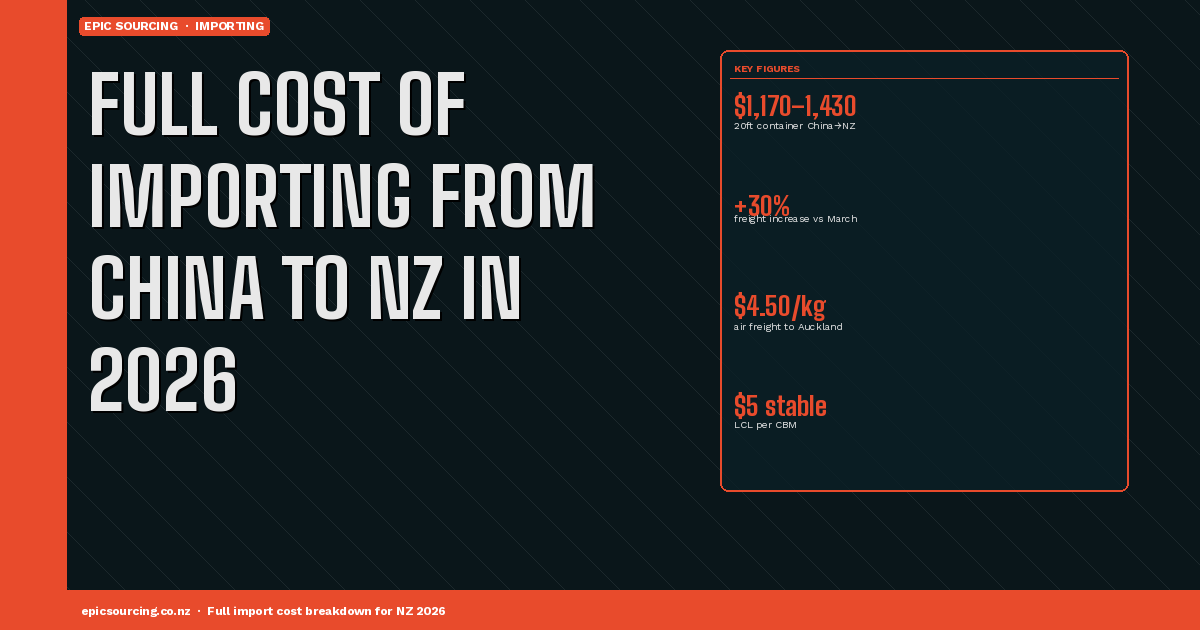
Freight rates are up sharply in 2026. A 20-foot container from China to NZ now costs between $1,170 and $1,430 — that's up around 30% compared to March. Air freight into Auckland is running at $4.50 per kilogram. These aren't costs you can ignore when you're building a business case.
So let's walk through every cost you need to account for, from factory gate to your front door. Grab a coffee — this one's worth taking notes on.
1. The Factory Price (FOB) — Your Starting Point
When a supplier gives you a price, they're usually quoting EXW (ex-works) or FOB (free on board). FOB means they've loaded the goods onto the ship at the Chinese port — that's typically where your responsibility and costs kick in.
Your FOB price covers: the goods themselves, domestic freight from the factory to the port, and export customs clearance in China. Everything after that is on you.
Real talk: always ask for FOB pricing when comparing quotes. EXW pricing can look attractive but the domestic logistics costs in China can surprise you — especially if the factory is inland rather than near a major port like Ningbo, Shanghai, or Shenzhen.
Sourcing Hack #1: Always Request FOB Port Pricing — When getting quotes, ask for "FOB [port name]" pricing — not EXW. This standardises your comparisons and eliminates hidden domestic freight variables. Most experienced factories will be comfortable with this.
2. International Freight — The Big Variable
This is where costs have moved the most in 2026. Here's the current picture (China to NZ, April/May 2026 data):
- Sea Freight — 20GP Container: $1,170 – $1,430 (up 30% vs March)
- Sea Freight — 40GP Container: $2,025 – $2,475 (up 15% vs March)
- LCL (Less than Container Load): $5 per CBM — stable and great for smaller shipments
- Air Freight to Auckland: $4.50/kg — up 12%, best for small, high-value goods
If you're starting out or testing a product, LCL is your friend. You share a container with other importers, pay for just the space you use, and avoid committing to a full container before you've validated the market. Yes, it's a bit slower and involves more handling, but for small businesses it's often the smart play.
Air freight is only worth it if your product is light, high-value, or genuinely time-sensitive. Think electronics, cosmetics, or fashion samples. Don't air freight furniture — you'll cry.
Sourcing Hack #2: Book Early in 2026 — Freight capacity is tight right now, particularly on the China–NZ lane. Last-minute bookings are attracting premiums and you risk delays. If you know you'll be shipping in June or July, talk to your freight forwarder now. Locking in rates 4–6 weeks out can save you real money.
3. Import Duties and GST — Don't Skip This Step
New Zealand's own tariff rates on Chinese goods haven't changed, which is good news — NZ runs a relatively open trade regime. Most goods attract 0–5% duty, though some categories like apparel and footwear can sit higher.
Then there's GST: 15% on the customs value of your goods plus the freight costs. This gets paid at the border before your goods are released. If you're GST-registered, you can claim it back — but you need the cash upfront to pay it first. Factor this into your cash flow planning.
Use the NZ Customs duty calculator (customs.govt.nz) to check the tariff code and duty rate for your specific product before you commit to ordering. Surprises here are expensive.
4. Customs Clearance and MPI Compliance
You'll need a customs broker to clear your goods through NZ Customs and MPI (Ministry for Primary Industries). Budget around $150–$350 per shipment for a standard clearance — more if there are delays, examinations, or compliance issues.
MPI inspection is mandatory for many product categories, especially anything with natural materials (timber, rattan, bamboo, wool). If your goods are flagged for examination, expect an additional $200–$500 and a delay of a few days. The best way to avoid this is to ensure your supplier provides proper treatment certificates (fumigation, heat treatment) and clean documentation.
5. Domestic Freight in NZ
Your goods arrive at Auckland port. Getting them from there to your warehouse or third-party logistics (3PL) provider is an additional cost. A pallet delivery within Auckland might run $50–$150. Freight to Wellington, Christchurch, or South Island locations adds more.
6. The Landed Cost Formula
Here's the formula every importer should know:
Landed Cost = FOB Price + Freight + Duty + GST + Customs Clearance + Domestic Freight
A quick worked example: You're importing 500 units of bamboo sunglasses at $8 FOB each. Total FOB: $4,000. LCL freight: $300. Duty (5%): $200. GST (15%): $660. Customs clearance: $250. Domestic freight: $120. Landed cost: $5,530 = $11.06 per unit. If you're selling at $49.99, you've got decent margin — but you need to model it, not guess it.
Sourcing Hack #3: Use a Landed Cost Spreadsheet Before You Order — Build a simple Excel model with all cost inputs before confirming any order. Include a "worst case" column with freight 20% higher than quoted. If the numbers still work in the worst case, you're in good shape.
7. Hidden Costs That Catch People Out
- Product compliance testing — some categories (kids' toys, electronics, cosmetics) need lab testing before sale in NZ. Budget $300–$1,500 depending on product.
- Quality inspection — if you're doing a pre-shipment quality check (highly recommended for first orders), budget $200–$350 per inspector day.
- Payment transfer fees — bank international wire fees plus currency conversion costs add up.
- Marine cargo insurance — optional but smart for higher-value shipments. Typically 0.5–1% of cargo value.
Keen to explore your options? Book a free consultation with the team at Epic Sourcing and let's map out a strategy that works for your business. No pressure, no jargon — just a straight-up conversation about what's possible.
Related Articles


Let’s Make It Epic
We're here to make sourcing simple – and a whole lot less stressful.
We are experiencing a higher volume of enquiries than usual. Our standard reply time for form submissions and emails is within 72 hours.
If your matter is urgent, please schedule a video call using the link below.
