.svg)
What Does a Sourcing Agent Actually Do? (And Does Your NZ Business Need One?)

.svg)
Welcome back to our Sourcing 101 blog, where we break down the nuts and bolts of importing and sourcing so that Kiwi businesses can buy smarter. Today, we're tackling a question we get asked all the time: what exactly is a sourcing agent, and do you actually need one?
The term gets thrown around a lot — sometimes interchangeably with 'import agent,' 'buying agent,' or 'China agent' — and there's a lot of confusion about what these folks actually do, how much they charge, and whether the investment is worth it.
So, let's clear it up once and for all.
What Is a Sourcing Agent?
Put simply, a sourcing agent is a professional who acts as your representative in a manufacturing market — typically China, Vietnam, India, or another Asian country. They sit between you (the buyer) and the factory (the seller), and their job is to make the sourcing process smoother, more reliable, and more efficient.
Think of it like hiring a local guide when you visit a foreign country. Could you navigate it yourself? Sure. But the guide knows which restaurants are actually good, speaks the language fluently, and won't let you pay tourist prices for everything. A sourcing agent is your guide in the world of Asian manufacturing.
A good sourcing agent based in New Zealand — or with strong NZ connections — understands both worlds: the practical needs of Kiwi SMEs and the realities of the manufacturing landscape in Asia. That combination is genuinely valuable.
What Does a Sourcing Agent Actually Do?
The day-to-day work varies depending on the sourcing model, but typically includes:
- Supplier identification — researching and shortlisting factories that can produce your product to your specs, volume, and quality requirements.
- Supplier vetting — checking factory credentials, production capacity, quality certifications, and business legitimacy.
- Quote and negotiation — getting multiple quotes and negotiating price, MOQ, payment terms, and production timelines.
- Sample coordination — managing the back-and-forth of samples, revisions, and approvals.
- Production oversight — following up with the factory during production to flag any issues early.
- Quality control — arranging third-party inspection or conducting in-factory checks before goods are shipped.
- Shipping coordination — working with freight forwarders to organise getting your goods to New Zealand.
Sourcing Hack #1: Ask About Their Vetting Process — Before hiring a sourcing agent, ask them exactly how they vet suppliers. A good agent should be able to walk you through their process — whether that's in-person factory audits, business licence verification, or third-party audit reports. If they can't clearly explain how they qualify suppliers, that's a red flag.
How Do Sourcing Agents Charge?
Pricing models vary, but here are the most common:
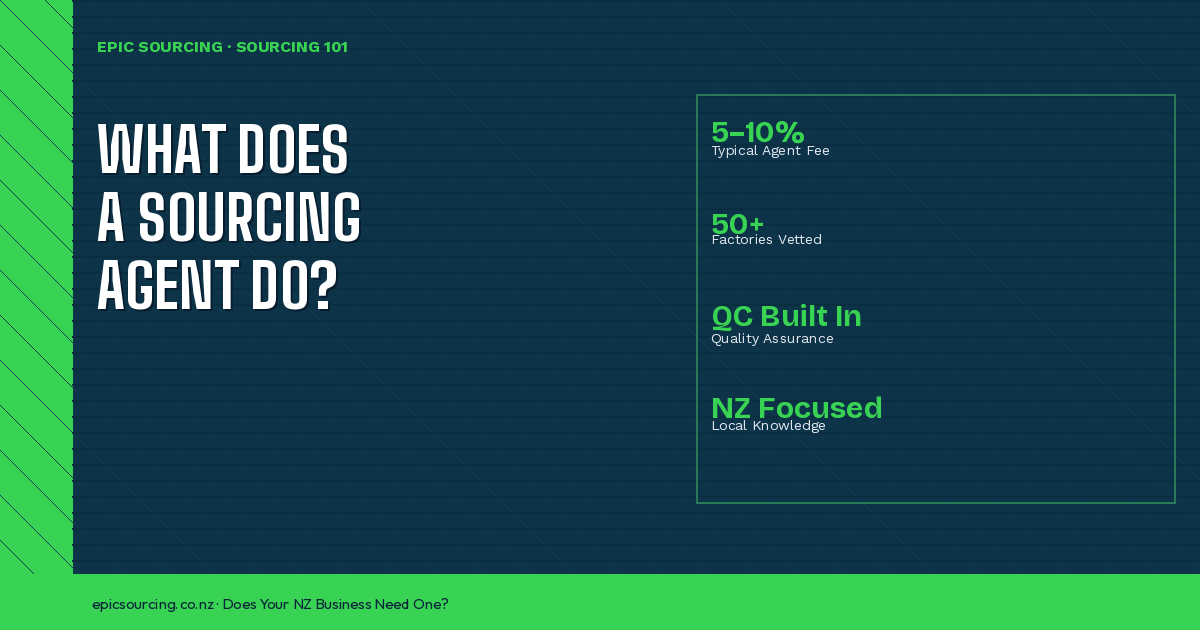
- Commission-based — the agent takes a percentage of your order value (typically 5–15%). This can work well for one-off orders but creates a potential conflict of interest.
- Fixed fee per service — a flat fee for specific deliverables like a sourcing report or supplier shortlist. Predictable and transparent.
- Retainer model — a monthly fee for ongoing sourcing and supply chain management support. Best for businesses importing regularly.
Be wary of agents who are completely 'free' — they're often taking undisclosed kickbacks from factories, which compromises their objectivity.
Do You Actually Need a Sourcing Agent?
Here's the honest answer: it depends on where you're at in your sourcing journey.
You probably don't need one if:
- You're just testing a small order from a well-reviewed Alibaba supplier
- You're importing a simple, off-the-shelf product with no customisation
- You have time, patience, and a reasonable risk appetite for trial and error
You probably do need one if:
- You're ordering in significant volume (e.g., multiple containers per year)
- Your product requires customisation, specific certifications, or strict quality standards
- You've had bad experiences with suppliers and want to avoid repeating them
- You don't have time to manage supplier relationships yourself
For many Kiwi businesses, the real value shows up in the mistakes avoided — the dodgy factories never contracted, the quality issues caught before shipment, the production delays managed proactively.
Sourcing Hack #2: Start With a Reverse Sourcing Report — Not sure if you need a full sourcing agent? A reverse sourcing report is a one-off service where an agent researches the supplier landscape for your specific product and delivers a shortlist of vetted factories. It's a cost-effective way to get professional intel without committing to an ongoing relationship.
What Makes a Good NZ Sourcing Agent?
- Transparency — upfront about how they make money and what's included.
- Real Asia experience — genuine factory relationships and on-the-ground experience, not just Alibaba access.
- NZ business understanding — they get the Kiwi market, typical import volumes, and the unique challenges of SMEs.
- Clear communication — they keep you updated proactively without you having to chase them.
- Track record — they can point to real clients and real projects completed successfully.
Working With Epic Sourcing NZ
Here at Epic Sourcing New Zealand, we're a sourcing and supply chain management company built specifically for Kiwi businesses. We've helped businesses source everything from packaging mailers and gym equipment to hotel furniture and activewear.
Whether you're after a one-off sourcing report, help vetting a specific supplier, or an ongoing supply chain partner, we'd love to have a chat. Book a free 30-minute consultation at epicsourcing.co.nz — no pressure, no hard sell. Just a genuine conversation about your sourcing goals.
Related Articles


Let’s Make It Epic
We're here to make sourcing simple – and a whole lot less stressful.
We are experiencing a higher volume of enquiries than usual. Our standard reply time for form submissions and emails is within 72 hours.
If your matter is urgent, please schedule a video call using the link below.
