.svg)
Importing Construction Materials from China to NZ: Your 2026 Buyer's Guide

.svg)
There's a quiet revolution happening in the New Zealand construction sector right now. Builders, developers, and project managers who used to rely entirely on local suppliers or Australian distributors are increasingly heading direct to China — and coming out significantly ahead on cost without sacrificing quality.
We're seeing more enquiries for construction materials than ever before, from hotel joinery and fit-out materials to structural components, tiles, and building hardware. The savings on large-format projects can be substantial, but there's also a right way and a wrong way to go about it. Get it wrong, and you're looking at MPI compliance headaches, freight delays, or materials that don't meet NZ building codes.
So let's walk through everything you need to know about importing construction materials from China to New Zealand in 2026.
Why NZ Builders Are Looking to China in 2026
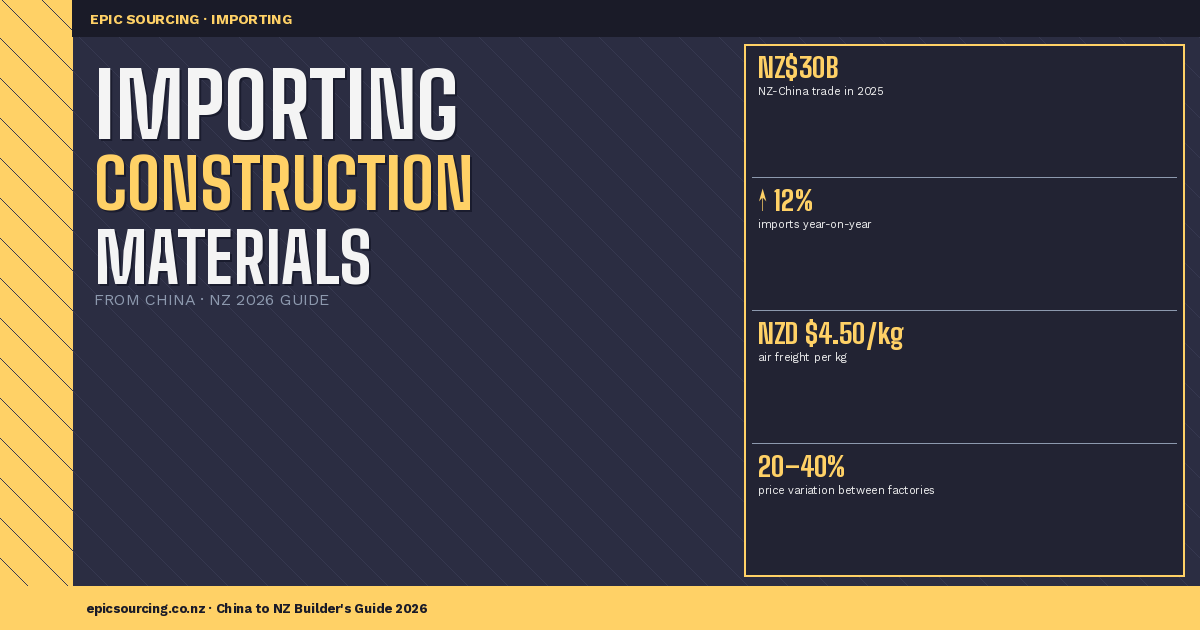
It's simple economics. NZ-China trade hit NZ$30 billion in 2025, with imports up 12% year-on-year. China commands a 28% share of New Zealand's import market — and for good reason. The sheer scale of Chinese manufacturing means that products like timber composites, tiles, steel fittings, bathroom hardware, cabinetry, and cladding panels can be manufactured to specification at a fraction of the local retail price.
For a hotel project ordering a 40-foot container of furniture and joinery monthly, the unit economics are compelling. When you're fitting out 50+ rooms, the savings can run into the tens of thousands per shipment versus local distributors. At the same time, Chinese factories have rapidly adopted AI-powered quality control — defect detection systems and 3D printing for prototypes that can take a design from concept to sample in days rather than weeks.
What Construction Products Can You Import from China?
The range is broader than most people assume. Here's what we commonly source for NZ construction clients:
- Joinery & cabinetry — kitchen cabinets, wardrobe systems, hotel room joinery, custom millwork
- Bathroom & kitchen fittings — tapware, basins, shower systems, tiles (porcelain, marble composite, mosaic)
- Structural hardware — brackets, connectors, fixings, steel components
- Flooring — engineered timber, luxury vinyl plank (LVP), laminate, porcelain tiles
- Cladding & panels — composite cladding, aluminium panels, stone composite panels
- Lighting & electrical fittings — LED commercial lighting, switches, outlet systems
- Doors & windows — aluminium framing systems, commercial glazing units
NZ Compliance: What You Need to Know
This is where a lot of first-time importers run into trouble. New Zealand has specific building code requirements (NZBC), and not every product sold in China will automatically comply. Here's what to watch:
- NZBC compliance — Products must meet the New Zealand Building Code. For structural products, this often means certification to NZ/AS standards or equivalent testing.
- MPI Biosecurity — Timber and timber-adjacent products require specific treatment (heat treatment or fumigation) and documentation.
- Electrical products — Any electrical fittings must meet NZ electrical safety standards and carry appropriate certification.
- Chemical content — Products like adhesives, sealants, and composite materials may need to meet VOC restrictions.
- Product testing — For high-spec builds or commercial projects, you may need independent third-party testing reports (e.g. from SGS, BV, or Intertek).
Sourcing Hack #1: Get Compliance Docs at the Factory Stage — Before placing your order, request that your factory provide relevant test reports, certifications, and compliance documentation upfront. Chinese factories supplying export markets often have these ready — but you need to ask. It's much easier to request a test report during negotiation than to chase one after the goods have landed in NZ.
Freight Costs: What's Changed in April 2026
Here's the straight talk on freight: rates have moved upward this month. China-NZ sea freight for a 40-foot container is currently running USD $2,025–$2,475, up about 15% from March. 20-foot containers are tracking USD $1,170–$1,430, up 30%. The driver? US-Iran geopolitical tensions are tightening bunker fuel supply globally, and Maersk has added emergency surcharges of up to USD $200 per container.
This isn't necessarily a reason to hold off — rates have been significantly higher — but it does mean you should lock in bookings early rather than shopping for last-minute capacity. LCL (Less than Container Load) is holding stable at around $5/cbm and is worth considering for smaller orders or trial shipments.
Sourcing Hack #2: Order Samples via LCL Before Committing to a Full Container — For any new product category, we always recommend sending a sample order via LCL before committing to full production. For construction materials, this might be a crate of tile samples, a set of cabinet doors, or a single bathroom vanity unit. The cost is modest compared to the risk of discovering quality or compliance issues after 500 units have arrived on your site.
The Quality Control Process
Quality control for construction materials is non-negotiable — especially when you're building to NZ code and your clients expect a 10+ year product lifespan. Here's the QC process we recommend:
- Factory audit before placing the order — verify production capacity, equipment, and existing quality systems.
- Pre-production sample sign-off — approve samples before production begins to lock in spec.
- During-production inspection (DPI) — check materials and production mid-run, typically at 30–50% completion.
- Pre-shipment inspection (PSI) — final check on finished goods before the container is loaded.
- Third-party lab testing — for products with compliance requirements, arrange independent testing through SGS, TUV, or Intertek.
Getting Started: The Practical First Steps
If you're a NZ builder, developer, or project manager considering direct sourcing from China for the first time, here's how to approach it:
- Define your spec — be specific about materials, finishes, dimensions, and compliance requirements.
- Research suppliers — Alibaba, Made-in-China, and Global Sources are starting points, but factory verification is essential.
- Get multiple quotes — always compare at least 3 factories. Price variation of 20–40% for the same product is common.
- Negotiate a sample — before any bulk order, pay for and receive a physical sample.
- Use a sourcing agent — for large or complex construction projects, working with a NZ sourcing partner removes the language barrier, manages QC, and handles logistics coordination.
Keen to explore sourcing for your business? Epic Sourcing offers a free consultation for NZ businesses — no obligation, just a straight-up conversation about what's possible. Book yours at epicsourcing.co.nz.
Related Articles
Let’s Make It Epic
We're here to make sourcing simple – and a whole lot less stressful.
We are experiencing a higher volume of enquiries than usual. Our standard reply time for form submissions and emails is within 72 hours.
If your matter is urgent, please schedule a video call using the link below.
