
.svg)
How NZ eCommerce Brands Are Winning with Social Commerce in 2026

.svg)
Something significant has shifted in how Kiwis shop online. It used to be that social media was for discovering products and Google was for buying them. Now, for a growing chunk of the NZ market, the scroll from 'I saw it on Instagram' to 'I just bought it' is happening in seconds — without ever leaving the app.
Social commerce — selling directly through social media platforms — isn't a trend anymore. It's a channel. And for NZ eCommerce brands that import products from overseas, it changes what you sell, how you present it, and what your supply chain needs to look like.
Let's dig into what's actually happening in the NZ market in 2026 and what it means for your sourcing strategy.
The NZ Social Commerce Landscape in 2026
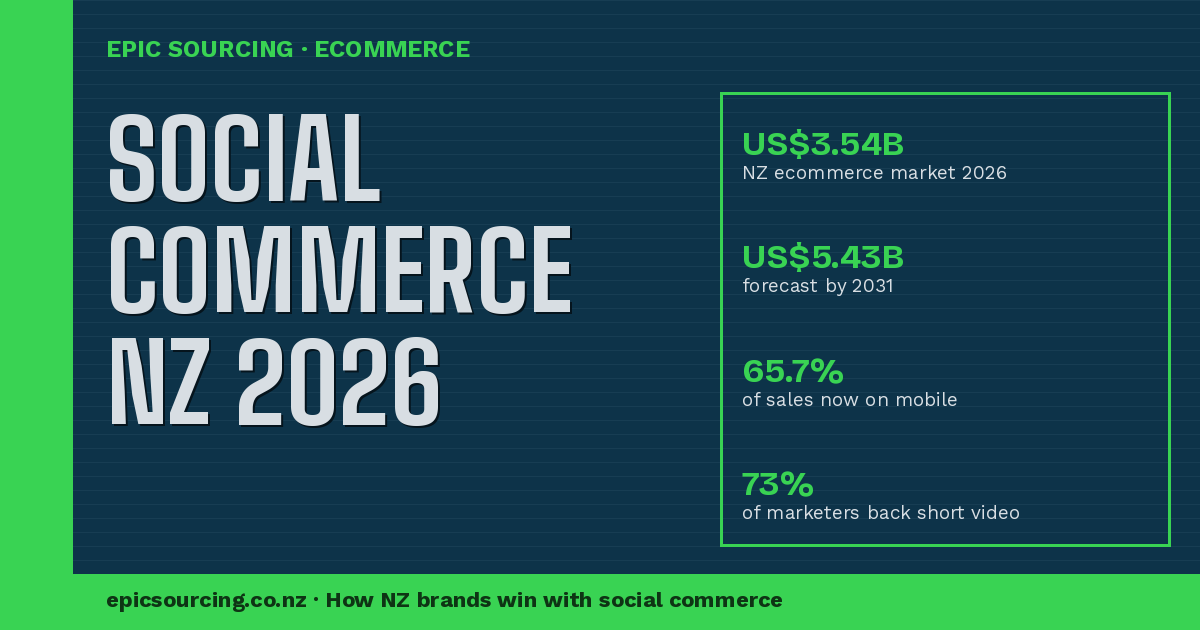
The numbers are hard to ignore. NZ's eCommerce market is worth US$3.54B in 2026, forecast to hit US$5.43B by 2031. But the bigger story is where those sales are coming from: mobile now generates 65.7% of all NZ online sales.
And younger Kiwis aren't just using TikTok and Instagram to browse — they're using them as search engines. When they want to find a new skincare product, a unique homewares brand, or the best activewear for the gym, they're searching on Instagram Reels and TikTok before they ever open Google.
For NZ marketers, the signal is loud and clear: 73% say short-form video will dominate their 2026 content strategy. Social platforms are no longer just top-of-funnel awareness tools. They're becoming full transactional channels.
What 'Mindful Shopping' Means for NZ Importers
Here's the nuance that separates winning eCommerce brands from those that struggle: NZ consumer behaviour in 2026 is defined by what analysts are calling 'mindfulness.' That means deliberate, research-heavy shopping that prioritises authenticity and transparency over convenience and price alone.
Kiwis are buying less and caring more about what they buy. They want to know where a product came from. They want to feel good about the brand they're supporting. For you as an importer, this means:
- Product story matters — The factory location, the materials, the process. Customers want this content.
- Quality over volume — Better to have 3 well-sourced, well-presented products than 20 generic ones.
- Transparency builds trust — If you're importing from China or Vietnam, owning that story (rather than hiding it) is increasingly a competitive advantage with informed consumers.
Sourcing Hack #1: Build Your Supply Chain Story Into Your Social Content — Visit your supplier's factory — virtually or in person. Get footage. Show the making process. NZ consumers respond well to behind-the-scenes content. It's authentic, and it answers the 'where does this come from?' question before they even have to ask it.
What Products Are Winning on Social Commerce in NZ?
Based on what's trending globally and what's selling through NZ social channels, here are the product categories performing well right now:
- Beauty and skincare — High visual appeal, easy to demonstrate on short-form video, and Kiwis are actively searching for new brands. If you're sourcing clean beauty products or developing a private label skincare range, social commerce is a natural fit.
- Activewear and gym apparel — The NZ activewear market is strong and socially driven. Locally branded activewear, sourced from Vietnam or China with quality fabrics, continues to perform well through social channels.
- Eco and sustainable homewares — Bamboo products, natural-fibre textiles, compostable kitchenware. NZ consumers actively seek these out, and they respond well to sustainability-forward storytelling.
- Innovative consumer products — Think collapsible camping gear, multi-function kitchen tools, or clever storage solutions. Products that demonstrate well on video tend to sell well on social.
- Pet products — A massive and growing category in NZ. Premium, innovative pet accessories and supplies have strong social commerce potential.
Sourcing Strategy for Social Commerce: What's Different?
If you're selling through social commerce, your sourcing strategy needs to adapt. Here's what matters most:
- Lower MOQs are your friend. Social commerce trends move fast. Chinese manufacturers are increasingly offering MOQs of 50–100 units for many product categories — making it viable to test products with small runs before scaling up.
- Responsiveness matters. If a product takes off unexpectedly, you need to restock quickly. Build relationships with suppliers who can turn around repeat orders within 2–4 weeks, or hold safety stock for your best performers.
- Packaging is part of the product. Social commerce customers share unboxing content. Invest in branded, photogenic packaging — it becomes user-generated content that markets your product for free.
- Quality control is non-negotiable. Social media is a double-edged sword: a great product gets shared and praised; a poor quality product gets called out loudly. Don't cut corners on QC, especially when you're scaling quickly.
Sourcing Hack #2: Order 100 Units Before You Order 1,000 — Before you scale up a social commerce product to a full production run, do a small test order. Run it through a real unboxing, film it, post it, and see the genuine customer response. This protects you from scaling up a product that has issues — and gives you authentic content at the same time.
Practical Steps for NZ eCommerce Brands Getting Into Social Commerce
Here's a realistic roadmap if you're looking to build a social commerce channel:
- Choose your platform — Instagram and TikTok are the primary channels for NZ audiences. Start with one, do it well, then expand.
- Identify 3–5 hero products — Don't try to run a 50-SKU catalogue through social commerce. Find your most visual, most story-worthy products and lead with those.
- Source for the channel — Consider how the product photographs and videos. Think about the unboxing experience before you finalise your sourcing brief.
- Build your content bank — Before you launch, create 4–6 weeks of content. You need consistent posting to build the algorithm's momentum.
- Test with small inventory — Use LCL shipping or small order quantities to test new products before scaling. This keeps your inventory risk low while you learn what resonates.
- Track what converts — Social commerce platforms give you data on what content drives purchases. Use it. Double down on what works; drop what doesn't.
The Sourcing and the Selling Are Connected
Here's the thing that's easy to miss: your social commerce success is directly connected to your sourcing quality. The best content strategy in the world won't rescue a mediocre product. Conversely, a well-sourced, beautifully packaged, story-rich product becomes a content engine in its own right.
If you're building a social commerce brand and want to make sure your sourcing is set up for success, the team at Epic Sourcing can help. From finding the right suppliers to getting your quality control right, we've helped NZ brands build supply chains that support their growth. Book a free 30-minute consultation at epicsourcing.co.nz/contact — we'd love to help.
Related Articles



Let’s Make It Epic
We're here to make sourcing simple – and a whole lot less stressful.
We are experiencing a higher volume of enquiries than usual. Our standard reply time for form submissions and emails is within 72 hours.
If your matter is urgent, please schedule a video call using the link below.
