.svg)
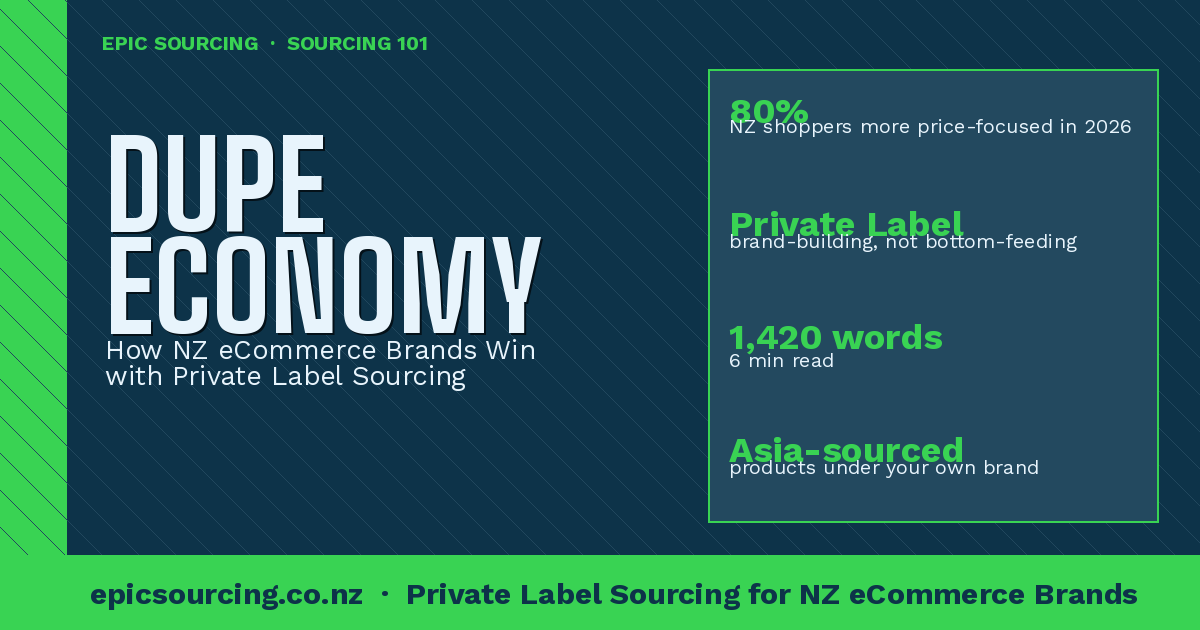
The ‘Dupe’ Economy Is Here — And NZ eCommerce Brands Can Capitalise with Private Label Sourcing

.svg)
There’s a word you’re hearing everywhere on social media right now: “dupe.” Short for duplicate, a dupe is a lower-priced product that delivers a similar experience to a much more expensive brand-name alternative. Stanley Cup dupes. Le Creuset dupes. Dyson Airwrap dupes. The trend is real, it’s accelerating, and 80% of NZ shoppers say they expect to be even more price-focused through 2026.
Here’s the opportunity that many NZ eCommerce brands are still missing: the dupe economy isn’t just about being cheap. It’s about being smart. And private label sourcing — where you put your brand on a well-sourced product from Asia — is exactly how you build a business that thrives in this environment.
This isn’t a race to the bottom. Done right, private label in the dupe economy is a genuine brand-building strategy. Let’s walk through how it works.
What the ‘Dupe’ Economy Actually Means for NZ eCommerce
The dupe trend is being driven by a generational shift in how consumers think about value. Younger shoppers — particularly Millennials and Gen Z — have grown up with access to global product information. They know that a $350 kitchen pot and a $79 alternative from a lesser-known brand often come from the same or equivalent factories. They’re not ashamed to buy the dupe; they wear it as a badge of smart shopping.
In NZ, cost-of-living pressure has extended this mindset well beyond younger demographics. Households that previously bought premium are now looking for quality at a more accessible price point.
Sourcing Hack #1: The ‘Similar Origin’ Advantage — Many premium consumer products are manufactured in the same Asian factories as their high-street alternatives. The difference is branding, packaging, and marketing — all of which you control when you go private label. Don’t assume that a higher price means a fundamentally better product.
How Private Label Sourcing Actually Works
Private label sourcing means you source a product from a manufacturer, add your branding (logo, packaging, product name), and sell it under your own brand. It’s different from white label (minimal customisation) and from product development (creating something genuinely new). Private label sits in the middle.
The basic process:
- Identify a product category with a market gap in NZ.
- Source a manufacturer in China, Vietnam, or another Asian country.
- Agree on product specification — material quality, dimensions, features, compliance certifications.
- Design your packaging, labels, and inserts.
- Order samples, test rigorously, request changes if needed.
- Arrange a production run with quality inspection before shipment.
- Arrange freight to NZ and sell under your brand.
The capital requirements are genuinely accessible — a first private label run in many categories can be done for $5,000–$20,000 NZD including product, freight, and basic branding.
Which Categories Work Best for Private Label in NZ?
The best categories share a few characteristics: not dominated by a single brand with cult-level loyalty, product quality is verifiable, and there’s strong search demand with room for new entrants.
Currently high-potential for private label NZ eCommerce: activewear and sportswear (Vietnam producing excellent quality at accessible prices), home organisation and storage (aesthetics of tidiness trend), wellness and self-care accessories (lightweight, high-margin, TikTok-friendly), pet products (NZ pet ownership is high), and kitchen and dining (ceramic cookware, bamboo utensils, speciality coffee gear).
Sourcing Hack #2: Check Trade Me Before You Buy — Before committing to a private label product, spend an hour on Trade Me searching your target category. If the current top sellers have poor images and generic descriptions, there’s almost certainly room for a well-presented brand to own that category.
The Branding Equation: Why Presentation Matters More Than You Think
Here’s the honest truth about private label: the product itself is often not the differentiator. The branding, presentation, and customer experience are. Two sellers could be selling the same product from the same factory — but the one with lifestyle photography, a genuinely helpful product page, and a thoughtful unboxing experience wins on price and on repeat purchases.
Things worth investing in: professional product photography (including lifestyle shots), well-written product descriptions that focus on benefits not features, packaging that looks intentional, and a returns/warranty policy you’re willing to stand behind.
Pricing Your Private Label Product in the Dupe Economy
The dupe economy doesn’t mean you have to be the cheapest option. It means you have to be a credible value option — clearly better than no-name alternatives, and clearly more accessible than premium brands. A good pricing framework: land your product at a fully-landed cost that allows you to retail at 3–4x landed cost while remaining 30–50% cheaper than the premium brand equivalent.
So if a premium silicone kitchen set retails for $180 NZD, and you can land a quality-equivalent version at $25 NZD per set, a retail price of $79–$95 NZD positions you exactly in the dupe sweet spot.
Common Mistakes NZ Importers Make with Private Label
Watch out for these pitfalls: going too cheap on samples and QC (your first 200-unit run is not the moment to discover a quality issue); underestimating compliance requirements (electrical products, children’s toys, food-contact items, and cosmetics all have specific NZ requirements); ignoring MOQ reality; relying on supplier photos instead of your own photography; and skipping market validation before committing to a production run.
The dupe economy is a genuine opportunity for NZ eCommerce brands who approach it strategically. If you’d like to explore which product categories make sense for a private label play, Epic Sourcing offers a free initial consultation. We work with Kiwi eCommerce brands to take ideas from concept to landed product. Book your free session at epicsourcing.co.nz.
Related Articles


Let’s Make It Epic
We're here to make sourcing simple – and a whole lot less stressful.
We are experiencing a higher volume of enquiries than usual. Our standard reply time for form submissions and emails is within 72 hours.
If your matter is urgent, please schedule a video call using the link below.
