.svg)
How to Source Skincare & Beauty Products from China: A Guide for NZ Brands

.svg)
So, you've got a vision for a skincare or beauty brand. Maybe it's a clean, locally-branded moisturiser. Maybe it's a private-label vitamin C serum you've been mixing in your kitchen and reckon you could scale up. Or perhaps you've spotted a gap in the NZ market for a particular beauty product and you're ready to back yourself.
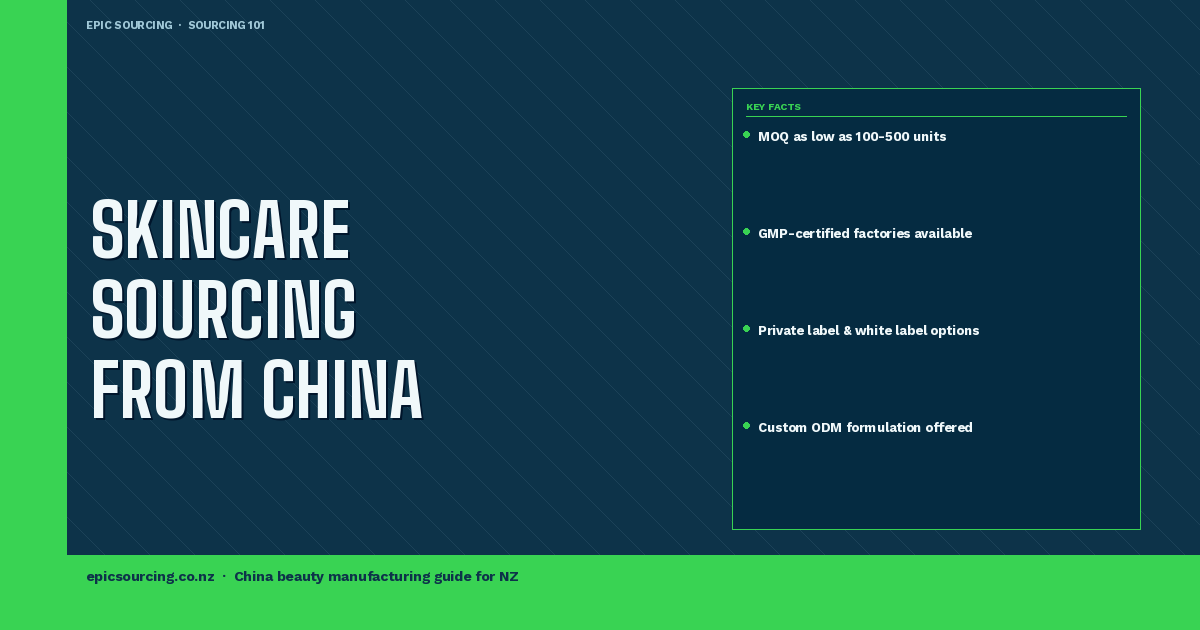
Here's the thing — China is one of the world's most sophisticated skincare and cosmetics manufacturing hubs. The same factories that produce for major international brands often have capacity to work with smaller NZ businesses. And with minimum order quantities dropping to as low as 100–500 units in some categories, getting your beauty brand off the ground has never been more accessible.
But (and it's a big but) the beauty and skincare category has specific compliance requirements, quality standards, and regulatory considerations that you need to get right before a single bottle lands on NZ shelves. So, let's arm you with everything you need to know.
Why China for Skincare? The Case Is Strong
China's cosmetic manufacturing industry has evolved dramatically over the past decade. Key reasons NZ brands are turning to Chinese manufacturers for skincare and beauty:
- Range of formulation capability: From basic moisturisers and serums to complex actives like retinol, niacinamide, and peptide blends — Chinese labs can handle it.
- GMP-certified factories: Good Manufacturing Practice (GMP) certification is widely available and verifiable. It's your baseline for quality assurance.
- Private label and white label options: Want to put your brand on an existing proven formula? Private label skincare is a thriving industry in China.
- Custom formulation: Got your own formula? Many factories offer ODM services where they'll work with your specs.
- Packaging options: Tubes, pumps, airless bottles, jars, droppers — the packaging ecosystem is extensive and often integrated with manufacturing.
Understanding NZ Compliance for Imported Skincare
Before you fall in love with a factory, you need to understand what's required to legally sell cosmetic and skincare products in New Zealand. NZ cosmetics are regulated under the Cosmetics Products Group Standard. Key requirements include:
- Ingredient compliance: All ingredients must be listed using their INCI names. Banned or restricted substances under NZ law must not be present.
- Label requirements: Products must have NZ English labelling with the full ingredient list, manufacturer details, batch code, and country of origin.
- No therapeutic claims: If your moisturiser claims to 'treat eczema' or 'cure acne', it becomes a medicine. Stick to cosmetic claims.
- Sunscreen is a special case: SPF products have their own compliance pathway. Get specific regulatory advice.
- No animal testing: NZ bans the sale of cosmetics tested on animals. Make sure your supplier can provide documentation confirming no animal testing.
Sourcing Hack #1: Ask for the Certificate of Analysis Before You Order
→ Every reputable Chinese cosmetic factory will provide a Certificate of Analysis (CoA) for their products.
→ The CoA confirms ingredient percentages, microbiological testing, and heavy metal limits.
→ If a supplier hesitates to share their CoA, walk away — that's a red flag bigger than a Chinese New Year banner.
Finding the Right Skincare Supplier in China
Alibaba and Made-in-China.com are the obvious starting points for discovery. What to look for on a supplier's profile:
- Verified supplier status — Alibaba's 'Verified Supplier' badge means they've been audited on-site.
- Years on platform — Established suppliers with 5+ years of history are generally more reliable.
- Certifications listed — ISO 22716 (cosmetics GMP), GMPC, or equivalent certifications.
- Product range consistency — A factory that does skincare, industrial equipment, and food packaging is probably not your best bet.
- Response rate and response time — These are actual indicators of how they'll treat you as a client.
White Label vs Custom Formulation: Which Should You Choose?
White label means you take an existing, already-tested formula and put your brand on it. The factory has done the R&D, the stability testing, and the batch production. This is faster, cheaper, and lower risk — ideal for getting your first product to market.
Custom formulation means you work with the factory's chemists to develop a unique formula to your specifications. You own the formula IP and can claim it's genuinely yours. This takes longer (6–18 months), costs more, and requires higher MOQs. But if your brand story centres on a truly unique product, it's worth it.
(One cheeky middle ground: start with white label to build sales and cash flow, then reinvest into custom formulation once you know your market. Many successful NZ beauty brands have followed exactly this path.)
Sourcing Hack #2: Always Request a Sample Order Before Committing
→ Never skip the sample stage, even if you've seen great photos and read glowing reviews.
→ Order 5–10 units of any product you're serious about and test them yourself — scent, texture, skin feel, packaging integrity.
→ If you can, get the samples independently tested by a NZ lab to verify ingredient claims. It's worth the few hundred dollars.
Minimum Order Quantities and What to Expect
The good news for newer NZ beauty brands is that MOQs have dropped significantly. In 2026, you can often find:
- White label skincare: 100–300 units per SKU
- Custom formulation: 500–1,000 units minimum
- Custom packaging with your brand: sometimes 500–1,000 units minimum for printed packaging
What this means practically: you can test a new product with a relatively small initial investment. If you're launching a moisturiser and serum as your first two products, you might be looking at NZ$3,000–8,000 for your first samples and initial production run — a genuinely accessible entry point.
Shipping Skincare from China: What You Need to Know
Most skincare products ship fine by sea freight, but there are practical considerations. Liquid products above a certain volume can't go by air. Products with alcohol content may have specific shipping classifications. Your freight forwarder should handle most of this — just be transparent with them about exactly what's in your shipment. For your first order, sea LCL at around $5/cbm is usually the most cost-effective option for small volumes.
The skincare sourcing world is genuinely exciting — and it's more accessible than most Kiwi entrepreneurs realise. If you'd like help finding vetted suppliers, navigating compliance, or just having a sounding board conversation before you commit to anything, the Epic Sourcing team offers a free consultation. Head to epicsourcing.co.nz to book yours — it's genuinely no obligation, just good conversation.
Related Articles

Let’s Make It Epic
We're here to make sourcing simple – and a whole lot less stressful.
We are experiencing a higher volume of enquiries than usual. Our standard reply time for form submissions and emails is within 72 hours.
If your matter is urgent, please schedule a video call using the link below.
