.svg)
Sourcing from Yiwu, China: A Kiwi Importer's Complete Guide to the World's Largest Wholesale Market

.svg)
If you've ever browsed products on Alibaba and thought 'there must be an actual place where all this stuff comes from' — you're thinking of Yiwu.
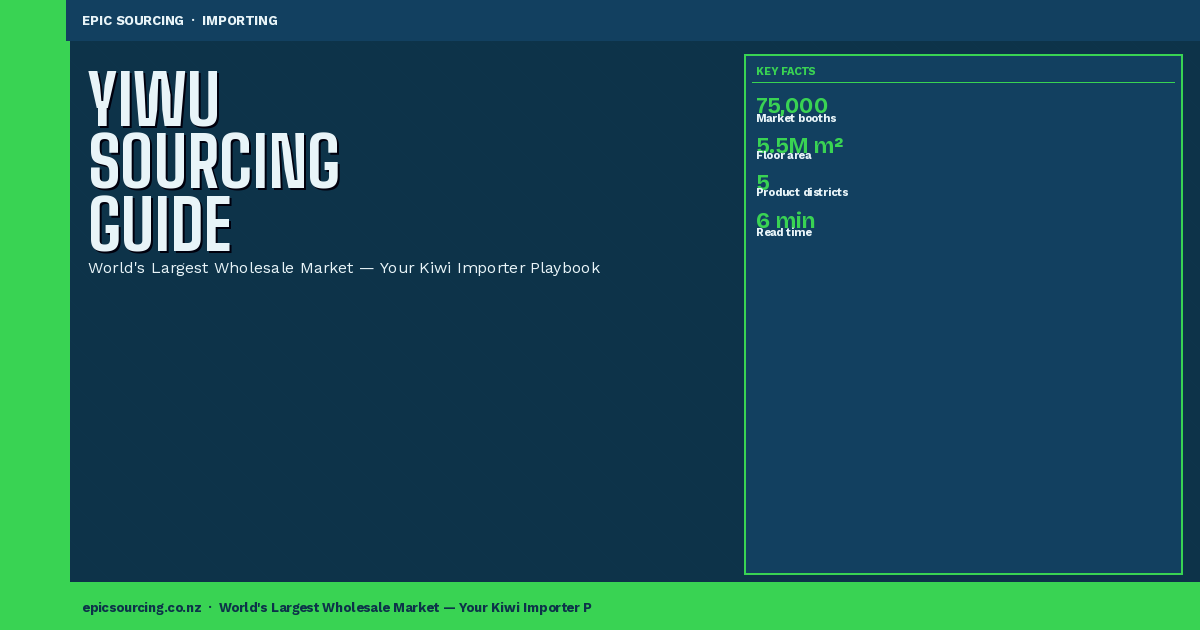
The Yiwu International Trade City in Zhejiang Province, China, is the world's largest small commodity wholesale market. It covers over 5.5 million square metres across five districts and houses more than 75,000 booths. Everything from Christmas decorations and stationery to fashion accessories, homewares, and toys is sold here at ex-factory prices — often in surprisingly low minimums.
For NZ importers, Yiwu can be an absolute goldmine. But navigating it without local help is genuinely challenging. In this guide, we'll break down how to source from Yiwu successfully — including how to find a reliable Yiwu agent and what to watch out for. Let's dive in.
What Is Yiwu and Why Should Kiwi Importers Care?
Yiwu's International Trade City operates like a permanent trade fair — open 365 days a year. The market is split into five districts, each covering different product categories:
- District 1 — Jewellery, accessories, cosmetics, glasses, umbrellas, locks, clocks
- District 2 — Toys, craft supplies, holiday goods, stationery, hats, bags
- District 3 — Tools, hardware, auto accessories, electrical supplies, sporting goods
- District 4 — Socks, underwear, knitted goods, scarves, leather goods
- District 5 — Imported goods (international suppliers selling into China)
The prices you'll find in Yiwu are often significantly lower than comparable goods on Alibaba, because you're dealing directly with the producer (or their dedicated sales agent) at the source. For Kiwi importers who want to buy a mix of product types without managing multiple factories, Yiwu is especially powerful — you can consolidate everything into a single shipment to Auckland.
What Products Are Best Sourced from Yiwu?
Not everything is well-suited to Yiwu. The market specialises in high-volume, small commodity goods. Here's where it shines: promotional and corporate merchandise (branded pens, bags, lanyards, keychains), seasonal goods (Christmas, Easter, Halloween decorations), fashion accessories (jewellery, sunglasses, scarves, hats, belts), gift and novelty items, stationery and office supplies, small homewares and giftware, socks and basic apparel, and baby products and toys.
What Yiwu is NOT ideal for: complex technical goods requiring certification, premium high-spec apparel (better sourced from dedicated garment factories), or products requiring significant R&D or custom tooling. For those, you'll want a factory-direct approach.
Sourcing Hack #1: The Yiwu Starter Mix Strategy — First-time Yiwu buyers often try to order everything at once across many categories. Instead, start with one category you know well, identify 3–5 strong suppliers, and test a small order of NZD $3,000–5,000. This lets you validate quality, supplier reliability, and logistics before you scale. One category done well beats ten categories done poorly.
How Does a Yiwu Sourcing Agent Work?
Unless you're physically going to Yiwu yourself (which is genuinely worthwhile — more on that below), you'll want a Yiwu sourcing agent. Here's how the typical model works:
- You tell the agent what you want — product type, budget, approximate quantities.
- The agent walks the market for you — visiting relevant booths, collecting samples, photographing options, negotiating prices.
- You receive a shortlist with photos, prices, and MOQs from multiple suppliers.
- You approve your selection; the agent purchases goods from multiple booths on your behalf.
- Everything is consolidated in the agent's Yiwu warehouse — inspected, packed, and prepared for export.
- Goods are shipped to New Zealand as a single consolidated LCL or FCL shipment.
That consolidation is the real magic. You might be sourcing from 15 different Yiwu booths, but you receive one container in Auckland. Without an agent, you'd be managing 15 separate supplier relationships, 15 separate quality checks, and 15 separate shipments.
How to Find a Reliable Yiwu Agent
This is where things get important — because not all Yiwu agents are created equal. Here's what to look for:
- Transparency on fees — Most legitimate agents charge a sourcing fee (typically 3–8% of product value) plus warehousing and handling. Be cautious of agents who claim zero fees and instead mark up product prices invisibly.
- Physical presence in Yiwu — Your agent should actually be based in Yiwu, not a middleman sitting somewhere else.
- Communication quality — Responsive, sends clear photos, and is honest about what they can and can't source. If they say yes to everything, that's a red flag.
- Consolidation and QC services — Can they inspect goods before shipping? Can they repack or relabel products to your spec?
- References from other importers — Especially from NZ, Australia, or similar markets. Ask specifically about on-time delivery and dispute resolution.
Sourcing Hack #2: Ask for Video Before You Buy — One of the simplest ways to vet a Yiwu supplier (via your agent) is to ask for a short video of the product being handled. Videos reveal what photos hide — flimsiness, poor construction, colour inconsistency. Any legitimate Yiwu booth will happily provide a 30-second product video if asked. If they won't, walk away.
Getting Your Yiwu Goods from China to New Zealand
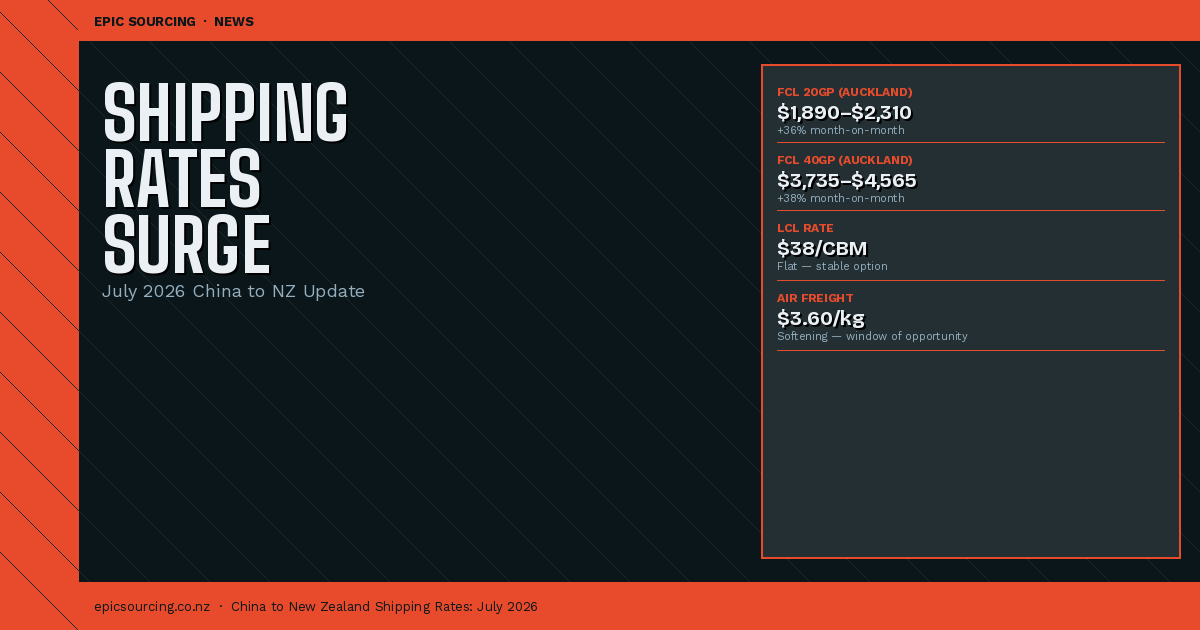
Once your goods are consolidated, the logistics are relatively straightforward. Goods are typically LCL or FCL shipped from Yiwu to Shanghai or Ningbo port, then onward to Auckland, with a transit time of approximately 25–30 days from port departure. July 2026 note: FCL ocean rates are currently elevated (up 36–38% vs June) — for smaller Yiwu orders, LCL is holding flat at ~USD $38/cbm and may be the smarter option right now. Most Yiwu goods attract 0% duty under the NZ-China FTA — always check HS codes for your specific product category.
One thing to factor in with Yiwu orders: because you're consolidating from multiple suppliers, your goods may spend 1–2 weeks in the agent's warehouse before shipping. Build this into your lead time expectations.
Should You Visit Yiwu in Person?
Yes — if you can. Walking Yiwu yourself, even once, gives you a completely different understanding of what's possible, what quality looks like at different price points, and how to negotiate with Chinese suppliers. There are direct flights from Auckland to Shanghai (then roughly 2.5 hours by high-speed rail to Yiwu). Many NZ importers who visit once find they can do subsequent orders remotely with much greater confidence — because they've seen the market firsthand.
If you do visit, go with a plan: know which districts and product categories you want to cover, arrive with a Google Translate-enabled phone, bring your business cards, and be prepared to spend at least 2–3 full days on the floor. It's an experience unlike anything else in global trade.
Is Yiwu Right for Your NZ Business?
Yiwu works best for importers who want a wide mix of product types consolidated into one shipment, are sourcing small commodity goods where factory-direct isn't practical, have a clear product brief and realistic quality expectations, and are willing to use a trusted Yiwu agent rather than going it alone. It's not ideal if you need complex manufactured goods, strict certification compliance, or highly customised products. But for gifting, accessories, promotional goods, homewares, and seasonal product? Yiwu is genuinely hard to beat.
Whether you're heading to Yiwu for the first time or want help connecting with a trusted Yiwu agent from New Zealand, Epic Sourcing can point you in the right direction. Book a free consultation at epicsourcing.co.nz and we'll share what we know about sourcing from Yiwu safely and profitably.
Related Articles

![How to Import Gym Equipment from China to New Zealand [2026 Guide]](https://cdn.prod.website-files.com/688a8969df3fa58c211fb141/69a4bc6994dd6b0ce2c1439b_Import%20Directly%20from%20China.png)
Let’s Make It Epic
We're here to make sourcing simple – and a whole lot less stressful.
We are experiencing a higher volume of enquiries than usual. Our standard reply time for form submissions and emails is within 72 hours.
If your matter is urgent, please schedule a video call using the link below.
