
.svg)
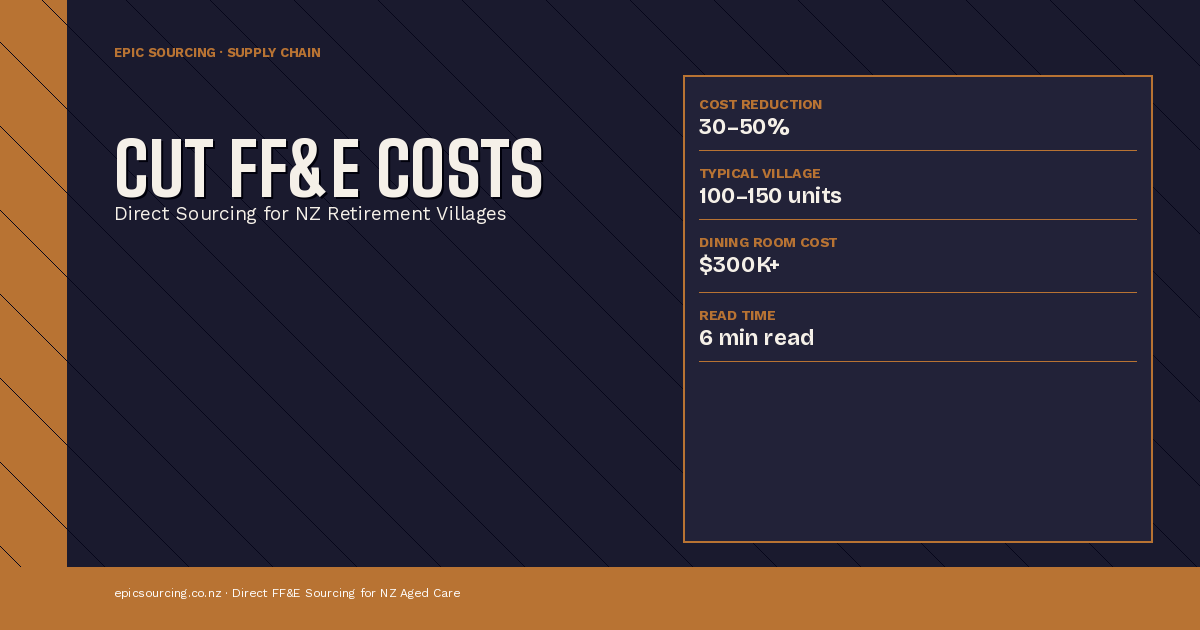
How NZ Retirement Villages Can Cut FF&E Costs by Sourcing Direct from China

.svg)
Running a retirement village in NZ has never been more complex. Between rising construction costs, staff wage pressures, and regulatory compliance requirements, operators are looking for every possible way to manage operating costs without compromising resident experience. One area that rarely gets the attention it deserves? FF&E — furniture, fixtures, and equipment.
For a medium-sized retirement village with 100–150 units, FF&E costs for a new development or a major refresh can easily run into the millions. A new dining room alone might cost $300,000 or more when kitted out through local commercial furniture dealers. And increasingly, retirement village operators are discovering that there's another way.
Let's talk about direct sourcing from China.
What Is FF&E and Why Does It Matter?
FF&E stands for Furniture, Fixtures, and Equipment — the physical items that furnish a building. For a retirement village, this typically includes:
- Bedroom furniture: beds, wardrobes, bedside tables, accent chairs
- Common area furniture: dining chairs, tables, lounge sofas, coffee tables, reception seating
- Outdoor furniture: patio sets, garden benches, sheltered seating areas
- Fixtures: lighting, mirrors, hooks, towel rails, artwork frames
- Equipment: commercial kitchen equipment, gym and wellness equipment, mobility aids and accessories
FF&E for a retirement village represents a substantial capital investment — and it's a recurring one. Most operators refresh common areas every 7–10 years; individual unit furniture gets replaced more frequently due to wear and resident turnover. This means every operator faces a significant ongoing FF&E budget across the life of the development.
The Cost Gap Between Local Supply and Direct Sourcing
Here's the uncomfortable truth: NZ commercial furniture dealers are typically importing from China themselves and adding a margin of 60–120% by the time the product reaches you.
When you source directly — cutting out the distributor or dealer — you access the same product quality at a fraction of the price. Here's a real-world comparison:
- Commercial dining chair: NZ dealer price ~$350–$450; direct China FOB ~$35–$65 (NZD ~$60–$110 landed)
- Three-drawer bedside table: NZ dealer ~$650; direct China FOB ~$70–$120 (NZD ~$120–$200 landed)
- Outdoor patio set (4 chairs + table): NZ dealer ~$2,500; direct China FOB ~$300–$500 (NZD ~$500–$850 landed)
At scale — say 150 dining chairs for a village's dining room — the savings can be $40,000–$50,000 on that single item alone. That's not a rounding error. That's a meaningful reinvestment opportunity for resident services, landscaping, or care staff wages.
Sourcing Hack #1: The Specification Sheet Play — Before contacting any Chinese factory, create a detailed specification sheet for each piece of furniture: dimensions in millimetres, materials, fabric types (including GSM for upholstery), weight ratings, colour and finish options, packaging requirements, and any compliance standards. The more specific you are upfront, the fewer back-and-forth revision cycles you'll need — and the more accurate your factory quotes will be.
What FF&E Categories Work Well When Sourced from China?
Not all FF&E is equally well suited to direct China sourcing. Here's how the categories stack up:
Well suited for direct sourcing:
- Timber and veneer furniture — beds, wardrobes, dining tables, sideboards. Chinese factories produce excellent quality when properly spec'd and sampled.
- Upholstered seating — dining chairs, lounge sofas, armchairs. The key is specifying fabric type, foam density, and frame construction clearly.
- Outdoor furniture — powder-coated aluminium or teak pieces. China is the world's leading producer of commercial outdoor furniture.
- Lighting — pendants, floor lamps, bedside lamps. Ensure NZ electrical compliance certifications are in order.
- Fitness and wellness equipment — stationary bikes, treadmills, resistance machines for village wellness centres.
Worth approaching with extra care: medical equipment with heavy compliance requirements, items requiring ongoing NZ-based service or warranty support, and fast-moving consumables where lead time variability matters.
The Compliance Angle — Getting It Right
Retirement village FF&E in NZ needs to meet specific standards. Before ordering, make sure you're across the key compliance requirements:
- Flammability standards: any upholstered furniture needs to comply with NZ/Australian fire rating standards. Specify this clearly to your supplier and ask for test certificates (ISO 8191 or equivalent).
- Weight and load ratings: beds and chairs need to be rated for appropriate commercial use. Request independent test reports, not factory self-certification.
- Accessibility requirements: if your village includes dementia care or mobility support units, some furniture needs to meet specific height and stability requirements under NZ building and disability codes.
- NZ electrical standards: any electrical items including lamps and small appliances must comply with NZ standards. Ask for SAA or equivalent certification.
Sourcing Hack #2: The Factory Audit Step — For any large FF&E order — say $100,000 NZD or more in product value — it's worth arranging a factory audit before production begins. A qualified third-party auditor will visit the factory, check production capacity, quality management systems, and material compliance. It typically costs $400–$800 USD and can save you from a very expensive quality failure when 150 beds arrive at the Port of Auckland.
Managing a Large FF&E Sourcing Project
Sourcing FF&E for a retirement village isn't a single transaction — it's a project. Here's how successful operators manage it:
- Start 12–18 months ahead: FF&E for a new development should be in sourcing planning long before the building is finished. Procurement timelines for China-sourced furniture can be 4–6 months from order confirmation to NZ delivery.
- Use a staged sampling process: get physical samples of every key piece before placing bulk orders. What looks great in a product photo often needs adjustment — fabric colour, leg height, cushion firmness.
- Plan for shipping consolidation: if you're ordering multiple furniture categories from different factories, consolidating into a single FCL (Full Container Load) saves significantly on freight. A sourcing agent will manage this for you.
- Build in a pre-shipment QC inspection: catches issues like wrong fabrics, incorrect dimensions, or packaging that won't survive the voyage to NZ.
- Account for current freight costs: rates from China to Auckland are currently $2,250–$2,750 USD for a 20GP FCL and $4,455–$5,445 USD for a 40GP FCL — up 36–38% since June 2026. Budget accordingly and book space early.
Why Retirement Village Operators Are Increasingly Choosing Direct Sourcing
We're seeing more aged care and retirement village operators come to Epic Sourcing not because they're trying to squeeze every last dollar out of their budget, but because they've done the maths and realised that smart procurement is simply good governance.
With NZ construction costs at record highs and challenging operating conditions for retirement village operators, capital efficiency matters. When you can furnish a 150-unit village dining room at half the cost of going through a local dealer — and achieve the same quality with proper sourcing management — that's just smart business.
The key word is "proper." Direct sourcing done well requires supplier verification, clear specifications, sampling, quality control, and logistics management. Done poorly, without experience or on-the-ground relationships, it can be a very expensive lesson.
That's why the best approach for most retirement village operators isn't to manage this in-house — it's to bring in a specialist who already knows the factories, the process, and the pitfalls.
Epic Sourcing works with NZ commercial property and hospitality operators sourcing FF&E from China and Vietnam. If you're planning a new development, a village refurbishment, or just want to explore what direct sourcing could save your organisation, we'd love to have a conversation. Book a free 30-minute consultation at epicsourcing.co.nz.
Related Articles
Let’s Make It Epic
We're here to make sourcing simple – and a whole lot less stressful.
We are experiencing a higher volume of enquiries than usual. Our standard reply time for form submissions and emails is within 72 hours.
If your matter is urgent, please schedule a video call using the link below.
