
.svg)
Shipping Rates From China to NZ Have Jumped 30% — Here's What Importers Need to Know

.svg)
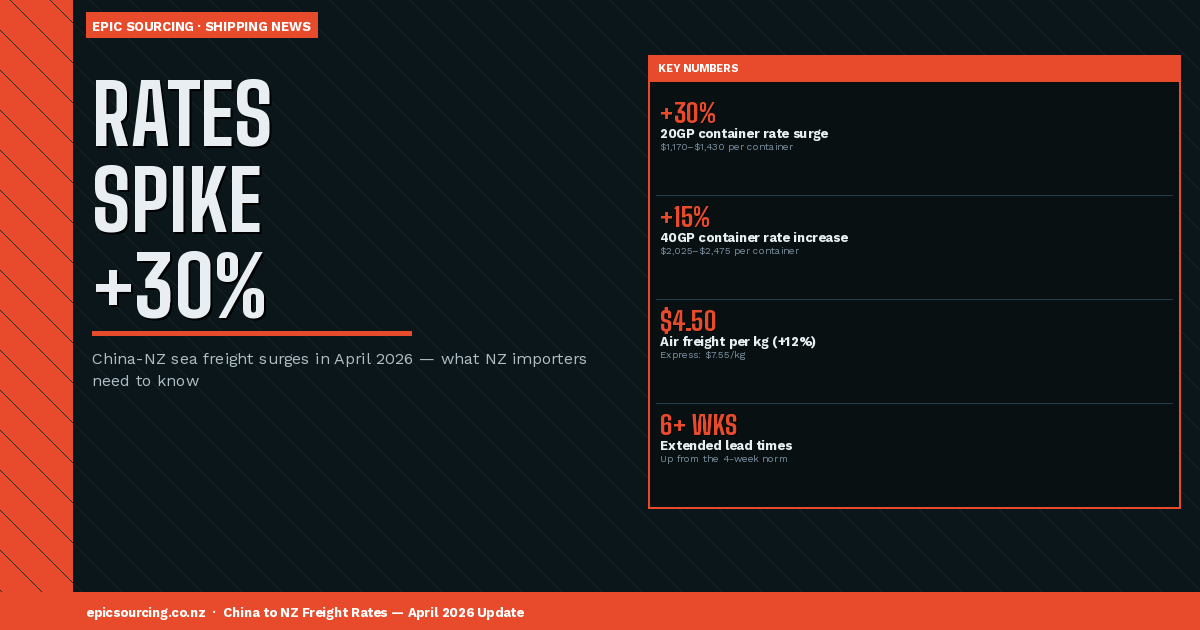
If you've opened a freight quote lately and done a bit of a double-take, you're not imagining things. Shipping rates from China to New Zealand have surged significantly in early 2026, with ocean freight costs up as much as 30% compared to just a month ago. Air freight and express shipping have also climbed 12%.
For Kiwi businesses that rely on importing products from Asia — whether it's activewear, electronics, packaging, or hospitality furniture — this is real money hitting your bottom line. And with extended lead times now stretching to 6+ weeks (up from the old 4-week norm), the disruption isn't just financial.
So, let's break down exactly what's happening, what you can expect to pay, and — more importantly — what you can do about it.
What's Actually Happening With Freight Rates Right Now
The headline number is a 30% jump in 20-foot container (20GP) rates from China to New Zealand, now sitting at $1,170–$1,430 per container. For a 40-foot container (40GP), rates have climbed 15%, ranging from $2,025–$2,475.
Air freight isn't immune either — prices have risen to around $4.50/kg, with express shipping hitting $7.55/kg. Both modes are up approximately 12% from March.
These aren't small adjustments. For a business importing a 40-foot container of outdoor furniture, the freight line in your costing sheet just got $300–$400 more expensive compared to last month.
Why Are Rates Going Up? (The Real Reasons)
There's no single villain here — it's a combination of factors stacking up at the same time:
- Middle East conflict disrupting shipping lanes — The ongoing conflict affecting the Strait of Hormuz has forced many vessels onto longer alternative routes. Longer routes mean higher fuel costs, and those costs get passed on to shippers.
- Fuel surcharges accelerating — Bunker fuel prices have been elevated across 2026, and carriers are applying additional fuel surcharges that compound the base freight rate.
- Port congestion and loading queues — High demand for shipping capacity, combined with port congestion at major Chinese export hubs, is creating loading queues and rolling delays.
- Increased global demand — With business confidence rising globally, more businesses are importing, pushing up demand for container space.
The net result? Higher costs and longer waits. A perfect storm for importers.
What You'll Actually Pay to Ship From China to NZ in April 2026
Here's the current rate snapshot so you can plan your costings accurately:
- Sea freight — 20GP container (China→NZ): NZD $1,170–$1,430 (↑30% vs March)
- Sea freight — 40GP container (China→NZ): NZD $2,025–$2,475 (↑15% vs March)
- Air freight: ~$4.50/kg (↑12% vs March)
- Express shipping: ~$7.55/kg (↑12% vs March)
Keep in mind these are base rates. You'll also need to add destination charges, customs clearance fees, and any fuel surcharges your forwarder applies. It adds up fast.
The New NZ Customs Goods Management Levy
From 1 April 2026, NZ Customs introduced a new Goods Management Levy. Imports valued at NZD $1,000 or less now incur an additional processing charge of approximately NZD $2–3 (plus GST). For eCommerce businesses importing lots of smaller shipments, this adds up quickly. If you're importing larger, consolidated shipments — which we typically recommend — the impact is minimal, but it's worth knowing.
What Extended Lead Times Mean for Your Business
Asia-derived goods are now averaging 6+ weeks transit time, compared to the old benchmark of around 4 weeks. Loading queues and rolling delays at origin are adding a week or more before the vessel even departs. What this means practically:
- If you used to order 6 weeks before you needed stock, you now need to order 8–9 weeks ahead.
- Seasonal or event-driven products (Christmas, summer ranges, promotional merch) need to be on order now if you want them arriving with any buffer.
- Rushing by air freight is going to cost you — $4.50/kg adds up very quickly on a large shipment.
Plan earlier. It's the single most effective thing you can do right now.
Sourcing Hack #1: Get Multiple Freight Quotes on Every Shipment — Freight rates from individual forwarders can vary by $200–$500 on the same lane. Reach out to 2–3 freight forwarders simultaneously and compare — it's a 10-minute task that could save you several hundred dollars per shipment.
How to Protect Your Margins When Shipping Costs Spike
So, what can you actually do about rising freight costs?
- Consolidate your orders — Fewer, larger shipments are almost always more cost-effective than many small ones.
- Use sea freight for everything that isn't urgent — At $4.50/kg, air freight on a typical product order can easily cost more than the products themselves.
- Negotiate on Incoterms (EXW vs FOB) — Make sure you understand exactly what's included in your supplier's price before comparing freight quotes.
- Review your landed cost model — If you built your product pricing on 2024 freight rates, you need to revisit those numbers now.
- Talk to your freight forwarder about timing — Some shipping lanes and departure windows are cheaper than others.
Sourcing Hack #2: Build an 8-Week Buffer Into Your Import Schedule — Until shipping congestion normalises, build at least an 8–9 week buffer between your order confirmation and your 'I need this stock' date. This protects you from rolling delays at origin, vessel changes, and customs clearance time at the NZ end.
So, What Now?
Rising freight rates are frustrating — there's no sugarcoating it. But the businesses that adapt their planning, costing, and supplier relationships fastest will come out ahead. The key moves: order earlier, consolidate shipments, use sea freight where possible, and update your landed cost models to reflect today's reality.
If you're not sure how to work freight costs into your product pricing, or you're thinking about consolidating multiple suppliers into a more efficient import schedule, that's exactly the kind of thing we help with at Epic Sourcing. Book a free consultation with the team and let's make sure your supply chain is as lean and cost-effective as possible, even in a tough freight environment.
Related Articles

Let’s Make It Epic
We're here to make sourcing simple – and a whole lot less stressful.
We are experiencing a higher volume of enquiries than usual. Our standard reply time for form submissions and emails is within 72 hours.
If your matter is urgent, please schedule a video call using the link below.
