
.svg)
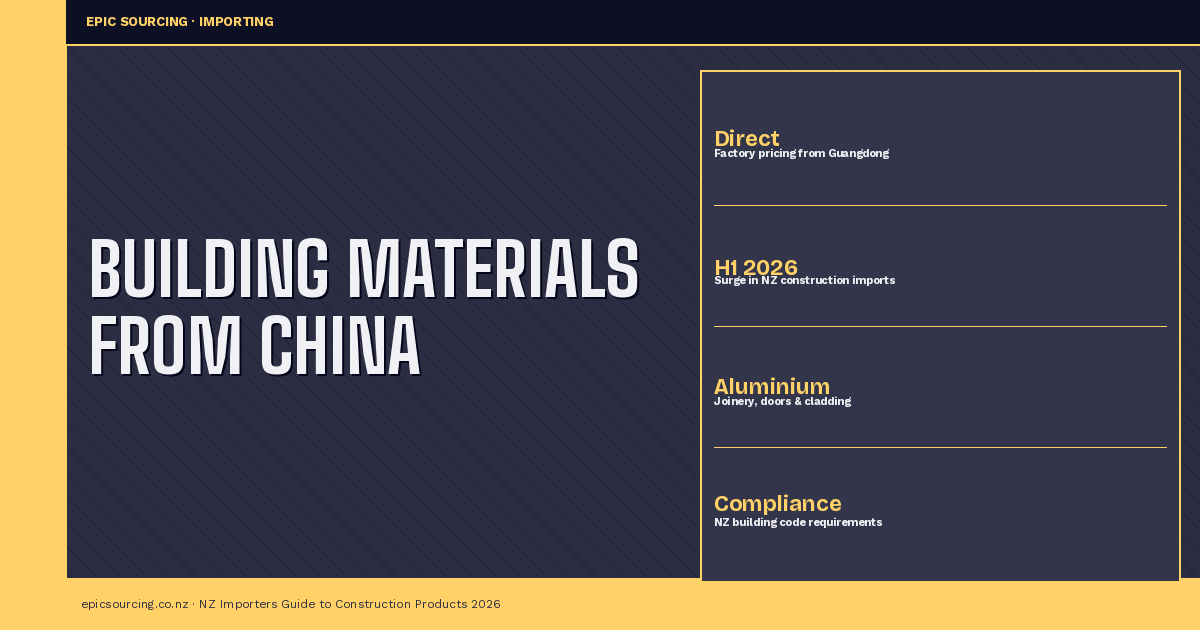
How to Source Building Materials and Construction Products from China for NZ

.svg)
Why NZ Builders and Developers Are Looking to China
Construction costs in New Zealand have been under significant pressure for the past several years. Material costs rose sharply post-pandemic, labour costs have climbed, and NZ's small market means local manufacturers often operate with limited competition. Importing directly from Chinese factories offers a meaningful alternative.
China is the world's largest manufacturer of building materials across almost every category: aluminium profiles and joinery, steel framing components, plywood and engineered timber, tiles and stone, sanitary ware, lighting fixtures, hardware, insulation products, and more. NZ-China trade hit NZ$30 billion in 2025, with construction-related categories making up a growing share. Under the NZ-China FTA, most building materials enter NZ at 0% import duty — making the numbers work even more convincingly when you factor in freight.
What Construction Products Can You Source from China?
Almost any non-structural building product is a candidate for Chinese sourcing. The categories NZ importers are most actively engaging with in 2026 include:
- Aluminium joinery: bifold doors, sliding doors, windows, louvre systems — some of the highest-margin opportunities given NZ's premium joinery pricing
- Interior doors: solid core timber veneer, MDF, glass-panel styles — enormous range and flexibility on sizing
- Sauna kits and wellness rooms: barrel saunas, infrared cabins, steam rooms — a fast-growing category driven by NZ wellness trends
- Composite cladding and decking: WPC boards, aluminium cladding panels
- Tiles, stone, and floor coverings: porcelain, marble-look, large format tiles
- Plumbing fixtures and tapware: quality has improved dramatically; some Chinese manufacturers supply global brands
- Hardware and fixings: hinges, handles, locks, structural connectors
- Prefab and modular components: increasingly relevant for the NZ housing affordability challenge
The key is matching the product category to the right sourcing region in China. Guangdong province dominates aluminium, tiles, and sanitary ware. Zhejiang and Jiangsu are strong for hardware and fixtures. Shandong leads in glass and windows. A good sourcing partner knows this geography — it affects quality, pricing, and MOQs significantly.
The 2026 Aluminium Safeguards Investigation: What Importers Need to Know
There's one important development NZ aluminium importers need to be across in 2026: the New Zealand Government has launched a safeguards investigation into certain aluminium extrusion products, likely focused on Chinese imports.
A safeguards investigation can result in temporary additional duties being applied to specific product categories if the investigation finds that imports are causing serious injury to domestic industry. For importers, this creates some uncertainty around aluminium extrusion products specifically — things like aluminium profiles, frames, and structural sections.
Key points for importers right now:
- The investigation relates to aluminium extrusions specifically — not all aluminium products. Completed doors and windows with glass are typically classified differently from raw extrusion material.
- Check the specific HS tariff codes for your products and monitor progress through the MBIE website.
- If you're placing large aluminium extrusion orders, consider timing and seek customs broker advice on current status.
- Finished fabricated products (assembled doors, windows) are generally classified differently from raw extrusion — but verify this with a licensed customs broker for your specific product.
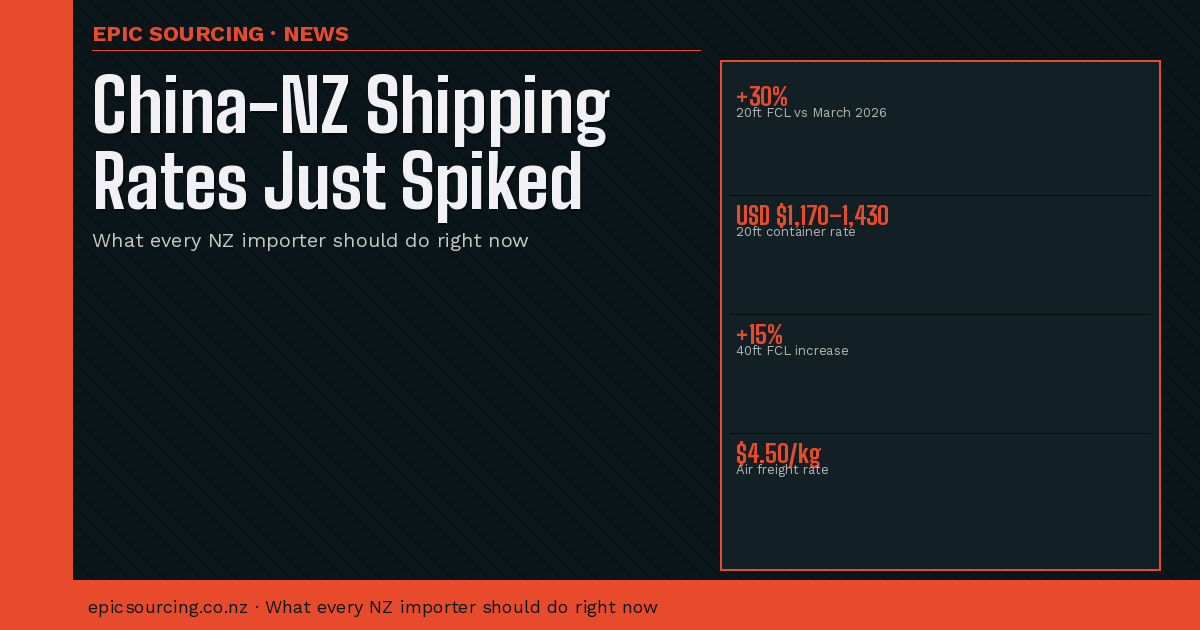
Sourcing Hack #1: FCL Timing for Heavy Goods — July and August are Oceania freight peak season — FCL rates from China to Auckland are up 36–38% on June levels right now (20GP: USD $1,890–$2,310). If you're planning a large building materials shipment, consider whether you can bring it forward or factor the higher freight cost into your landed pricing. LCL rates are holding flat at USD $38/cbm — a better option for partial loads.
Freight and Logistics for Heavy Building Products
Building materials present specific freight considerations that standard consumer goods don't. Here's what to plan for:
- Sea freight mode: Sea is almost always right for construction products — the volume and weight make air freight cost-prohibitive. Current FCL rates from China to Auckland: USD $1,890–$2,310 for a 20GP and USD $3,735–$4,565 for a 40GP, with transit times of 20–23 days.
- Oversized cargo: Aluminium extrusions and doors often exceed standard pallet heights. Confirm with your freight forwarder whether your goods qualify as out-of-gauge — this can attract surcharges.
- Weight limits: Steel products can hit FCL weight limits before filling the container. A 20GP has a typical cargo weight limit of around 28 tonnes — check your product weight before booking.
- MPI biosecurity: Untreated timber, bamboo, and natural-fibre products require MPI clearance. Pre-treat where possible to avoid holds at the border.
- Insurance: Building products at high unit value should be covered with marine cargo insurance. Don't skip this.
Quality Control and NZ Compliance for Building Materials
Getting building products to comply with NZ standards is non-negotiable, particularly for anything that goes into consented construction.
- NZS/AS standards: Aluminium joinery must meet NZS 4211 (performance of windows) and NZS 4212 (selection). Electrical components need NZ compliance marks.
- BRANZ appraisals: For cladding systems and structural components, a BRANZ appraisal significantly eases the building consent process.
- CodeMark certification: Some categories of building products benefit from CodeMark for smooth Building Consent processing.
- Third-party QC inspection: For your first container of a new product, always commission a pre-shipment inspection from a QC company like SGS, Bureau Veritas, or QIMA. It costs USD $200–$400 and identifies problems before goods leave China.
Sourcing Hack #2: Pre-Shipment QC for Building Goods — For construction products where compliance is critical — joinery, structural components, cladding — always commission a pre-shipment inspection report before goods are loaded. QC companies will check dimensions, materials, finishes, and packaging at the factory. Catching a factory substituting cheaper materials before loading is infinitely easier than dealing with it after the container arrives.
Finding Reliable Chinese Suppliers for Construction
- Canton Fair (Guangzhou): The world's largest trade fair, held twice yearly. Building materials and hardware are well-represented. If you're sourcing multiple categories, attending in person is invaluable.
- Alibaba Trade Assurance: Look for suppliers with 5+ years on platform, verified trade assurance, and strong review history.
- Industry-specific B2B platforms: Made-in-China.com and Global Sources often have more specialist building product suppliers than general Alibaba.
- Factory audits: For suppliers you plan to order regularly from, commission a social compliance and technical capability audit through QIMA or Bureau Veritas.
- Sourcing agent: For new categories, an experienced sourcing partner with existing supplier relationships in the right province saves months of trial and error.
Ready to Start Sourcing Building Products from China?
If you're importing building materials from China and want to make sure you're getting the right product, the right compliance, and the right price — talk to the Epic Sourcing team. Book a free 15-minute consultation at epicsourcing.co.nz and we'll help you figure out the best path forward for your project.
Related Articles

Let’s Make It Epic
We're here to make sourcing simple – and a whole lot less stressful.
We are experiencing a higher volume of enquiries than usual. Our standard reply time for form submissions and emails is within 72 hours.
If your matter is urgent, please schedule a video call using the link below.
