.svg)
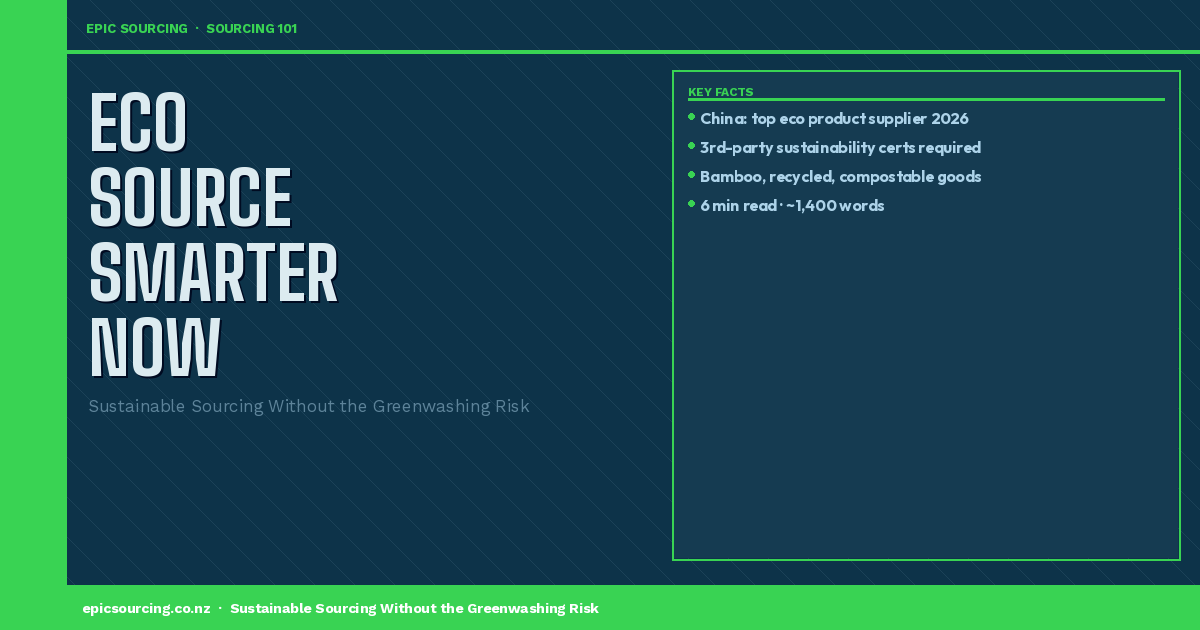
How to Source Eco-Friendly Products from China for Your NZ Brand (Without the Greenwashing Risk)

.svg)
Eco-conscious brands are having a moment in New Zealand. We're seeing more enquiries from Kiwi entrepreneurs wanting to launch sustainable product lines — everything from biodegradable packaging and bamboo homewares to organic activewear and compostable personal care products. And China, perhaps surprisingly, is increasingly the best place to source many of them.
Yes, really. Chinese manufacturers have invested heavily in sustainable production over the last few years — renewable energy, recycled materials, carbon reduction programmes, and third-party sustainability certifications. The global market has pushed factories to adapt, and the better ones have.
The challenge isn't finding eco products in China. It's finding the right suppliers, verifying their claims, and building a brand that stands up to NZ consumers' increasingly sharp BS detectors. Here's exactly how to do it.
What Eco Products Are Actually Sourceable from China?
Let's get specific, because 'eco products' covers a huge range. Here are the categories where NZ brands are finding great value and genuine sustainability credentials:
- Bamboo products — cutlery, toothbrushes, homewares, furniture components, sunglasses frames, and apparel blends. Bamboo is fast-growing, low-pesticide, and genuinely sustainable when processed responsibly.
- Organic & recycled apparel — activewear, basics, and streetwear in GOTS-certified organic cotton, recycled polyester (rPET), and Tencel/Lyocell. China has some of the world's largest certified organic textile mills.
- Biodegradable personal care — flushable wipes, compostable packaging, bamboo packaging for skincare, and natural ingredient formulations. This is a fast-growing category with strong NZ consumer demand.
- Eco packaging solutions — paper-based mailers, compostable bubble wrap alternatives, FSC-certified boxes, soy-based inks.
- Solar & renewable energy accessories — solar phone chargers, LED lighting, energy-efficient home products.
The key across all of these: not all suppliers claiming 'eco' are genuinely eco. That's where the verification step becomes critical.
How to Verify Eco Claims Without Flying to China
This is the part most people skip — and it's exactly how brands end up with greenwashing claims that blow up on social media. Here's a systematic approach:
- Ask for third-party certifications — not just marketing claims. For textiles, look for GOTS (Global Organic Textile Standard), OEKO-TEX, or bluesign certification. For bamboo products, look for FSC (Forest Stewardship Council) certification. For personal care and wipes, look for TÜV OK compost or DIN CERTCO certification.
- Request lab test reports — any reputable eco supplier can provide SGS, Intertek, or Bureau Veritas test reports for their products. Biodegradability claims especially need lab-backed data.
- Use a sourcing agent or quality control inspector — a third-party QC inspection in China before your goods ship gives you eyes on the production process, not just the finished sample.
- Check the factory on audit databases — platforms like QIMA, Bureau Veritas, or SGS maintain databases of audited factories. Asking suppliers for their audit history tells you a lot.
- Start with a smaller MOQ trial order — before committing to large volumes, run a small test order and get the product independently tested in NZ if your category requires it.
Sourcing Hack #1: Search Alibaba With Certification Filters — When searching for eco suppliers on Alibaba, use the 'Verified Supplier' filter alongside searching for the specific certification name (e.g., 'GOTS certified organic cotton manufacturer'). Then cross-reference the certificate number directly on the certifying body's website — GOTS has a public database at global-standard.org where you can verify any certificate in 30 seconds.
Understanding Minimum Order Quantities for Eco Products
One of the biggest questions we get from NZ brands launching eco lines: what are the MOQs? The honest answer is it varies significantly, but here's a rough guide:
- Bamboo toothbrushes or cutlery: often 500–1,000 units per SKU
- Organic cotton apparel (t-shirts, activewear): typically 100–300 units per style per colour
- Biodegradable flushable wipes: often 3,000–5,000 units minimum but varies widely by formulation
- Eco packaging (mailers, boxes): usually 500–1,000 units, lower for stock items vs custom print
- Bamboo homewares (boards, bowls, utensils): often 200–500 per SKU
The good news for NZ brands: smaller-batch eco suppliers have proliferated on platforms like 1688 (China's domestic trade platform) where you can sometimes find manufacturers willing to work with 100–200 unit MOQs, particularly for packaging and smaller accessories.
Sourcing Hack #2: Use a China Consolidation Service for Eco Test Orders — If you want to trial 3 or 4 different eco products from different suppliers simultaneously without paying separate freight for each, use a China consolidation warehouse. You order from multiple suppliers, everything ships to the consolidator's warehouse in China, then goes out in one LCL shipment to NZ. It dramatically reduces your shipping cost on test orders and lets you verify multiple suppliers at once.
The China+1 Option: When Vietnam Makes More Sense
Not all eco categories are best sourced from China. Vietnam has become genuinely outstanding for certain sustainable product types — particularly mid-to-premium furniture using FSC-certified timber, natural rattan, water hyacinth, and bamboo. Vietnam's furniture industry has invested heavily in sustainability certifications and is now preferred by many global retailers for natural material products.
The NZ-Vietnam Comprehensive Strategic Partnership (upgraded in 2025) and the AANZFTA upgrade make Vietnam an increasingly attractive sourcing partner for NZ brands wanting premium eco furniture or home goods. If that's your category, Vietnam warrants serious consideration alongside or instead of China.
Building Your Brand Story Around Transparent Sourcing
Here's the thing about eco products in 2026: NZ consumers are sophisticated. They've grown up reading greenwashing exposés and they're not impressed by vague claims like 'sustainable' or 'natural.' What actually works is radical transparency.
Tell the story of your sourcing process. Share the factory name and location. Publish the certifications with clickable verification links. Show behind-the-scenes content from your QC visits or inspection reports. This kind of transparency isn't just good ethics — it's excellent marketing that builds genuine brand loyalty.
Sourcing Hack #3: Create a 'Made With' Page — Add a 'Made With' or 'Our Sourcing' page to your website before you launch. Include your key supplier's certification details, country of origin, production method, and any QC process you use. This page does triple duty: it builds consumer trust, helps with SEO (unique long-tail content), and differentiates you from generic eco brands who say nothing substantive about their supply chain.
Ready to take the next step? Book a free consultation with the team at Epic Sourcing — we help NZ brands source eco products the right way, with verified suppliers, proper QC, and transparent supply chains. No obligation, just practical advice from people who do this every day.
Related Articles


Let’s Make It Epic
We're here to make sourcing simple – and a whole lot less stressful.
We are experiencing a higher volume of enquiries than usual. Our standard reply time for form submissions and emails is within 72 hours.
If your matter is urgent, please schedule a video call using the link below.
