
.svg)
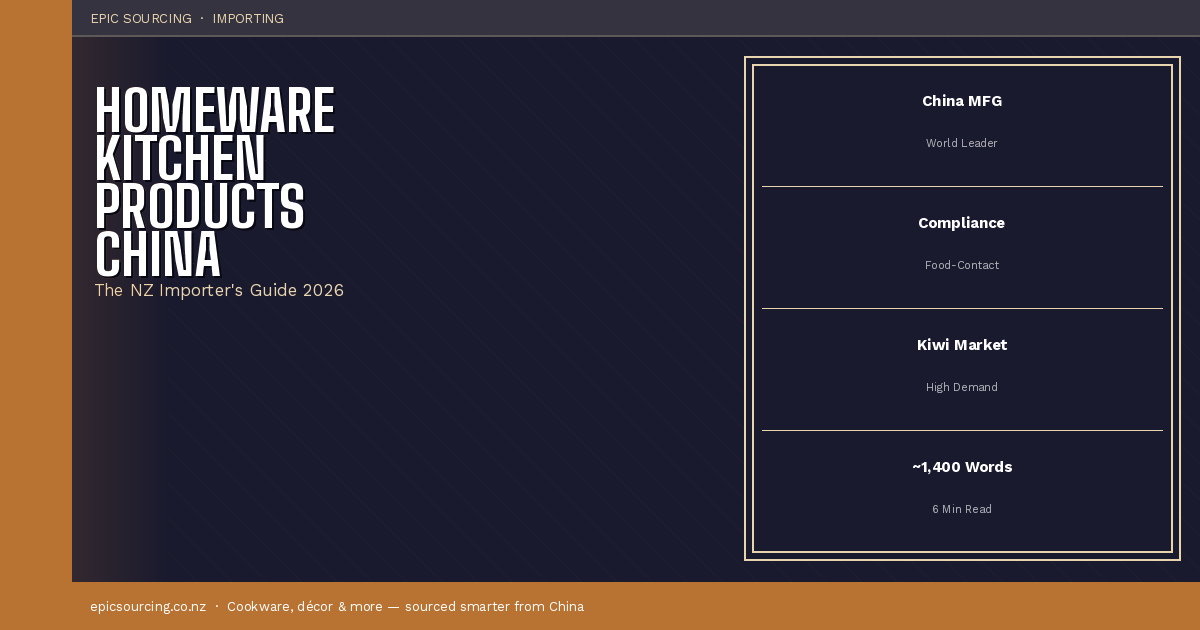
Sourcing Homeware & Kitchen Products from China: The NZ Importer's Guide for 2026

.svg)
There are few import categories with as much depth and demand as homeware and kitchen products. Kiwis renovate, redecorate, and upgrade their kitchens constantly — and with NZ retail prices for quality homeware stubbornly high, there's a genuine appetite for well-priced, well-made alternatives.
China is, unambiguously, the world's leading manufacturer of homeware and kitchen products. From hand-painted ceramic bowls to precision-engineered chef's knives to designer-look concrete planters — the factories are there, the quality ceiling is high, and the pricing advantage over local wholesale is significant.
But importing homeware isn't without nuance. Compliance requirements for food-contact materials, the fragility of ceramic and glass goods, and the need to navigate a sea of suppliers to find the ones making genuinely good product — these are all real challenges. Here's how to approach them.
Why Homeware is One of the Best Import Categories for Kiwi Businesses
- High consumer demand year-round — people always need cookware, storage, serving pieces, and décor
- Strong margins — quality Chinese homeware can be sourced for 15–30% of NZ retail pricing
- Huge range of sub-categories — build a differentiated product range without duplicating what's already in the market
- Suitable for B2C and B2B — sell direct to consumers online, or wholesale to gift stores, hospitality businesses, and interior designers
- Giftable, photographable, social media-friendly — homeware drives strong organic marketing
The Most Popular Homeware & Kitchen Categories NZ Businesses Are Importing
- Ceramics and dinnerware — hand-made-look stoneware with reactive glaze finishes, matte textures, and earthy tones aligned with the Scandi-meets-NZ aesthetic
- Cookware — cast iron skillets, carbon steel pans, non-stick ceramic-coated sets that compete with European brands at a fraction of the price
- Storage and organisation — bamboo drawer organisers, woven baskets, modular pantry systems
- Kitchen tools and utensils — silicone spatulas, wooden spoon sets, knife blocks, mandoline slicers
- Coffee and tea accessories — pour-over sets, French press, ceramic mugs, bamboo serving boards
- Outdoor entertaining — outdoor dinnerware sets, bamboo serving platters, melamine tableware
- Home fragrance — reed diffusers, ceramic oil burners, candle holders
Finding Quality Homeware Suppliers in China
The homeware category has strong geographic clustering in China, which makes supplier research more efficient:
- Jingdezhen, Jiangxi — the historic porcelain capital; exceptional ceramics quality, particularly for fine dining and artisan-feel pieces
- Chaozhou, Guangdong — high-volume ceramics for commercial and retail use; consistent quality, competitive pricing
- Zhejiang Province (Yiwu, Jinhua) — household goods, kitchenware, small appliances; the widest variety of products in one geographic area
- Guangdong Province — cookware, bakeware, kitchen tools and gadgets; strong export infrastructure
For online sourcing, look beyond Alibaba to Global Sources (often better for premium manufacturers) and 1688.com (China's domestic B2B platform — pricing is closer to factory gate, but you'll need a China-based agent to navigate it).
Sourcing Hack #1: Request Food-Contact Safety Certs for Anything Touching Food — Any product that will contact food — cookware, dinnerware, cutting boards, storage containers, water bottles, utensils — must have food-contact safety certification. Ask your supplier for their LFGB (German/EU) or FDA (USA) test report before ordering. Non-stick coatings should specifically confirm they are PFOA-free.
Navigating NZ Standards for Kitchen & Homeware Products
As the importer, you carry responsibility for ensuring products are safe and fit for purpose. Key compliance areas:
- Food-contact materials — LFGB or FDA certification required for anything touching food
- Electrical products — any kitchen appliance must meet AS/NZS safety standards and carry the RCM mark; importing without it is illegal
- Glassware and ceramics — must not leach lead or cadmium above NZ/EU limits; test reports should confirm compliance
- Labelling — country of origin, care instructions, and material composition must be clearly labelled in English
- Flammability — for oven mitts, aprons, or placemats, flammability compliance applies
MOQ and Pricing Expectations
- Mass-produced kitchenware (silicone tools, storage containers) — MOQ as low as 200–500 pieces
- Ceramics and dinnerware — typically 300–1,000 pieces per design
- Cookware (cast iron, carbon steel) — often 100–300 pieces per SKU
- Custom or private-label products — MOQs typically double, but the margin improvement justifies it for established ranges
A rough rule of thumb: if you're not achieving a landed cost of 20–25% of your intended retail price, the product is either too complex or sourced from the wrong factory tier. Experienced importers targeting NZ retail at $25–$80 NZD typically source at $3–$15 NZD per unit landed.
Sourcing Hack #2: Order Samples from 3–4 Suppliers Simultaneously — Don't just order a single sample. When the samples arrive, do a side-by-side comparison of quality, finish, and packaging. This gives you negotiating leverage with your preferred supplier and ensures you're making a decision based on real product, not photographs. Budget $150–$350 NZD per sample round for ceramics and kitchen goods.
Building a Profitable Homeware Range from Sourced Products
The best NZ homeware import businesses aren't just reselling generic products — they're building cohesive, branded ranges that tell a story. Whether that's a coastal NZ aesthetic, a bold artisan-market feel, or a sleek modern kitchen look, having a design direction makes product selection more coherent and marketing far easier.
- Focus on 8–12 SKUs to start — depth beats breadth
- Source pieces that work as sets (a serving bowl, four side bowls, a matching platter)
- Consider custom packaging from day one — inexpensive to add and significantly lifts perceived value
- Price for the full landed cost including freight, duties (5% for most homeware), and GST
- List on Trade Me alongside your own store to build volume and social proof
Ready to build your homeware range? Epic Sourcing helps Kiwi businesses source quality products from China and Asia — without the guesswork. Book your free consultation at epicsourcing.co.nz and let's talk about your product range.
Related Articles

Let’s Make It Epic
We're here to make sourcing simple – and a whole lot less stressful.
We are experiencing a higher volume of enquiries than usual. Our standard reply time for form submissions and emails is within 72 hours.
If your matter is urgent, please schedule a video call using the link below.
