.svg)
How to Source Private Label Products Without Breaking the Bank
.jpg)
.svg)
Private label products have never been more accessible. Thanks to lower minimum order quantities, better communication tools, and sourcing agents who actually know what they're doing, New Zealand entrepreneurs are launching their own branded products from China and Vietnam on budgets that would have seemed impossible a decade ago.
But here's the thing — a tight budget doesn't mean low quality. It means being strategic. In this guide we'll walk you through six practical strategies to source private label products without burning through your cash, plus some honest numbers so you can plan properly before you commit.
What Is Private Label Sourcing, Exactly?
Private label is when you commission a manufacturer to produce a product that you then sell under your own brand. Unlike white label (where you slap your logo on a generic, off-the-shelf product), private label gives you more control — over materials, design, packaging, and positioning.
It's the model behind some of the most successful eCommerce brands in New Zealand and globally. The key is finding the right manufacturer at the right MOQ (minimum order quantity) at a price point that makes commercial sense for your stage of business.
Strategy 1: Start with a White Label Prototype, Then Customise
One of the most cost-effective ways to break into private label is to begin with a white label product and layer customisation over time. Find a manufacturer already producing something close to what you want, order a small run with your logo and packaging, validate the market, then invest in deeper customisation once you know it sells.
This approach dramatically reduces your upfront risk. You're not paying for mould costs or bespoke tooling until you've proven demand. For many NZ startups, this is the smartest entry point.
Strategy 2: Negotiate Lower MOQs — They're Not Fixed
MOQs are negotiable. Full stop. Manufacturers list minimum order quantities as a starting position, not a hard rule. If you approach a supplier professionally, show you're a serious buyer, and explain that you're testing the market before scaling — most reputable factories will work with you.
Tactics that help lower your MOQ include:
- Offering a slightly higher unit price in exchange for a smaller run
- Keeping packaging simple for your first order (reduces setup costs for the factory)
- Being flexible on colour or variant options
- Building a longer-term relationship from the start — factories reward loyalty
A sourcing agent can be invaluable here. Negotiating in Mandarin with a factory you found on Alibaba is very different from having an experienced agent who has existing relationships and credibility with the supplier.
Strategy 3: Choose the Right Product Category
Some product categories are simply more accessible at low volumes than others. If budget is a constraint, steer toward categories where tooling and setup costs are low and factories are accustomed to smaller runs.
Good low-MOQ private label categories include:
- Health and wellness accessories (resistance bands, yoga props, massage tools)
- Beauty and personal care (serums, balms, scrubs)
- Kitchen and home accessories
- Pet products
- Apparel basics (where you're customising colour and label rather than pattern)
Categories to be cautious with at low budgets include electronics (RCM compliance costs in NZ can be significant), heavily regulated health products, and anything requiring expensive custom tooling or moulds.
Strategy 4: Keep Packaging Simple for Your First Order
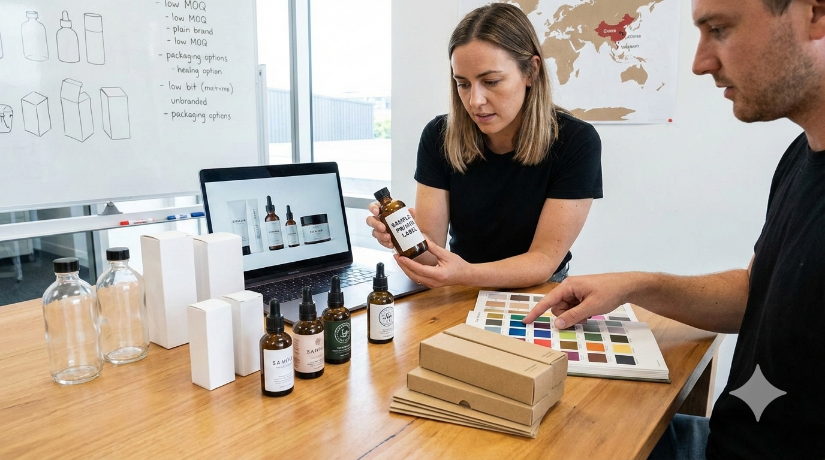
Custom packaging is one of the biggest cost drivers in private label. A fully bespoke box with embossing, foiling, and multiple colour printing will cost significantly more per unit than a simple kraft box with a custom label.
For your first run, consider:
- Standard packaging with a custom printed label (sticker application)
- Unboxed product with a custom hang tag or sleeve
- Simple mailer box with one or two colour print
Once you've proven your product and have volume behind you, invest in the premium unboxing experience. In the early stages, what's inside the box matters more than the box itself.
Strategy 5: Use a Sourcing Agent on an Hourly Rate
Many people assume a sourcing agent is an expensive luxury. In reality, using the right agent on the right fee model can save you significantly — in money, time, and costly mistakes.
At Epic Sourcing, we operate on a transparent hourly rate with no commission on orders. That means we're never incentivised to push you toward a more expensive supplier or a larger order than you need. We work in your interest, full stop.
For a bootstrapped private label startup, an hourly rate model means you can engage support exactly when you need it — to shortlist suppliers, negotiate MOQs, review samples, or manage quality control — without committing to a large ongoing retainer. It's the most cost-effective way to access professional sourcing expertise without the risk of paying commissions that quietly eat your margin.
We're based in New Zealand with a team on the ground in China, which means we can sit down with you here and have eyes and ears at the factory. That combination is hard to replicate when you're sourcing alone from behind a laptop.
Strategy 6: Plan for Compliance Costs Upfront
One area where Kiwi importers consistently get caught out is compliance. New Zealand has specific import requirements across many categories — MPI biosecurity rules, product safety standards, labelling requirements — and these costs need to be factored into your budget before you place your first order, not after your shipment arrives.
Build the following into your planning:
- MPI import health standards (if your product includes organic materials, textiles, or timber)
- Consumer Guarantees Act labelling requirements
- Product safety standards relevant to your category
- GST and customs duty on import value
Getting this right from day one protects your business and builds trust with your customers. A good sourcing agent will flag these requirements early so there are no nasty surprises at the border.
Realistic Budget Ranges for First-Time Private Labellers
Every product is different, but here's a rough guide to help you frame your expectations for a first private label run sourced from China or Vietnam:
- Product sampling: NZ$200–$600 (including courier from factory)
- First production run (low MOQ): NZ$2,000–$8,000 depending on category and volume
- Packaging (basic label/sleeve): NZ$300–$1,200
- Freight (sea vs air): NZ$400–$2,000 depending on volume and urgency
- Sourcing agent fees (hourly): NZ$500–$2,000 depending on complexity
- Total first order budget: NZ$3,500–$14,000
Yes, you can go lower than this. And yes, some categories will cost more. But this range gives you a realistic starting point for planning purposes.
The Bottom Line
Private label sourcing on a budget is absolutely achievable — but it requires the right strategy, the right product category, and the right support. Skimping on supplier vetting or skipping compliance checks to save a few hundred dollars almost always costs more in the long run.
If you're at the planning stage and want to talk through whether your idea is viable, what realistic MOQs look like for your category, or how Epic Sourcing can help you navigate the process — book a free consultation with our team. We work with first-time importers every week and love helping Kiwi businesses get their first product off the ground.
Related Articles
Let’s Make It Epic
We're here to make sourcing simple – and a whole lot less stressful.
We are experiencing a higher volume of enquiries than usual. Our standard reply time for form submissions and emails is within 72 hours.
If your matter is urgent, please schedule a video call using the link below.
