.svg)
How to Source Products for Your NZ Online Store (2026 Ecommerce Sourcing Guide)

.svg)
NZ Ecommerce Is Booming — and Smart Sourcing Is the Edge
If you're running an online store in New Zealand — or thinking about starting one — you've probably figured out that the cheapest way to sell products online is not to buy them retail and flip them. It's to go direct to the source.
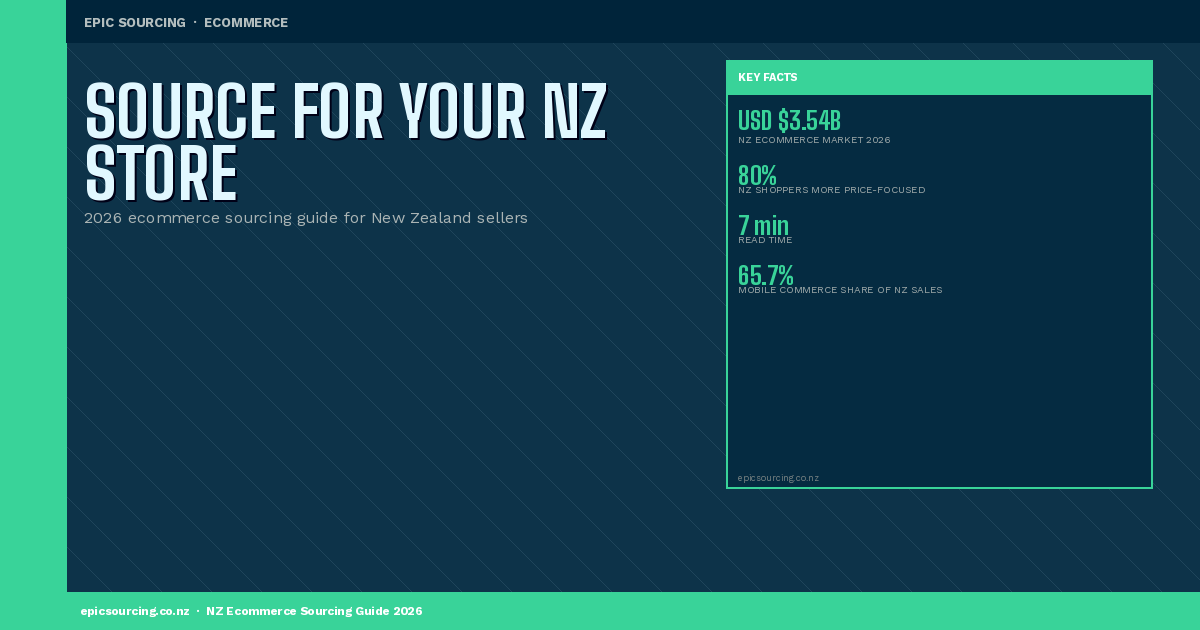
New Zealand's ecommerce market is worth USD $3.54 billion in 2026, projected to reach USD $5.43 billion by 2031. Mobile commerce accounts for 65.7% of all NZ ecommerce transactions and is growing at 10% CAGR. And here's the critical insight for online sellers: 80% of NZ consumers say they expect to be even more price-focused in 2026. Private labels and 'dupe' products are booming. If you want a slice of that, sourcing is your biggest lever.
The brands winning in NZ ecommerce right now aren't reselling other people's stuff at slim margins. They're sourcing smart, building their own labels, and owning their product categories.
What Products Are Kiwi Online Stores Importing in 2026?
Epic Sourcing's enquiry data from H1 2026 — the strongest enquiry period in the business's history — tells us exactly what NZ online sellers are chasing right now:
- Streetwear and fashion apparel: Private label streetwear, limited-edition drops, athleisure and activewear. Apparel is consistently the #1 enquiry category across three years of data — it's a proven NZ ecommerce market.
- Eco and sustainable products: Eco-conscious personal care, refillable packaging, bamboo products, organic cotton apparel. The sustainability trend is growing fast — NZ consumers actively seek it out.
- Health, wellness and fitness: Protein shakers, gym accessories, infrared sauna kits, wellness supplements packaging.
- Home and lifestyle: Candle-making supplies, custom homewares, aesthetically-led décor products that perform well on Instagram and Pinterest.
- Pet products: A reliable evergreen category with strong repeat purchase rates.
- Custom packaging and branded merchandise: Businesses adding branded products to their service offerings — corporate gifts, event products, branded accessories.
The common thread: products where you can build a brand story, hit a meaningful price point, and create repeat buyers.
China vs Vietnam: Which Source is Right for Your Online Store?
Most NZ ecommerce sellers start with China — and that's the right call for most product categories. Here's a direct comparison:
China's advantages for ecommerce sourcing:
- Widest product range of any manufacturing country on earth — if it exists, China makes it
- More competitive MOQs — you can often start with 200–500 units for apparel or accessories
- Faster product development cycles — factories are experienced with rapid sampling
- 0% NZ import duty under the FTA — your landed costs are lower than US competitors importing the same goods
- Strong logistics infrastructure — Alibaba, 1688.com, freight forwarders, and QC companies all well-developed
Vietnam's advantages for specific categories:
- Labour costs ~76% lower than China — significant for labour-intensive products like garments, footwear, bags
- Growing quality reputation for mid-to-premium furniture and soft goods (QIMA audit demand up 30% year-on-year)
- AANZFTA trade agreement upgraded in 2025 with better e-commerce provisions and tariff access
- "Made in Vietnam" can be a positive brand story for some consumer audiences
For most first-time ecommerce importers: start with China. Get one product right, prove the model, then diversify to Vietnam for specific categories where it makes sense.
Sourcing Hack #1: TikTok and Instagram for Product Research — Before committing to a product category, spend 30 minutes on TikTok and Instagram searching your niche with NZ-specific hashtags (#nzsmallbusiness, #nzshop, #nzmade). This tells you two things: is anyone already selling this successfully in NZ (demand validated), and what do they charge (price point confirmed)? Cross-reference with Alibaba pricing to work backwards on your margin. Free market research that most new importers skip entirely.
Private Label vs White Label vs Reselling: What Model is Best?
This is the question we hear most from NZ ecommerce sellers.
Reselling (buying branded wholesale and flipping) offers the lowest barrier to entry but the worst margins. You're competing with every other reseller on price and your supply is visible to everyone. Avoid unless you have a unique distribution advantage.
White label means taking a generic factory product and putting your branding on it. Lower cost than full private label, faster to market, but limited differentiation. Good for testing a category before investing in custom product development.
Private label is the goal for serious ecommerce brands. You work with a factory to develop a product to your specifications — your packaging, your formulation, your design. Higher upfront investment and typically higher MOQs, but infinitely better margins and brand defensibility. Streetwear brands Epic works with often start with white-label basics (tees, hoodies, track pants) and layer custom design work on top to create something uniquely theirs.
For NZ ecommerce, the sweet spot: start white label to test your market, then move to private label once you've proven demand.
Managing MOQs and Cash Flow for Online Sellers
The main constraint for ecommerce importers is usually cash flow, not product knowledge. Here's how to manage it sensibly:
- Start small: Many factories will negotiate MOQs down for a first order, especially if you signal you're planning repeat orders. Don't be afraid to ask.
- Mix and match SKUs: If you're launching 5 products, you don't need 1,000 units of each. Talk to your supplier about combining SKUs in one production run to hit the factory's overall MOQ.
- Use LCL freight: Less-than-container-load shipping is ideal for smaller ecommerce import volumes. LCL rates from China to Auckland are holding flat at USD $38/cbm — much more accessible than a full container for first orders.
- BNPL is spreading: Buy Now Pay Later has exploded in NZ, particularly in the 18–35 age group. Some freight and sourcing providers now offer flexible payment terms for businesses.
- Don't overorder first time: Test with a smaller quantity, learn your real sell-through rate, then scale confidently on your second order.
Sourcing Hack #2: Start with LCL, Scale to FCL — Your first import should almost always be LCL — Less than Container Load. You're only paying for the space you use (USD $38/cbm to Auckland right now), there's no minimum container commitment, and it lets you test the full import process at lower stakes. Once you know your product sells and you're reordering consistently, you'll grow into FCL economics naturally. A 20-foot container is roughly 25–28 cbm — that's the healthy progression.
Getting Your Stock Here on Time
Freight is the part of ecommerce importing that catches sellers out most often — mainly because they underestimate lead times and run out of stock. The full timeline from 'I need to reorder' to 'stock available to ship':
- Production lead time: typically 15–30 days after order confirmation and deposit
- Pre-shipment inspection (recommended): 1–3 days
- Export customs and port loading: 3–5 working days
- Sea transit China to Auckland: 20–23 days FCL, 21–27 days LCL
- Import customs and NZ delivery: 3–5 working days
That's a total lead time of 6–12 weeks from reorder to back in stock. Place reorders well before you think you need to. The number one stock management mistake NZ online sellers make is waiting until they're nearly out.
Ready to Source Your Next Winning Product?
The NZ ecommerce opportunity is real and growing. The sellers winning are the ones with their sourcing dialled in — great product, great supplier, great margins, reliable restock cycle. Epic Sourcing works with NZ online businesses to find the right factories, negotiate the best pricing, manage quality control, and get your products to your door. Book a free 15-minute consultation at epicsourcing.co.nz and let's find your next winning product together.
Related Articles

Let’s Make It Epic
We're here to make sourcing simple – and a whole lot less stressful.
We are experiencing a higher volume of enquiries than usual. Our standard reply time for form submissions and emails is within 72 hours.
If your matter is urgent, please schedule a video call using the link below.
