.svg)

Why Savvy Kiwi Businesses Are Sourcing from Vietnam in 2026 (And How to Get Started)

.svg)
If you've been paying attention to the global sourcing landscape lately, you've probably heard the term "China+1" floating around. It's one of those business phrases that sounds like jargon but actually describes something pretty significant happening in manufacturing right now — and as a Kiwi importer, it could change how you think about where your products come from.
So, what's the deal with Vietnam? Why is it suddenly the hot topic in sourcing conversations? And more importantly — how can NZ businesses actually access Vietnamese suppliers without flying to Hanoi? Let's dive in.
What Is the China+1 Strategy and Why Does It Matter?
The "China+1" strategy is exactly what it sounds like: instead of relying on China as your sole manufacturing country, you add at least one additional country to diversify your supply chain risk. For most businesses doing this, Vietnam is the number one choice.
Why now? A few things have converged in 2026 to make this urgent:
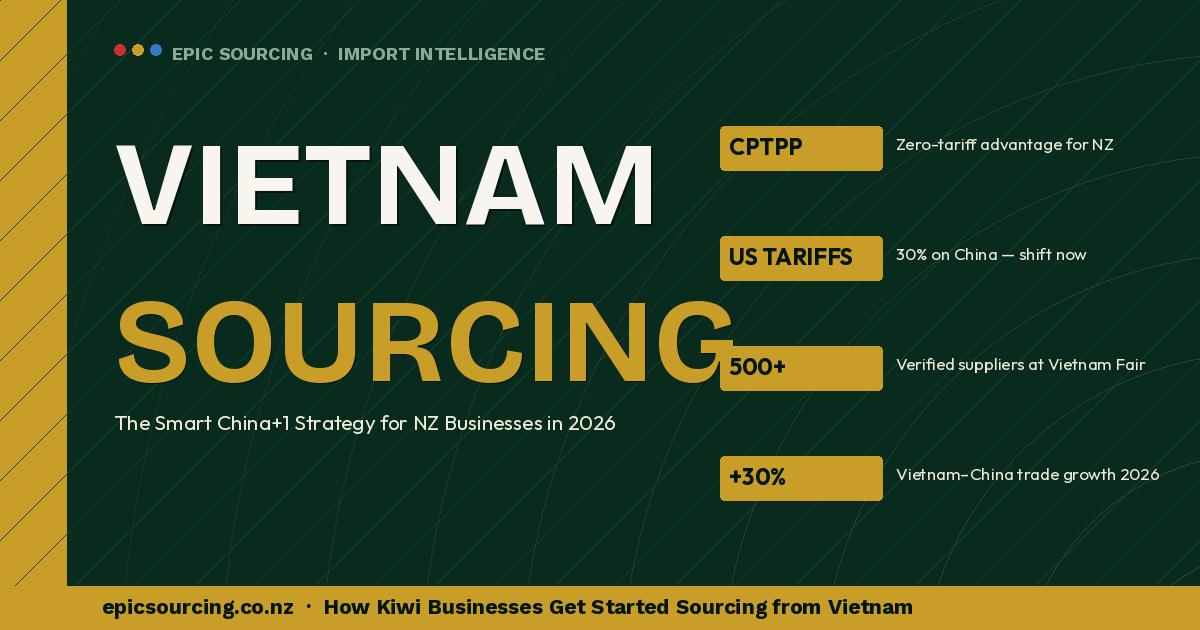
- US tariffs on Chinese goods remain at approximately 30% — reshaping global supply chains in ways that affect NZ importers too.
- Geopolitical risk is real — concentrating 100% of your supply chain in one country is a risk most businesses are reconsidering.
- Vietnam's manufacturing quality has matured significantly — textiles, electronics, furniture, footwear are all produced at genuinely high quality.
- Trade agreements favour Vietnam — NZ has preferential access under CPTPP that makes Vietnamese goods competitively priced at the border.
Vietnam's Manufacturing Strengths: What to Source There
Not every product category is equally well suited to Vietnam sourcing. Here's where Vietnamese manufacturers genuinely excel:
- Textiles and apparel — Vietnam is the world's third largest garment exporter. Activewear, workwear, resort wear, uniforms — quality is high, MOQs are often lower than China, and factories are increasingly set up for sustainable production.
- Furniture and homewares — Particularly rattan, bamboo, teak, and recycled-wood pieces. Vietnam produces beautiful natural-materials furniture sought after worldwide.
- Footwear — Major global brands manufacture in Vietnam. The expertise and infrastructure is there for custom footwear labels.
- Packaging and printing — The Global Sourcing Fair Vietnam 2026 (April 22–24) showcased hundreds of printing and packaging suppliers, including bespoke mailer box manufacturers.
- Electronics components and accessories — Vietnam has grown substantially in phone accessories, cable products, and small consumer electronics.
Sourcing Hack #1: Use Vietnam for Product Development, China for Volume
Develop and sample your products in Vietnam (often more flexible with smaller MOQs and customisation), then consider moving volume production to China once you've validated demand. This gives you the best of both worlds — creative collaboration in Vietnam, pricing muscle in China.
The Trade Agreement Advantage for NZ Importers
Here's something most Kiwi business owners don't fully appreciate: New Zealand has exceptional trade agreement coverage with Vietnam. Under CPTPP (the Comprehensive and Progressive Agreement for Trans-Pacific Partnership), NZ businesses importing from Vietnam benefit from preferential or zero tariff rates on a wide range of goods.
Compare that to importing from China, where standard duty rates apply to most categories, and suddenly the Vietnam option looks even more attractive on a total landed cost basis. The duty savings can often more than compensate for slightly higher freight costs.
How to Find Verified Vietnamese Suppliers
- Global Sourcing Fair Vietnam — This annual event brings together 500+ verified suppliers across textiles, printing, and packaging. Well worth attending if Vietnam is a strategic priority.
- Online platforms — Made-in-Vietnam.com and international B2B platforms like Global Sources include Vietnamese suppliers.
- Trade delegations — VITAS (Vietnam Textile and Apparel Association) and NZ Trade and Enterprise both run programmes to help NZ businesses connect with Vietnamese manufacturers.
- Work with a sourcing agent — For most Kiwi businesses new to Vietnam, this is the fastest path to quality results. A sourcing partner with Vietnamese factory relationships saves you months of trial and error.
Sourcing Hack #2: Request a Factory Profile Before Committing
For any Vietnamese supplier you're considering, ask for: years in operation, major client list, factory certifications (WRAP, BSCI, SA8000 for textiles), a recent audit report, and current lead times. A legitimate factory will have this documentation ready. One that hesitates is a red flag worth taking seriously.
Vietnam vs China: The Honest Comparison
- Price: China generally wins on pure factory price for high-volume orders. Vietnam is competitive and often better on smaller runs.
- MOQs: Vietnam factories often accept lower minimum order quantities — more accessible for smaller Kiwi brands testing new products.
- Lead times: Similar for both — roughly 4–8 weeks for production, plus 6+ weeks shipping to NZ.
- Sustainability: Vietnam is investing heavily in factory certifications. Good news for brands responding to NZ consumer demand — 92% of Kiwi consumers say ethical sourcing matters to them.
Getting Started: Your First Step Into Vietnam Sourcing
The best way to dip your toes into Vietnam sourcing is to start with one product category where Vietnam genuinely excels — apparel, natural furniture, or packaging are great starting points. Request samples before any commitment, get factory documentation, and use CPTPP preferential rates to your advantage.
Keen to explore what Vietnam sourcing could mean for your business? Book a FREE consultation with the Epic Sourcing team and let's map out a strategy together. No commitment required — just a practical conversation about your sourcing options.
Related Articles

Let’s Make It Epic
We're here to make sourcing simple – and a whole lot less stressful.
We are experiencing a higher volume of enquiries than usual. Our standard reply time for form submissions and emails is within 72 hours.
If your matter is urgent, please schedule a video call using the link below.
