.svg)
China's Manufacturing Slowdown in 2026: What NZ Importers Need to Know

.svg)
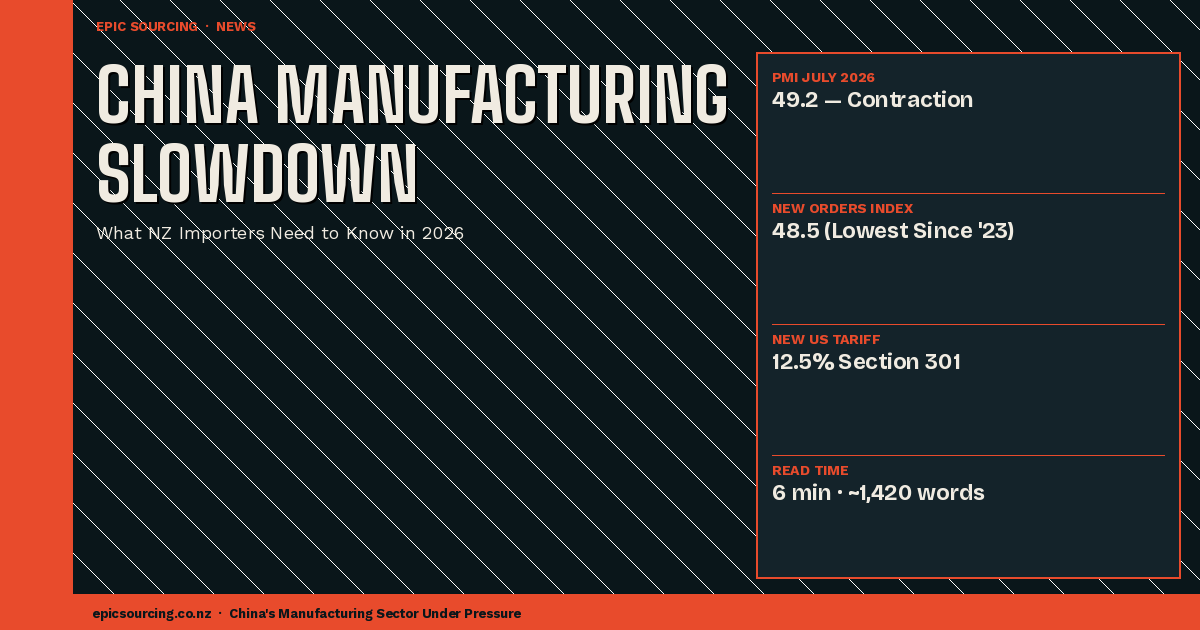
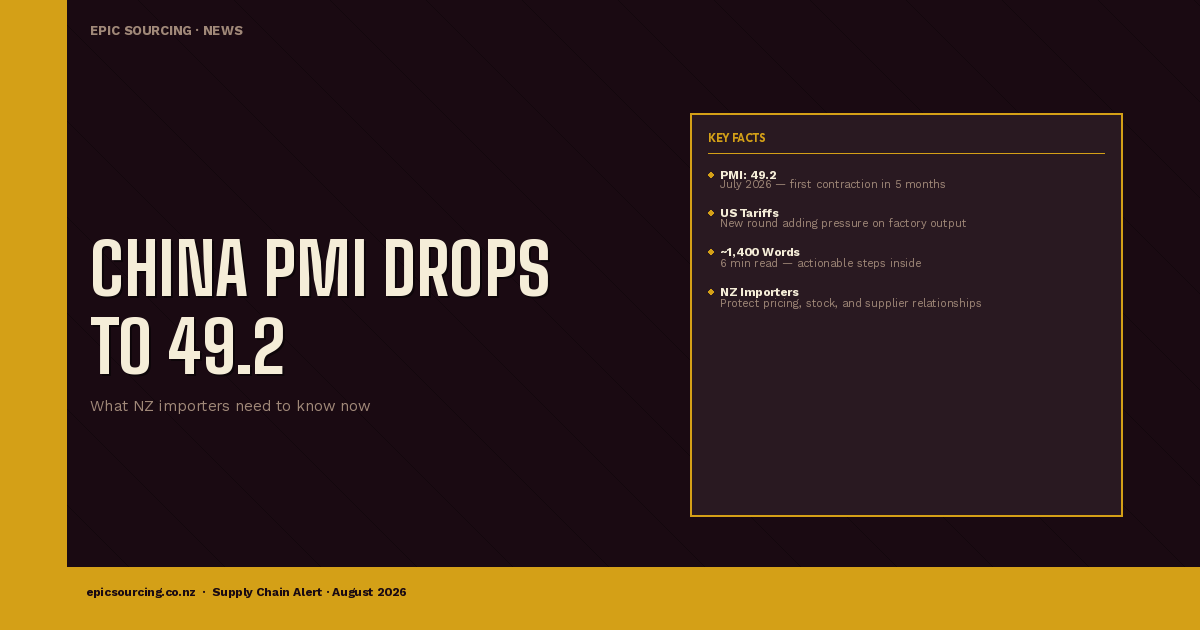
Something's shifted in China's manufacturing sector, and if you're sourcing products from there, it pays to be across it. In July 2026, China's official manufacturing PMI dropped to 49.2 — slipping into contraction territory for the first time in five months. The new orders sub-index hit 48.5, its lowest since 2023. Add a new 12.5% Section 301 tariff on Chinese goods (effective 24 July 2026), and you've got a market that's under real pressure.
This doesn't mean China is done as a manufacturing powerhouse — far from it. But for NZ importers, the signals are worth paying attention to. Whether you're sourcing activewear, homewares, construction products, or electronics, the decisions you make in the next few months could make a real difference to your costs and timelines.
Let's break down what's actually happening and — more importantly — what you can do about it.
What the PMI Dip Actually Means for NZ Importers
The Purchasing Managers Index (PMI) is like a temperature check for manufacturing. Anything above 50 signals expansion; below 50 means contraction. China's July 2026 reading of 49.2 isn't catastrophic, but it does reflect softening factory activity — fewer new orders, quieter production floors, and suppliers under more pressure than they've been in months.
For NZ businesses importing from China, here's what a PMI dip often translates to in practice:
- More negotiating power on price. When orders slow, factories become more competitive. If you're planning a new product order, now could be a good time to negotiate.
- Longer lead time uncertainty. Supply chain disruptions tend to cluster during uncertain periods. Some factories may consolidate production runs.
- Supplier instability risk. Smaller factories in particular may face cashflow pressures. Always worth checking in on the health of your key suppliers right now.
It's not all doom and gloom — Q1 2026 was actually China's best quarter since 2020. But the slowdown in momentum is real, and smart importers are taking notice.
New US Tariffs and What They Mean for You
On 24 July 2026, the US imposed a new 12.5% Section 301 tariff on Chinese goods — stacked on top of existing duties. You might be thinking: we're in NZ, not the US. Why does this affect me?
It does — here's why. First, some of your suppliers may have been selling heavily into the US market. When that demand drops, they're looking for new buyers, which can be a good opportunity for NZ businesses to negotiate better pricing. Second, supply chain ripple effects are real — factories that lose major US contracts may subcontract work to less experienced workshops, and that's where quality risks creep in. Third, global pricing benchmarks shift as competitive dynamics change.
⚡ Sourcing Hack #1: Ask Your Suppliers the Right Question — When reviewing orders with Chinese suppliers, directly ask: "How has your export business been affected by recent tariff changes, and are you offering any pricing adjustments?" A factory under pressure is often more flexible than one operating at full capacity.
Shipping Rates Have Jumped — Here's What to Budget
As of early August 2026, sea freight rates from China to NZ have climbed significantly:
- FCL 20ft container: $1,890–$2,310 (up ~36% month-on-month)
- FCL 40ft container: $3,735–$4,565 (up ~38% month-on-month)
- LCL (less-than-container load): ~$38/cbm (stable)
- Air freight: $4–$8/kg (stable)
The Oceania peak-season capacity crunch is pushing FCL rates higher. If you're shipping full containers, confirm your freight rates with your forwarder before committing to supplier orders. The good news? LCL and air freight are holding steady for smaller or urgent shipments.
Which Product Categories Are Most Affected
Not all importing is equal right now. Electronics and tech accessories, fashion and apparel, and construction materials are facing the most pressure. Homewares, furniture, packaging, and personal care products are holding relatively steady. Private label products — skincare, activewear, vitamins — remain strong opportunities where you own the design and specification.
Practical Steps for NZ Importers Right Now
- Check in with your suppliers. A quick message asking about current capacity and lead times costs nothing and tells you a lot.
- Get fresh freight quotes. Rates have moved significantly. Don't use quotes from three months ago.
- Review your product mix for diversification opportunities — China, Vietnam, India, Indonesia.
- Lock in pricing agreements where possible. Ask trusted factories to hold pricing for your next 2–3 orders.
- Consolidate orders into fewer, larger shipments to reduce per-unit freight costs.
⚡ Sourcing Hack #2: Use the Slowdown to Get Samples — When factories are quieter, it's the perfect time to request samples from new potential suppliers. Lead times are shorter, quality managers have more bandwidth, and you'll get a more accurate picture of real production capability.
Should You Be Diversifying Away from China?
China remains the world's most capable manufacturing base — the infrastructure, supply chain depth, and specialisation clusters don't disappear because of one soft quarter. If you're making custom products with complex tooling, switching isn't easy or quick.
But for more commoditised products — furniture, apparel basics, packaging, simple electronics accessories — Vietnam, India, and Bangladesh are increasingly viable alternatives. The smart play for most NZ importers isn't a wholesale switch; it's adding a second string to your sourcing bow. Know what your options are before you need them.
If you're not sure how to read the current market or want a second opinion on your sourcing strategy, the Epic Sourcing team offers a free 30-minute consultation — no obligation, no hard sell. Just a straight conversation about your product and what your options look like. Book a free call at epicsourcing.co.nz.
Related Articles

Let’s Make It Epic
We're here to make sourcing simple – and a whole lot less stressful.
We are experiencing a higher volume of enquiries than usual. Our standard reply time for form submissions and emails is within 72 hours.
If your matter is urgent, please schedule a video call using the link below.
