
.svg)
The New 12.5% US Tariff on NZ Exports: What Kiwi Importers Need to Know

.svg)
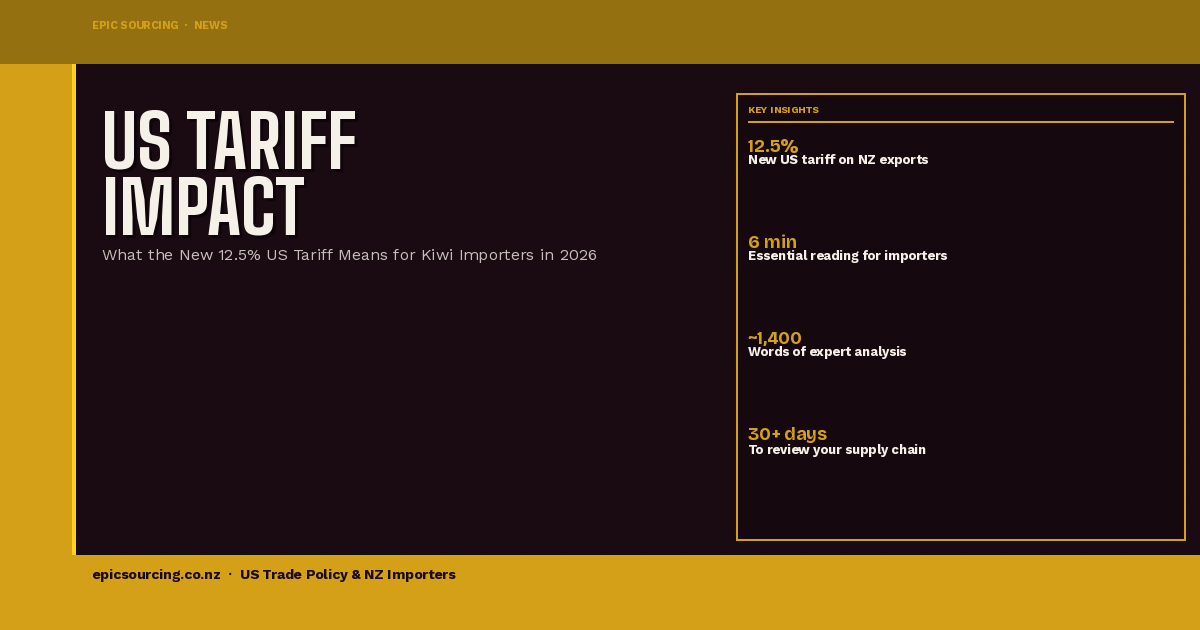
If you've been following trade news lately, you'll have spotted the headline: the United States has confirmed a 12.5% tariff on New Zealand exports. The stated reason? Washington claims NZ has failed to enforce a prohibition on goods produced with forced labour. NZ has pushed back, calling the basis 'not credible' — but the tariff is real, and it's here.
For New Zealand businesses that source products from China or elsewhere and sell into the US market, this is significant. And even for those who don't export to the US, the flow-on effects on supply chains, costs, and competition deserve your attention.
Let's unpack what's actually happening, what it means for Kiwi importers and sourcing businesses, and what steps you can take right now.
What Exactly Is the 12.5% US Tariff?
The new 12.5% tariff applies to a range of NZ exports entering the United States market. Products specifically mentioned include wine, hockey sticks, and cement — but the scope is broader. If your business exports goods to the US or works with brands that do, you'll want to check whether your category is affected.
This tariff is separate from the broader US-China trade tensions. It's a bilateral measure targeting NZ specifically, though NZ has officially rejected the forced-labour rationale. The short-term impact? Higher landed costs for NZ goods entering the US. The medium-term impact? Potentially significant competitive disadvantage versus other exporting nations not facing the same tariff.
How Does This Affect NZ Importers (Even Those Not Selling to the US)?
Here's where it gets interesting. If you're a NZ business sourcing products from China or Vietnam, you might be thinking 'this doesn't apply to me — I'm not exporting to the US.' But there are indirect effects worth understanding:
- Global trade reshuffling: When major tariffs hit, global supply chains adjust. Some Chinese manufacturers who previously exported to the US may now pivot to selling more aggressively into ANZ markets — potentially increasing competition for NZ importers.
- NZ business cost pressures: Household debt is already climbing (Kiwibank reports 40% of Kiwis taking on debt to cover living costs). If tariff-affected NZ exporters see reduced revenue, domestic spending tightens.
- Currency effects: Trade disruptions can move the NZD, affecting your cost of goods when paying Chinese suppliers in USD.
- Supplier relationship dynamics: If global demand for Chinese goods shifts, factories may adjust their pricing, MOQs, or capacity allocation.
Sourcing Hack #1: Lock In Your Freight Rates Now — FCL rates into Auckland are already up 36–38% month-on-month. With trade disruption increasing uncertainty, locking in forward freight rates with your freight forwarder for Q3/Q4 can save you from nasty surprises.
What Should NZ Importers Do Right Now?
First: don't panic. NZ-China trade is not directly affected by this US tariff — you're buying from China, not selling to the US. But it's a useful reminder to audit your supply chain resilience. Here's a practical checklist:
- Map your exposure: Do any of your suppliers also export to the US? If so, they may be facing their own disruptions that could affect your lead times or pricing.
- Diversify your supplier base: The 2026 trend among savvy buyers is qualifying at least two suppliers per SKU. If one factory gets caught up in trade disruptions, you've got a backup.
- Review your contracts: If you've signed supply agreements in NZD, check how currency fluctuations are handled.
- Watch the NZD-USD rate: With global trade uncertainty rising, the exchange rate could move. A weaker NZD means your China imports cost more.
Sourcing Hack #2: Build a Two-Supplier Strategy — Don't source from just one factory. Qualify a second supplier for your key SKUs now — before a trade disruption forces your hand. Epic Sourcing can help you build a parallel supplier shortlist for any product category.
The Bigger Picture: What This Tells Us About Global Trade in 2026
Trade policy has become unpredictable in a way that would have seemed unthinkable five years ago. The US-China tariff war reshaped global manufacturing. US-NZ friction is another signal that supply chain diversification isn't just smart — it's essential. Smart NZ importers are increasingly building resilient sourcing strategies:
- Multi-country sourcing — qualifying suppliers in both China and Vietnam for key product categories
- Dual-supplier qualification — two verified suppliers per SKU
- Inventory buffering — holding slightly more stock to cushion against disruptions
- Landed cost modelling — factoring in freight, tariffs, FX, and customs duties
How Epic Sourcing Helps NZ Businesses Navigate Trade Complexity
This is exactly the kind of environment where having a sourcing partner pays for itself. Epic Sourcing's team is on the ground in China and Vietnam, working with suppliers daily. We keep across the trade landscape so you don't have to. Whether you're looking to diversify your supplier base, explore Vietnam sourcing alongside China, or simply get a clearer picture of your supply chain risks, we can help.
The businesses that thrive through trade disruption are the ones who've built the right foundations: verified suppliers, multiple sourcing options, and a team they trust.
Ready to get started? Book a free consultation with the Epic Sourcing team at epicsourcing.co.nz — no obligation, just a straight-talking conversation about your product and where you want to take it.
Related Articles


Let’s Make It Epic
We're here to make sourcing simple – and a whole lot less stressful.
We are experiencing a higher volume of enquiries than usual. Our standard reply time for form submissions and emails is within 72 hours.
If your matter is urgent, please schedule a video call using the link below.
