

Vietnam's Manufacturing Boom 2026: Should Kiwi Importers Be Paying Attention?


There's a quiet revolution happening in Southeast Asia, and it's got real implications for Kiwi businesses that source products overseas. Vietnam's manufacturing sector is booming — and not in a slow, incremental way. We're talking about billions of dollars of new industrial investment, five consecutive months of employment growth, and a country rapidly becoming the go-to alternative (or complement) to China for global importers.
So should New Zealand businesses be paying attention? Absolutely. Whether you're currently sourcing from China, thinking about diversifying your supply chain, or simply exploring what's possible — Vietnam deserves a serious look in 2026. Let's dive in.
What's Driving Vietnam's Manufacturing Surge?
Vietnam's manufacturing boom in 2026 is being driven by several converging forces:
- New industrial park investment: Two major new industrial parks are breaking ground in Da Nang, representing a combined investment of VND 2.05 trillion. In Bac Ninh, the 75-hectare Ngoc Chau Industrial Cluster is underway with ~VND 1 trillion in investment. These aren't just expansion plans — the ground is being broken right now.
- Workforce growth: Manufacturing employment has grown for five consecutive months in 2026, the fastest sustained growth since late 2022.
- Diversification from China: Global brands and SMEs alike have been quietly shifting part of their supply chains to Vietnam — post-pandemic resilience planning, geopolitical hedging, and competitive labour costs have all played a role.
- Tech and furniture gaining ground: While textiles still account for around 40% of Vietnam-US exports, high-tech electronics and furniture are growing fast — opening up new product categories for importers.
Sourcing Hack #1: Use Vietnam for the Right Product Categories — Vietnam excels at textiles, garments, wooden furniture, footwear, electronics assembly, and handicrafts. If your product falls into one of these categories, get at least 3 Vietnamese supplier quotes alongside your Chinese ones. You may be surprised.
Vietnam vs China: Which Is Right for Your Product?
Let's be real — China isn't going anywhere. It still produces about 29% of global manufacturing output and remains the most practical option for the vast majority of NZ importers, especially for complex products or custom tooling. But Vietnam is increasingly competitive for specific categories:
- Textiles and activewear: Vietnam is highly competitive, with strong quality controls and growing technical fabric capability.
- Wooden furniture: Vietnam has a long tradition of furniture manufacturing, particularly in Ho Chi Minh City and Binh Duong.
- Footwear: Vietnam is the world's second-largest footwear exporter.
- Electronics: Growing capability, but China still dominates for complexity and price.
- Custom FMCG/personal care: Emerging capability, but China typically has better infrastructure for this category.
The honest answer? For most NZ importers sourcing general consumer goods, China remains the primary source. Vietnam is best positioned as a secondary option or for specific category strengths.
What Does It Cost to Ship from Vietnam to New Zealand?
Shipping from Vietnam to NZ typically runs 25-30 days by sea (FCL). Key ports are Ho Chi Minh City (south) and Haiphong (north). Rates are broadly comparable to China-NZ rates, though capacity and routing options are more limited — you'll often be transshipping through Singapore or Malaysia, adding 3-5 days to transit times.
Air freight from Vietnam to NZ runs similarly to China — typically $5-7/kg depending on volume and carrier, with 5-8 day transit.
Sourcing Hack #2: Consolidate Loads Across Both Countries — If you're buying from both China and Vietnam in the same shipment window, ask your freight forwarder about consolidation options. Some forwarders can co-load containers from both origins into a single shipment to NZ, saving on freight and Customs admin.
What NZ Importers Need to Know About Vietnam Compliance
- Certificates of Origin: Vietnamese-origin goods can access preferential duty rates under the ASEAN-Australia-New Zealand Free Trade Agreement (AANZFTA). It's worth checking whether your product qualifies — the savings can be meaningful.
- Factory audits: Vietnam's factory landscape is more fragmented than China's in some categories. Quality audits before placing orders are strongly recommended for first-time relationships.
- Payment terms: 30% deposit, 70% before shipping is common. Letters of credit are also used for larger orders.
- Communication: English is widely spoken in Vietnam's export manufacturing sector, but having a local partner or agent on the ground can smooth out misunderstandings significantly.
The Smart Play: Dual-Source Strategy
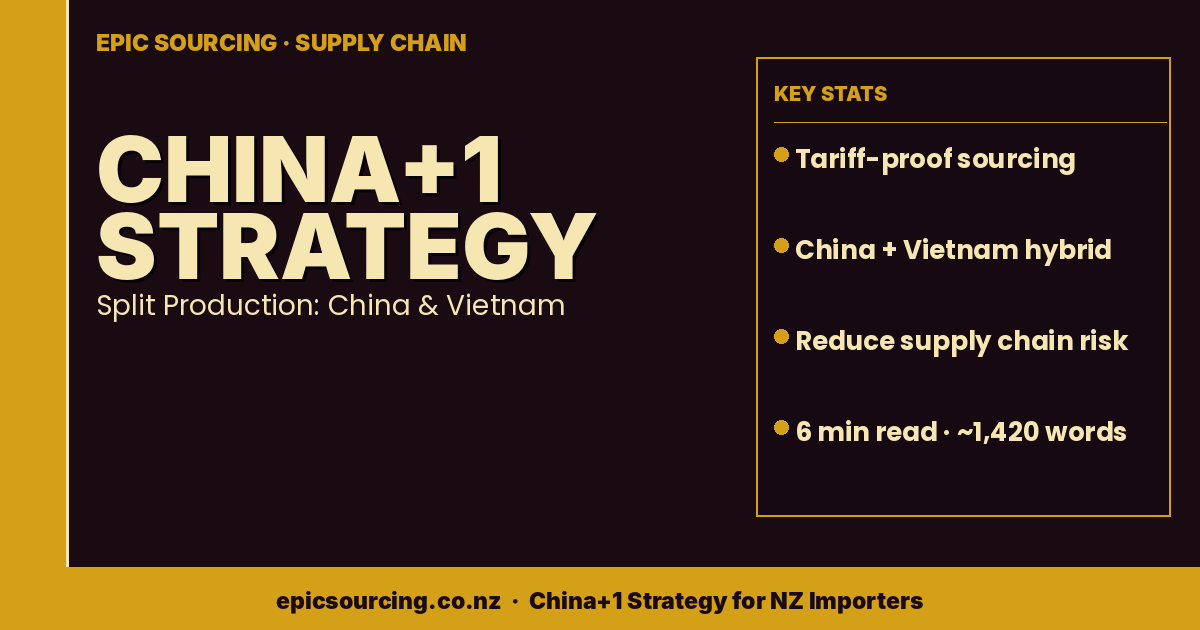
The most resilient NZ importers we work with don't put all their eggs in one basket. A dual-source strategy — maintaining relationships with both Chinese and Vietnamese suppliers for key product lines — provides excellent protection against geopolitical disruptions, capacity crunches, quality issues, and currency fluctuations.
It takes more work to manage two supply chains, but the resilience payoff is significant — especially as NZ businesses encounter peak-season freight squeezes like the current 36-38% surge in China-NZ shipping rates.
Is Now a Good Time to Explore Vietnam Sourcing?
Yes — and here's why. New industrial capacity coming online in 2026 means Vietnamese factories are actively looking for new clients to fill that capacity. That's a buyer's market, which means better pricing, more flexibility on MOQs, and suppliers eager to build long-term relationships.
That said, Vietnam isn't a magic shortcut. Due diligence matters. Verification visits (virtual or in-person) are worth the investment before placing a significant order.
Want help navigating this for your business? Epic Sourcing offers a free 30-minute consultation for Kiwi importers — no obligation, just practical advice from people who do this every day. Book your free chat at epicsourcing.co.nz.
Related Articles
Let’s Make It Epic
We're here to make sourcing simple – and a whole lot less stressful.
We are experiencing a higher volume of enquiries than usual. Our standard reply time for form submissions and emails is within 72 hours.
If your matter is urgent, please schedule a video call using the link below.
