

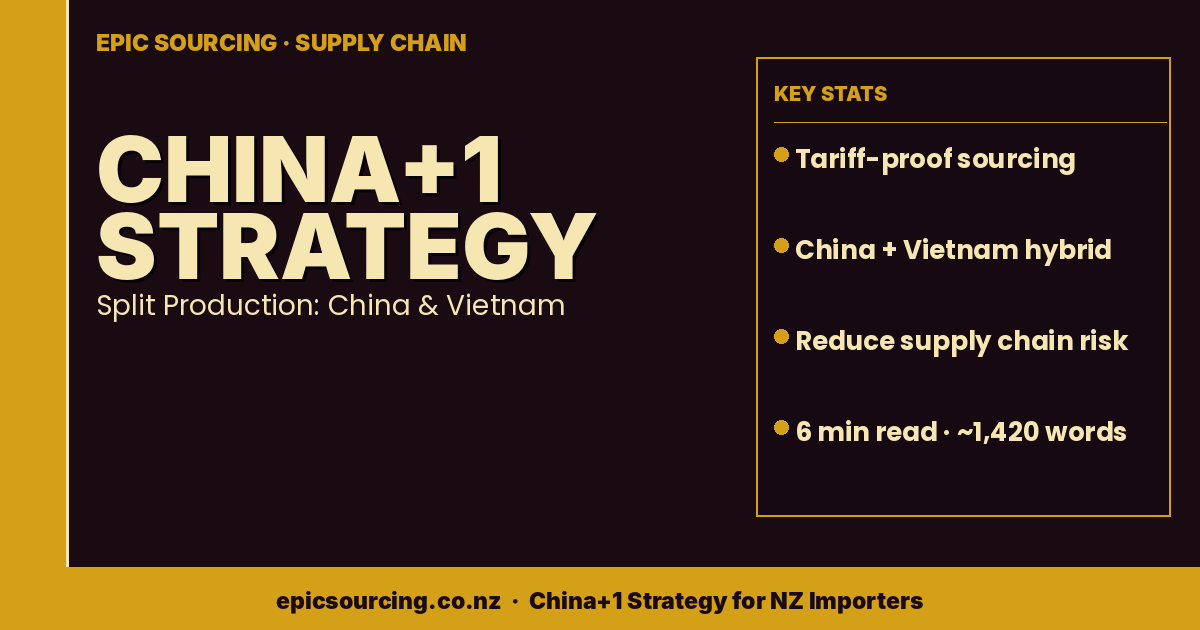
China+1 Sourcing Strategy: How NZ Importers Can Split Production Between China and Vietnam


If you've been watching the news on US tariffs lately, you're probably wondering what it all means for your importing business. Here's the short version: the tariff environment has shifted again, and smart importers — including a growing number of Kiwi brands — are responding by adopting what's called a China+1 strategy.
China+1 simply means you don't rely on a single country for all your manufacturing. You keep China for the products where it's unbeatable, and you add a second source — usually Vietnam, Bangladesh, or India — to spread your risk and reduce your exposure to tariff changes.
Let's break down how this works in practice, why it matters right now, and how NZ importers can implement it without blowing up their supply chain.
What's Changed With US Tariffs (and Why It Affects Kiwi Importers)
You might be thinking: 'I sell in New Zealand, not the US. Why do American tariffs matter to me?' Fair question. Here's why.
When the US imposes tariffs on Chinese goods, Chinese factories lose a significant customer — the world's largest economy. To compensate, they often push harder into other markets, including Australia and New Zealand, sometimes at lower prices. That sounds great, but it also means your supply chain is tangled up in geopolitical decisions made in Washington.
As of late July 2026, the US Section 122 tariff on Chinese goods expired and was immediately replaced by a new Section 301 forced-labour tariff, putting China in the 12.5% tier — on top of existing 25% product-specific tariffs. Vietnam, by contrast, sits at 12.5% for the base rate with no additional product-level Section 301 tariffs on most goods.
The tariff gap between China and Vietnam has widened. That's the number one driver behind the China+1 movement right now.
What Is the China+1 Strategy, Exactly?
China+1 doesn't mean abandoning China. It means being strategic about what you make where.
China still wins for:
- Electronics, tech accessories, and complex manufactured goods
- Highly specialised products requiring advanced tooling
- Products where scale and supplier density give China a cost advantage (e.g. plastic goods, packaging)
- Custom product development with fast-turnaround prototyping
Vietnam, Bangladesh, or India often win for:
- Apparel, activewear, and fashion (Vietnam is especially strong here)
- Furniture, rattan, and home goods (Vietnam has world-class furniture manufacturing)
- FMCG and consumer goods where labour costs are critical
- Products where your customers care about 'Made in Vietnam' vs 'Made in China' perception
The idea is to run both simultaneously — using China for what it does best, Vietnam for what it does best — so a disruption in one country doesn't flatten your whole operation.
How to Start a China+1 Strategy Without Losing Your Mind
The biggest mistake importers make is trying to move everything at once. A staged approach works much better:
- Audit your current product range. Which products are most exposed to tariff risk? Which are commodity-like enough that a second supplier could step in?
- Identify your highest-volume or highest-margin product lines. Start there — the ROI of diversification is clearest for your biggest sellers.
- Research alternative manufacturing hubs. Vietnam is the obvious pick for apparel, furniture, and FMCG. For electronics, you might look at India or Mexico. Each market has different strengths.
- Run a parallel supplier search. Don't drop your Chinese factory the moment you find a Vietnamese one. Run them in parallel, compare samples, compare pricing, and build the relationship before you commit.
- Phase the transition. Start with 20–30% of your order volume from the new market, keep 70–80% in China. As confidence builds, adjust the ratio.
Sourcing Hack #1: Request a factory visit before committing — Any reputable sourcing agency can arrange a virtual or in-person factory tour before you place your first order in a new market. This is non-negotiable for quality assurance. Don't let geography be a reason to skip due diligence.
Vietnam: The Go-To China+1 Market for NZ Importers
Vietnam has become the default China+1 destination for most NZ importers — and for good reason.
The country has invested heavily in manufacturing infrastructure over the past decade. Major industrial zones like Binh Duong, Dong Nai, and the newer Da Nang Chu Lai Open Economic Zone (two new parks just broke ground in August 2026) are expanding fast. Foreign-invested enterprises saw nearly a 6% workforce increase in early 2026, and manufacturing employment has grown for five consecutive months.
For NZ importers specifically, Vietnam offers:
- Competitive labour costs (still well below China, even after a 7.2% minimum wage increase in January 2026)
- Strong textile, apparel, and furniture manufacturing clusters
- Free trade access under RCEP, CPTPP, and bilateral agreements
- A growing pool of English-speaking factory managers and quality control staff
The Hidden Risk: Tariff Evasion Crackdowns
One thing to watch: the US has been cracking down on transshipment — where goods made in China are routed through Vietnam (or another country) to claim a different country of origin. The White House published new guidance on this in August 2026.
This matters because legitimate Vietnam-made products need to genuinely be manufactured in Vietnam, not just finished there. If you're working with a factory that offers suspiciously low 'Made in Vietnam' prices on goods that look exactly like Chinese products, ask hard questions about where the actual manufacturing happens.
Sourcing Hack #2: Ask your factory for a Certificate of Origin — A legitimate Vietnamese manufacturer can provide a Form D (ASEAN origin certificate) or C/O for export. If a factory can't or won't provide origin documentation, that's a red flag worth digging into before you commit.
What Does This Cost to Set Up?
The honest answer: there's an upfront cost in time and money to establish a second supply chain. You're looking at supplier search fees, sample orders, and potentially a factory audit or visit.
But the ongoing benefits — reduced tariff exposure, negotiating leverage with your existing suppliers, and business continuity if one market is disrupted — typically pay back the setup cost within one or two order cycles.
Epic Sourcing NZ works with clients across both China and Vietnam, so we can help you assess whether China+1 makes sense for your specific products and run the supplier search in both markets simultaneously. We have teams on the ground in both countries.
Ready to take the next step? Book a free consultation with the Epic Sourcing team at epicsourcing.co.nz and let's talk about your product and your goals. No obligation, no jargon — just real sourcing advice from people who do this every day.
Related Articles
Let’s Make It Epic
We're here to make sourcing simple – and a whole lot less stressful.
We are experiencing a higher volume of enquiries than usual. Our standard reply time for form submissions and emails is within 72 hours.
If your matter is urgent, please schedule a video call using the link below.
