.svg)
Vietnam vs China Sourcing in 2026: Which Country Should Your NZ Business Use?

.svg)
"China+1." If you've been following global supply chain news lately, you've heard this phrase a lot. It refers to the strategy of keeping China in your supply chain but adding at least one alternative country — typically Vietnam, Bangladesh, India, or Mexico — to reduce risk and, in some cases, access better tariff arrangements.
For NZ businesses importing from Asia, the practical question is simpler than it sounds: should I be sourcing from Vietnam, China, or both?
The honest answer is: it depends on your product, your volume, and what you're optimising for. So let's break it down properly.
Why Everyone's Talking About Vietnam Right Now
Vietnam has had a remarkable decade. It's gone from a secondary sourcing destination to a genuine first-choice option for a wide range of product categories. Several things are driving this:
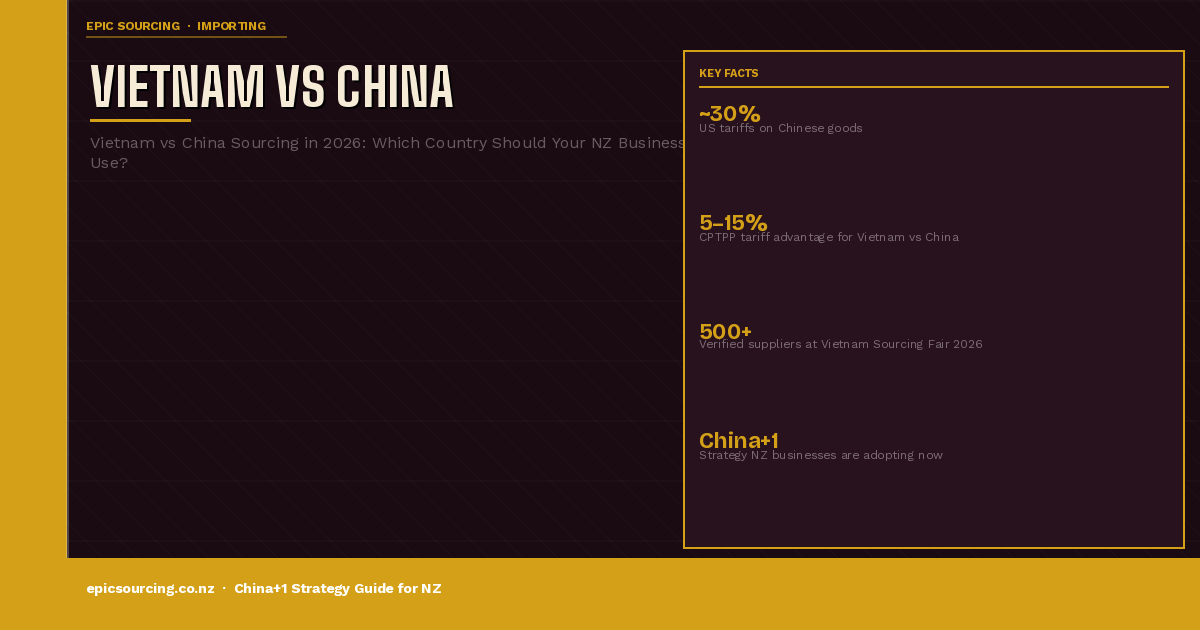
First, US tariffs on Chinese goods currently sit at around 30%, which has pushed a huge amount of manufacturing investment — and capability — from China into Vietnam. Factories that used to only exist in Guangdong or Zhejiang have set up satellite operations in Vietnam's industrial zones.
Second, Vietnam's trade agreements are genuinely excellent. Under the Comprehensive and Progressive Agreement for Trans-Pacific Partnership (CPTPP), Vietnam exports to NZ with reduced or zero tariffs on many product categories. That tariff advantage can be worth 5–15% on your landed cost — meaningful money for any business doing serious volume.
Third, the Global Sourcing Fair Vietnam 2026 (held 22–24 April) showcased over 500 verified suppliers across textiles, printing, and packaging — with 700+ booths. The supplier ecosystem is maturing fast, and the quality is following.
What Vietnam Does Really Well
Vietnam's sweet spot is textiles and light manufacturing. If you're sourcing any of the following, Vietnam is highly competitive:
- Activewear and sportswear
- Uniforms and workwear
- Swimwear and resort apparel
- Hotel and resort textiles (towels, robes, linen)
- Bags, backpacks, and soft goods
- Custom packaging (mailer boxes, retail packaging, printed materials)
Sourcing activewear from Vietnam vs China, for example, is no longer a quality trade-off — it's a cost advantage with similar quality outcomes for most brands. Labour costs are lower, quality has improved significantly over the past five years, and the trade agreement advantages make the maths compelling.
What Vietnam Doesn't Do as Well (Yet)
Here's the thing — Vietnam is excellent at textiles and light manufacturing, but it's not the right answer for everything. For consumer electronics, complex components, hard goods like ceramics and metalwork, or high-volume price-sensitive commodity products, China is still where most of the world's manufacturing capability lives.
The supply chain depth in China — the ability to source materials, components, packaging, and finished goods all within a few hours of a major industrial city — is something Vietnam simply can't match yet.
Vietnam also has capacity constraints. Its industrial zones are at or near capacity in some sectors, which means lead times can be longer than expected and MOQs (minimum order quantities) can be higher than you'd encounter with equivalent Chinese factories.
Sourcing Hack #1: For Textiles, Always Get Quotes From Both Countries — Before committing to either Vietnam or China for any apparel or textile order, get comparable quotes from both. The CPTPP tariff advantage can make Vietnam genuinely cheaper landed cost, even if the ex-factory price looks similar. Run the full landed cost calculation (factory price + freight + tariff + NZ customs) before making your decision.
The Case for Keeping China in Your Mix
Let's be clear: China isn't going anywhere. Despite the tariff pressures and the diversification trend, China remains the world's most capable, most connected manufacturing ecosystem. For NZ businesses, the China advantage is strong in several areas:
- Sheer product range — You can source almost anything from China. Whether it's bamboo sunglasses, hotel furniture, custom packaging, gym equipment, or personal care products — there's a factory for it.
- Price competitiveness at volume — For high-volume orders, China's manufacturing efficiency typically delivers the best ex-factory price.
- Supplier maturity — Many Chinese factories have been exporting for 20+ years. They understand international quality standards, documentation requirements, and the expectations of overseas buyers.
- The 1688.com factor — Alibaba's domestic B2B marketplace connects buyers directly to Chinese factories at domestic wholesale prices, opening up factory diversity and pricing transparency no other country can match.
Sourcing Hack #2: Check Your CPTPP Tariff Position Before You Order — NZ is a signatory to the CPTPP, which includes Vietnam, Malaysia, Singapore, Japan, and others. Goods manufactured in these countries can often enter NZ at reduced or zero tariff. Before you source from China for a product category where Vietnam is also viable, check the NZ tariff rate for both origins. Even a 5% tariff difference can meaningfully change your landed cost.
So Which Should You Use? A Practical Guide
Use Vietnam when:
- Your product is in textiles, apparel, or soft goods
- CPTPP tariff savings are meaningful for your category
- You want to reduce China dependency for risk management
- You're building an ethical sourcing story (Vietnamese factories tend to have stronger labour standards documentation)
Use China when:
- Your product is in electronics, hard goods, ceramics, metalwork, or complex components
- You need access to a very wide supplier base and high production flexibility
- Volume is high and price is the primary driver
- Your product requires supply chain depth (raw materials + components + finished goods in one region)
Use both when:
- You want supply chain resilience (if one country has a disruption, you have a backup)
- You're sourcing multiple product lines across different categories
- You want to test Vietnam's quality and lead times without fully committing
What This Looks Like for NZ Businesses Right Now
The businesses we're seeing do this well in 2026 aren't making an either/or choice — they're building a dual-country supply chain. Their hotel textiles come from Vietnam. Their furniture comes from Foshan, China. Their electronics from Shenzhen. Their packaging developed with a Vietnam printing specialist.
It takes more supplier management, but the combination of cost efficiency, risk diversification, and tariff optimisation is worth it for businesses doing serious volume.
Not sure where to start? That's exactly what we're here for. Book a free consultation with the Epic Sourcing team and we'll help you map out the right sourcing country strategy for your specific products and business goals.
Related Articles
Let’s Make It Epic
We're here to make sourcing simple – and a whole lot less stressful.
We are experiencing a higher volume of enquiries than usual. Our standard reply time for form submissions and emails is within 72 hours.
If your matter is urgent, please schedule a video call using the link below.
