.svg)
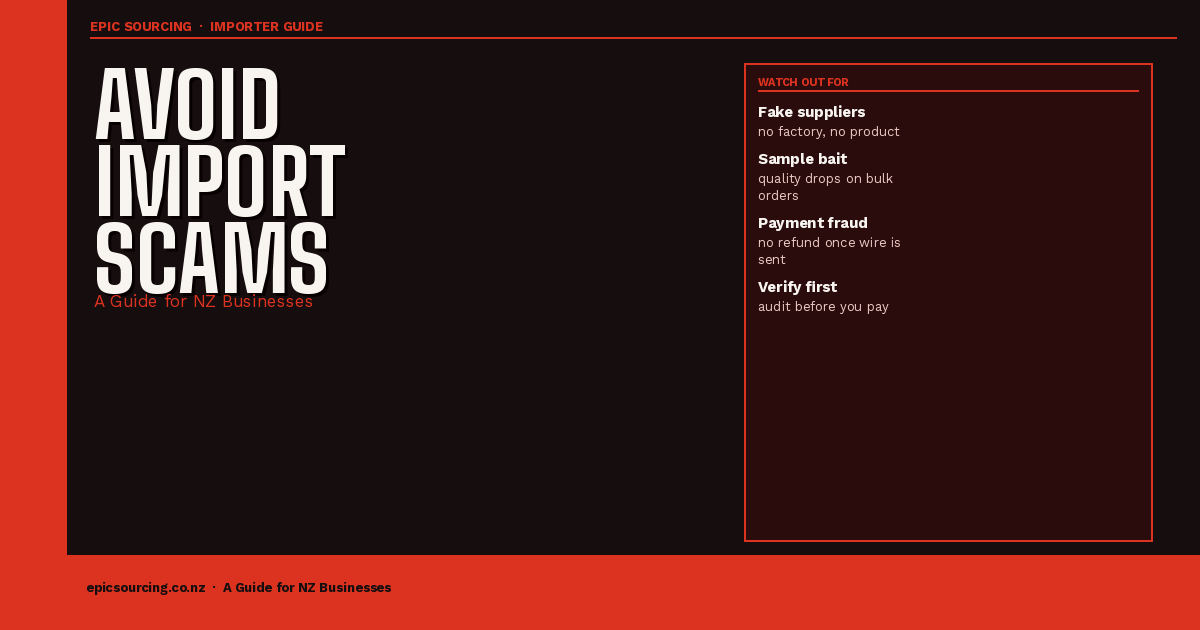
Avoiding Import Scams: A Guide for New Zealand Businesses
.jpg)
.svg)
Last updated: August 2026
The most common import scam targeting Kiwi buyers is a fake supplier who collects a deposit and disappears. It happens more than most people admit, and it doesn't just catch inexperienced buyers. Professional-looking websites, fast email responses, and Alibaba Gold Supplier badges have all been used to run convincing scams that have cost NZ businesses thousands of dollars.
This guide covers the most common import scams targeting New Zealand businesses, how to spot them before you wire any money, and the red flags to check before you commit to any new supplier.
What Are the Most Common Import Scams Targeting NZ Buyers?
A handful of patterns show up again and again. Knowing them in advance is half the battle.
The ghost supplier. A factory with a professional website, an Alibaba store, and fast email responses takes your deposit and either disappears entirely or sends you a fraction of what was ordered. By the time you realise what's happened, they've blocked you.
The bait-and-switch. You approve a high-quality sample, pay in full, and receive a shipment of significantly inferior goods. The sample was made properly to win your order; the production run itself was cut-price.
The fake trading company. Someone presents themselves as a factory but is a middleman with no real control over production. Not always a scam outright, but it leaves you with no visibility into who made your product or what quality standards they hold.
Business Email Compromise (BEC). A fraudster intercepts your email thread with a real supplier and sends updated payment instructions pointing to their own account. You think you're paying the factory. You're paying a scammer. This one is particularly nasty because you've done everything right, as it's the communication channel that's been compromised.
The advance fee scam. You're told your shipment is held at customs and you need to pay a release fee. The fee is fabricated. No legitimate customs process works this way.
How Do You Check If a Supplier Is Legitimate?
Verification is the most important step you can take, and it doesn't have to be complicated.
Start with a video call. Ask to see the factory floor via Zoom or WeChat Video. A legitimate manufacturer will accommodate this without hesitation. A scammer operating from an apartment will make excuses or send stock footage.
Verify their business registration. In China, you can check a factory's registration via the National Enterprise Credit Information Publicity System. Ask the supplier for their Unified Social Credit Code and verify it yourself. A legitimate factory has nothing to hide.
Pay for a factory audit. A third-party verification company like SGS or Bureau Veritas can visit the factory and confirm it exists, is operating, and can produce what you've ordered. For a first substantial order, this is worth every dollar.
Reverse image search their product photos. Stock images used on fake supplier sites frequently appear on dozens of other listings. If their product photos show up on AliExpress, Amazon, or unrelated sites, that's a warning sign.
Sourcing Hack #1: Before placing any first order, request a short video of the factory floor with a piece of paper showing today's date and your company name. It takes the supplier 10 minutes to produce. A legitimate factory won't object. A scammer can't fake it.
Free Download: Manufacturer Red Flags Checklist
12 warning signs to check before you wire a cent to any new overseas supplier. Don't place a first order without it.
Download the Free ChecklistWhat Red Flags Should You Watch For in Supplier Communications?
Scammers follow patterns. These are the ones that should make you stop and think.
Prices that seem too good to be true. If a quote comes in dramatically below every other supplier, ask why. It might be a material substitution, a production shortcut, or simply a hook to get your deposit.
Pressure to move fast. A genuine factory isn't going to cancel your order if you take three extra days to do due diligence. Anyone insisting you wire money today is managing you, not serving you.
Requests for payment via Western Union, MoneyGram, or cryptocurrency. These are irreversible, untraceable transfer methods. No legitimate manufacturer operating at B2B scale uses them.
Inconsistent contact details. Email addresses that don't match the company domain, phone numbers that go to personal mobiles, addresses that don't appear on Google Maps, all worth flagging.
Reluctance to sign a purchase order. A professional supplier will sign a purchase order outlining product specs, quantities, pricing, and timelines. Resistance to putting things in writing is a major red flag.
Sourcing Hack #2: Run the supplier's email domain through a basic WHOIS lookup. If a company claiming to be a 10-year-old manufacturer has a domain registered six months ago, something doesn't add up.
What Should You Do If You've Already Been Scammed?
It happens, even to experienced importers. Don't let embarrassment slow you down. Speed matters here.
Contact your bank immediately. If you paid by bank wire, report it as a fraudulent transfer within 24 hours. Banks have fraud recovery processes, and after 48 hours, international wire recovery becomes significantly harder.
Report it to CERT NZ. CERT NZ (cert.govt.nz) is New Zealand's cyber security agency and handles business fraud cases including import scams. A report creates an official record and helps build cases against repeat offenders.
File a police report. Even if recovery seems unlikely, an official record matters for insurance claims and potential legal action.
If you paid via Alibaba Trade Assurance, open a dispute immediately through the platform. Trade Assurance disputes are time-sensitive.
Sourcing Hack #3: Screenshot everything from the first contact. Every email, WeChat message, product listing, and invoice. If something goes wrong, documentation is what makes recovery possible.
How Do You Source Safely Going Forward?
The easiest way to avoid import scams is to work with someone who already knows the terrain. A sourcing company with employed staff on the ground in your sourcing country can physically verify factories, conduct pre-shipment inspections, and build relationships with manufacturers they've personally vetted. They've seen the scam patterns before and know which warning signs to take seriously before any money changes hands.
If you're going direct, the minimum safe practice is: verify the factory independently, use Trade Assurance for Alibaba orders, never pay 100% upfront, use a 30/70 split payment structure (30% deposit, 70% after pre-shipment inspection), and never release the balance based on the supplier's say-so alone.
Frequently Asked Questions
What is the most common import scam targeting NZ businesses?
The most common is the ghost supplier scam: a fake or non-operational factory collects a deposit and disappears, or sends goods that bear no resemblance to what was ordered. Business Email Compromise, where a scammer intercepts your payment instructions, is a close second and is particularly dangerous because it can target buyers who have done their due diligence on the supplier itself.
How do I verify a Chinese supplier is legitimate?
Ask for their Unified Social Credit Code and check it on China's National Enterprise Credit Information Publicity System. Request a video call showing the factory floor with a date-stamped identifier. Pay for a third-party factory audit from SGS or Bureau Veritas. And ask to sign a formal purchase order — a legitimate supplier will have no objection.
Is Alibaba safe for importing to New Zealand?
Alibaba itself is a legitimate platform, but not all suppliers on it are. Trade Assurance suppliers offer more protection than non-verified listings. Always verify independently before placing a significant first order, use Trade Assurance for payment, and check supplier reviews and transaction history. Gold Supplier badges are paid memberships, not quality endorsements.
What should I do if I've been scammed by an overseas supplier?
Contact your bank immediately (within 24 hours if possible), report to CERT NZ at cert.govt.nz, file a police report, and if you paid via Alibaba Trade Assurance, open a dispute on the platform straight away. Speed matters; the sooner you act, the better your chances of recovery.
Can I get my money back if I've been scammed?
It depends on the payment method and how quickly you act. Bank wire transfers reported within 24 to 48 hours have the best chance of recovery. Alibaba Trade Assurance disputes can result in refunds. Western Union, MoneyGram, and cryptocurrency payments are almost never recoverable. Credit card payments may have chargeback options worth exploring.
How does a sourcing agent protect me from import scams?
A sourcing agent with employed staff in the sourcing country can physically verify factories, conduct pre-shipment inspections, and build ongoing relationships with manufacturers they've personally vetted. They've also seen the scam patterns before, and know which warning signs to take seriously before any money changes hands.
Free Download: Manufacturer Red Flags Checklist
12 warning signs to check before you wire a cent to any new overseas supplier. Don't place a first order without it.
Download the Free ChecklistStay in the Loop
Get weekly sourcing tips, market updates, and supplier insights from the Epic Sourcing team, delivered straight to your inbox.
Subscribe to the NewsletterBy TK Wang, Director and Supply Chain Manager at Epic Sourcing New Zealand, helping Kiwi businesses source smarter and avoid the mistakes that cost real money.
Related Articles


Let’s Make It Epic
We're here to make sourcing simple – and a whole lot less stressful.
We are experiencing a higher volume of enquiries than usual. Our standard reply time for form submissions and emails is within 72 hours.
If your matter is urgent, please schedule a video call using the link below.
