.svg)
El Niño 2026: What NZ Importers Need to Know About Supply Chain Disruption

.svg)
If you're importing products into New Zealand right now, you've probably noticed things are a little... unpredictable. Shipping lead times fluctuating. Port congestion appearing out of nowhere. Suppliers hinting at production delays. Some of it is business as usual. But in 2026, there's a larger force at play: El Niño.
El Niño — the periodic warming of Pacific Ocean surface temperatures — doesn't just mean dry summers for Kiwi farmers. For importers, it can mean disrupted logistics corridors, stressed manufacturing capacity, and unexpected cost spikes right across the supply chain. Understanding what's happening and why puts you ahead of most of your competitors who are still just reacting.
Let's break down exactly how El Niño is affecting global supply chains in 2026, what that means for NZ businesses importing from China, Vietnam, and Southeast Asia, and what you can do about it.
1. How El Niño Disrupts Global Shipping Routes
The Panama Canal is one of the world's most critical shipping shortcuts. It connects the Pacific and Atlantic oceans, handling around 5% of global maritime trade. Here's the problem: the canal relies heavily on freshwater reservoirs to operate its locks — and during El Niño years, rainfall in Central America drops dramatically.
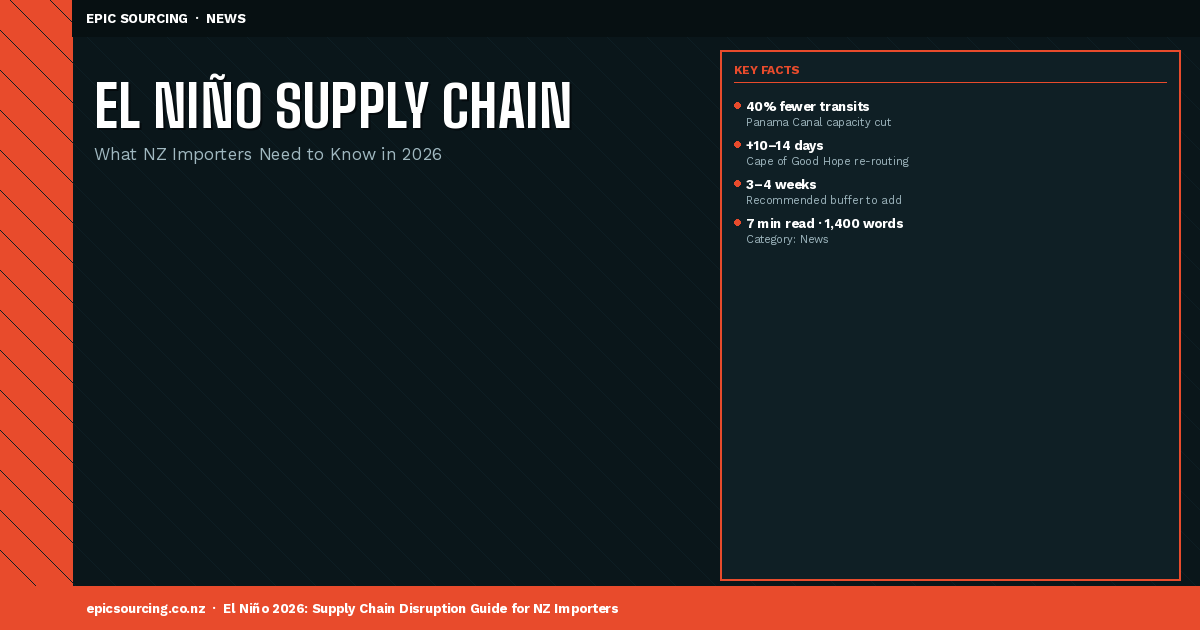
In 2023–24, the last significant El Niño event forced the Panama Canal Authority to impose vessel weight restrictions and reduce daily transits by up to 40%. The result? Shipping delays of two to four weeks for goods travelling from Asia to the US East Coast and Europe, with knock-on effects felt worldwide — including for NZ importers whose suppliers were managing backed-up production queues and delayed inbound materials.
In 2026, conditions are again being monitored carefully. Shipping lines are already re-routing some vessels around the Cape of Good Hope (adding 10–14 days) or choosing different loading ports. That affects freight rates, vessel availability, and ultimately your lead times.
Sourcing Hack #1: Build Buffer Into Your Lead Times — Add 3–4 weeks to your standard import lead time estimates when ordering through the second half of 2026. Tell your customers and retail buyers to expect slightly longer delivery windows. Under-promise and over-deliver — it's much better than scrambling to explain a two-week delay after the fact.
2. Manufacturing Disruptions in Southeast Asia
El Niño doesn't just affect the ocean — it reshapes weather patterns across the Asia-Pacific manufacturing belt. Vietnam, Thailand, and parts of southern China experience hotter, drier conditions. That affects energy grids (hydropower contributes significantly to Vietnam's electricity supply), water availability for industrial use, and worker conditions in factories without adequate cooling.
In practical terms, this can mean factories running at reduced capacity during peak heat periods, unscheduled downtime, and longer production lead times. For NZ importers working with Vietnamese factories on textiles, furniture, or footwear, it's worth building these risks into your planning now.
Sourcing Hack #2: Ask Your Supplier About Their Contingency Capacity — When placing orders, ask your supplier directly: 'What happens to our production timeline if you face an energy or weather disruption?' A reliable factory will have a clear answer. If they look blank, that's a red flag worth noting before you commit large volumes.
3. Freight Rate Volatility — What to Expect
Freight rates are never static, but El Niño years historically correlate with increased volatility. When shipping lines re-route vessels around the Cape of Good Hope, they're burning more fuel, occupying ships for longer, and removing capacity from key trade lanes. Fewer ships on your route plus the same demand equals higher rates.
Mid-2026 rates have been elevated compared to the 2023 lows but remain well below the 2021–22 pandemic peaks. The smart play is to lock in rates where possible for planned shipments, use a freight forwarder who can advise on route options, and avoid leaving large orders until the last minute when spot rates spike.
4. Agricultural Inputs and Raw Material Delays
If you're importing products with natural material inputs — cotton clothing, bamboo goods, timber furniture, natural rubber — El Niño-driven droughts in producing regions can squeeze supply and push raw material costs higher. This often takes 6–12 months to flow through to finished goods pricing.
Cotton production in India and Pakistan (key global suppliers) is particularly sensitive to monsoon disruption, which El Niño affects significantly. Bamboo and timber from Vietnam and parts of China can also see price pressure if growing conditions are stressed.
Sourcing Hack #3: Request a Price Lock Clause for Long Orders — For any order with a production run exceeding 60 days, ask your supplier to include a price lock clause or at least a cap on raw material surcharges. Many factories will accommodate this if you ask — they rarely offer it proactively.
5. What Smart NZ Importers Are Doing Right Now
The businesses that weather supply chain disruption best aren't necessarily the biggest — they're the most prepared. Here's what experienced NZ importers are doing right now:
- Ordering higher quantities earlier than planned to buffer against lead time blowouts
- Diversifying across two or three factories rather than relying on a single supplier
- Shifting more volume to sea freight while keeping air freight for urgent top-up orders
- Building stronger relationships with suppliers to get priority treatment during capacity crunches
- Using a local sourcing agent to monitor factory capacity and flag issues before they become crises
6. The Upside — Opportunity for Nimble NZ Businesses
Here's something people don't talk about enough: supply chain disruption creates opportunity. When lead times blow out and costs rise, some importers panic and exit markets. Others use the disruption as cover to renegotiate with suppliers, explore alternative manufacturers, or launch products their competitors have delayed.
If you're a small or medium NZ business with a flexible approach to sourcing — willing to explore Vietnam as a complement to China, open to different product specifications, not locked into a single supplier — 2026's El Niño-affected supply chain environment might actually be a good time to move.
Book Your Free Consultation
Ready to start sourcing smarter? Epic Sourcing offers a free, no-obligation consultation for Kiwi businesses looking to import products from China, Vietnam, or beyond. Whether you're at the idea stage or ready to place your first order, we'd love to have a chat. Book your free consultation at epicsourcing.co.nz — no sales pressure, just straight-up sourcing advice from people who've done it thousands of times.
Related Articles


Let’s Make It Epic
We're here to make sourcing simple – and a whole lot less stressful.
We are experiencing a higher volume of enquiries than usual. Our standard reply time for form submissions and emails is within 72 hours.
If your matter is urgent, please schedule a video call using the link below.
