
.svg)

China to NZ Shipping Rates Are Up 30%: What Kiwi Importers Need to Do Right Now

.svg)
If you've been getting freight quotes recently and doing a double-take at the numbers — you're not imagining it. China-to-NZ sea freight rates have jumped significantly in May 2026, and the outlook suggests they'll stay elevated for a while. If you're an importer, this directly affects your landed costs, your margins, and your ability to plan ahead.
The good news? This isn't a crisis — it's a planning problem. And planning problems have solutions. Let's break down what's happening, why, and what you can actually do about it.
What Are the Current China–NZ Freight Rates?
Here's the latest data as at May 2026:
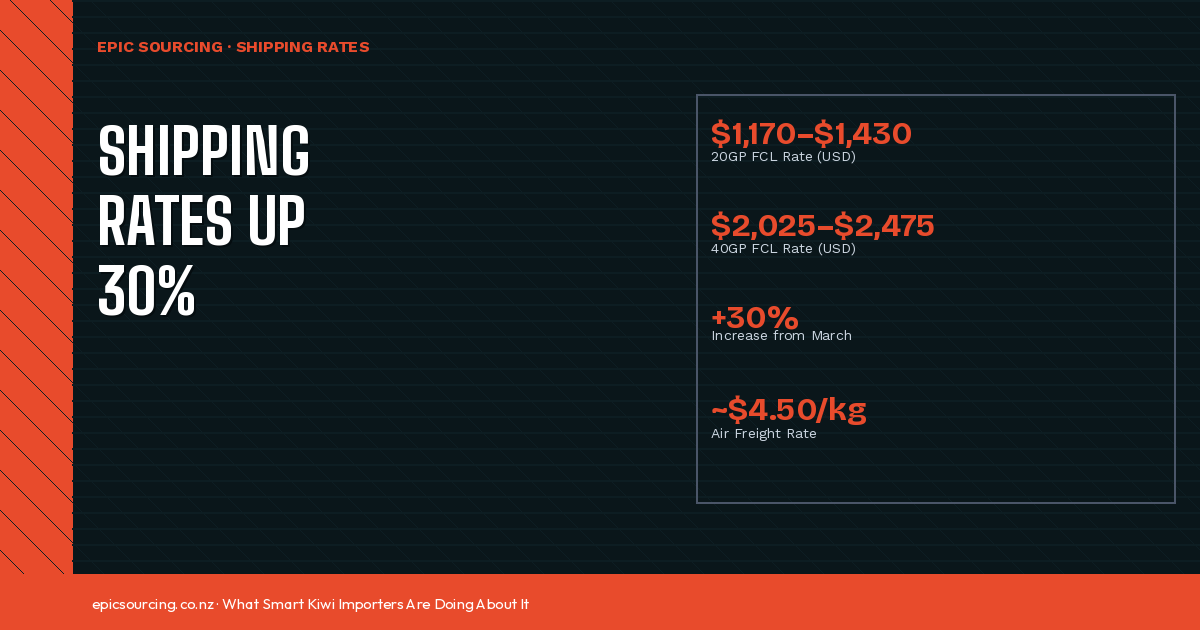
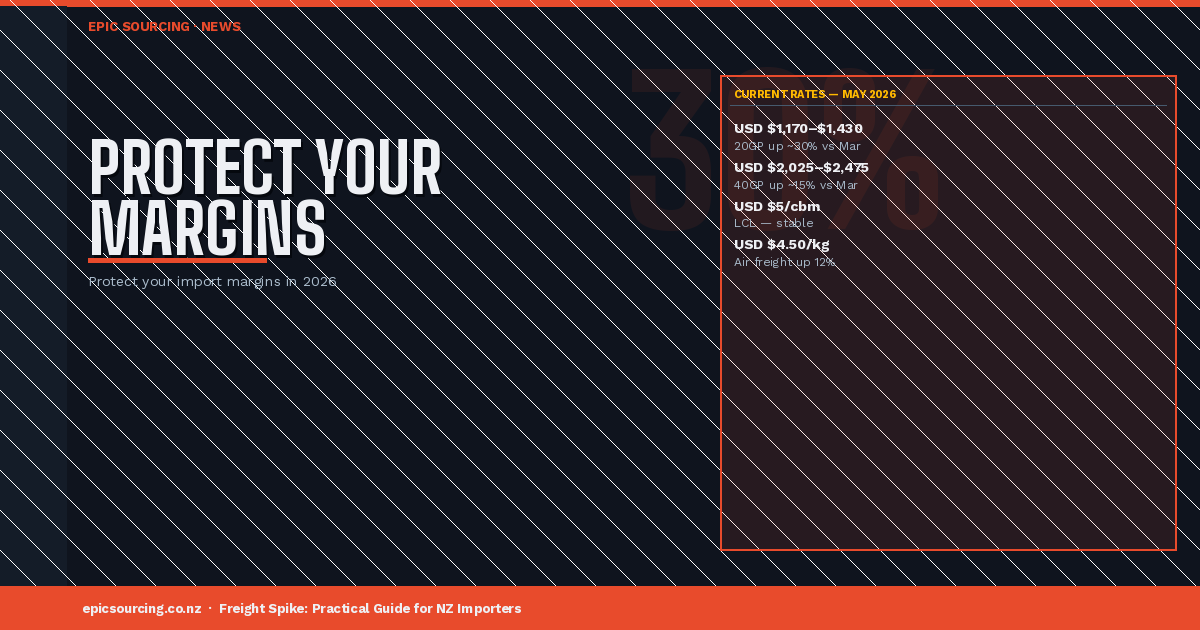
- 20GP (20-foot container): USD $1,170–$1,430 — up ~30% vs March 2026
- 40GP (40-foot container): USD $2,025–$2,475 — up ~15% vs March 2026
- LCL (Less than Container Load): USD $5/cbm — stable
- Air freight: USD $4.50/kg — up ~12%
- Express courier: USD $7.55/kg — up ~12%
Transit times on sea freight are running 20–23 days for FCL and 25–30 days for LCL. Air freight is still your fastest option at 7–9 days, with express cutting that to 3–5 days — but you'll pay for the speed.
Sourcing Hack #1: Get a Rate Lock — Some freight forwarders will lock in a rate for a booking made today with a shipment date 4–6 weeks out. If you know you have stock coming, book now and lock the rate — don't wait until you're ready to ship.
Why Have Rates Gone Up?
A few things are happening simultaneously on the China–NZ corridor:
- US–China trade war displacement: With US tariffs on Chinese goods sitting around 30% (and having been as high as 145% on some categories), many ships that would've carried China–US cargo have been redeployed to other trade lanes — including Asia–Pacific routes to NZ and Australia. Increased vessel demand on this lane = higher rates.
- Post-COVID capacity games: Shipping lines have gotten better (from their perspective) at managing capacity. When demand ticks up even slightly, rates respond fast.
- Seasonal pre-ordering: May–June tends to be when Kiwi importers are placing orders for Q3/Q4 arrival. More bookings competing for the same space.
- Global port congestion: Conflict-related rerouting and general supply chain fragility have tightened available vessel capacity.
NZ freight forwarders are consistently advising: book earlier, secure your space, and don't rely on last-minute capacity being available at reasonable rates.
How Does This Hit Your Import Economics?
Let's put this in real terms. Say you're importing a 40GP container of furniture from Foshan. In March, that sea freight leg cost you around USD $1,750. Today, it's closer to USD $2,200–$2,400. That's an extra NZD $700–$1,000 on just the freight for a single container — not business-ending, but definitely margin-affecting, especially if you've already quoted customers on landed prices.
For smaller importers using LCL, the news is actually okay — LCL rates have stayed stable at around USD $5/cbm. If you're shipping partial loads, LCL remains a cost-effective option and is less exposed to the current FCL volatility.
Sourcing Hack #2: Consider LCL for Smaller Orders — If you're importing under ~10–12 CBM, LCL is almost always more cost-effective than booking a full 20GP. And right now, with FCL rates volatile, LCL's stability is an extra bonus. Talk to your freight forwarder about whether your shipment size suits LCL.
What Should Importers Do Right Now?
- Book space early — Secure your shipping slot before you actually need it. Freight forwarders are advising 4–6 weeks' lead time for bookings.
- Consolidate shipments where possible — Instead of multiple small shipments, batch your orders to fill a 40GP container. Economies of scale still work in your favour.
- Review your LCL vs FCL threshold — If your shipments are growing in volume, there's a break-even point where FCL becomes cheaper per CBM than LCL. Know where that is for your business.
- Factor freight into new pricing — If you're quoting customers on new product lines, use current freight rates, not rates from 3–6 months ago. Build in a 10–15% freight contingency.
- Ask your supplier about price flexibility — Suppliers in China are aware of the freight situation. Some may be willing to adjust FOB pricing or help consolidate shipments to reduce costs.
- Explore air for high-margin items — For products with high enough margins (e.g. fashion accessories, electronics), air freight at USD $4.50/kg can still pencil out while avoiding freight uncertainty.
Is Air Freight Worth Considering?
Air freight costs are also up — around 12% vs earlier this year. At USD $4.50/kg, it's not cheap. But for the right product categories, it makes sense: high-margin fashion items (activewear, accessories, limited editions), time-sensitive seasonal products, small lightweight samples, and emergency restocks when stock runs out unexpectedly.
If your product weighs under 30kg total and has a retail value of more than NZD $50/unit, run the air freight numbers. You might find the speed and certainty is worth the premium, especially right now when FCL rates are unpredictable.
What Does Epic Sourcing Recommend for Our Clients?
For clients currently in active sourcing projects, we're recommending: submitting production confirmations and payment early so shipments can be booked 4–6 weeks ahead; considering consolidating multiple suppliers' stock into a single container where possible (we can coordinate this); and for eCommerce and fashion clients with smaller, more frequent orders, using LCL or air freight depending on your volume and speed requirements.
Freight is one of the most dynamic parts of the import equation — and often the most overlooked when budgeting. Getting this right can make a real difference to your bottom line.
Want to talk through your importing strategy with someone who knows the NZ market inside out? Book a free consultation with the Epic Sourcing team at epicsourcing.co.nz — no pressure, just good advice.
Related Articles


Let’s Make It Epic
We're here to make sourcing simple – and a whole lot less stressful.
We are experiencing a higher volume of enquiries than usual. Our standard reply time for form submissions and emails is within 72 hours.
If your matter is urgent, please schedule a video call using the link below.
