
.svg)
The True Cost of Importing from China to NZ in 2026: What Every Kiwi Importer Needs to Know

.svg)
There's a question we get asked constantly by NZ businesses who are new to importing: "How much does it actually cost?" And the honest answer is — a lot more than just the product price.
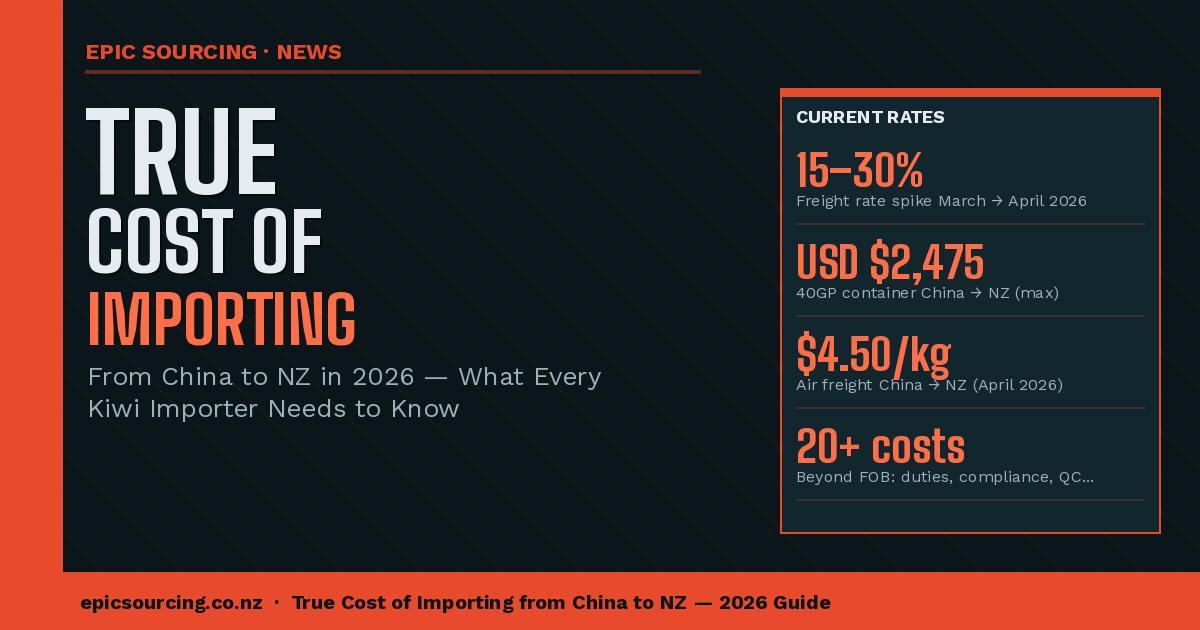
In 2026, the landscape for NZ importers has shifted noticeably. Freight rates have jumped 15–30% from March to April. New cost categories like compliance fees, geopolitical risk premiums, and cost of capital are factoring into landed costs for the first time. And with the NZ dollar doing its own thing, margins can evaporate fast if you haven't done your homework.
Whether you're importing for the first time or you've been doing it for years and feel like the goalposts have moved — this guide is your complete breakdown of what importing from China to NZ actually costs in 2026. Let's get into it.
Step One: The Product Price — But Not the One You Think
When a Chinese factory quotes you a price, they're usually quoting FOB (Free On Board) — meaning the cost of the goods plus getting them to the port of departure. It's a useful baseline, but it's nowhere near your total cost. Think of FOB as the starting line, not the finish.
Before the goods even leave China, you might also have:
- Sample fees — usually refundable on order, but sometimes not
- Product development / tooling costs — for custom designs or moulds
- Quality inspection fees — typically USD $200–350 per inspection day
- Export documentation fees — charged by your supplier or their freight agent
These pre-shipment costs can range from negligible (standard off-the-shelf products) to significant (custom tooled goods with inspection requirements). Know what you're paying for before you sign off on production.
The Big One: Freight Costs in April 2026
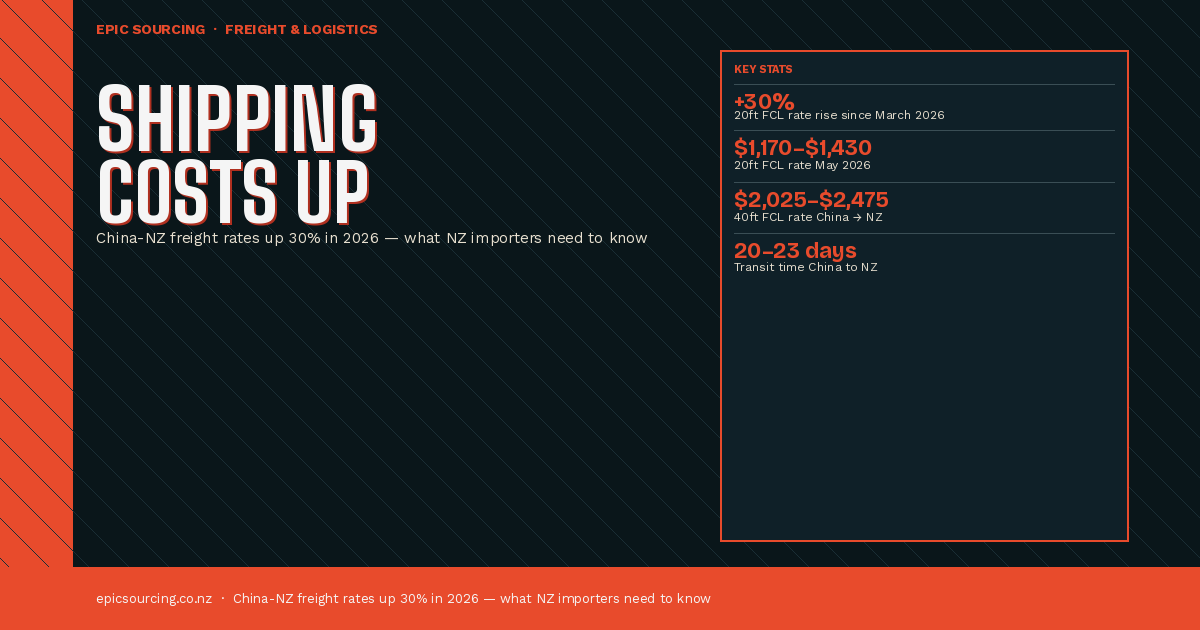
This is where things have shifted most noticeably. Here are the current rates from China to New Zealand as of April 2026:
- China-NZ 20GP container: USD $1,170–$1,430 (up 30% from March)
- China-NZ 40GP container: USD $2,025–$2,475 (up 15% from March)
- China-NZ LCL (Less than Container Load): ~$5 per cbm (stable)
- China-NZ Air Freight: $4.50/kg (up 12% from March)
The spike is being driven by US-Iran geopolitical tensions constraining bunker fuel supply, Maersk's emergency fuel surcharges of up to USD $200 per container, and strong buyer activity following Chinese New Year. These aren't temporary blips — plan for elevated rates through at least mid-2026.
Sourcing Hack #1: Always Get a Current Freight Quote Before Pricing Your Product — Freight quotes from even 4–6 weeks ago are out of date right now. Before you finalise your product pricing or quote a client, call your freight forwarder for a live rate. The difference between an old quote and today's rate could easily be $400–600 on a 40-foot container.
Import Duties and GST
Once your goods arrive in NZ, Customs will assess import duties and GST. Here's how it breaks down:
- Import duties: Vary by product category and HS code — typically 0–10% in NZ
- GST: 15% applied on the CIF value (cost + insurance + freight) plus duties
- Border processing levies: Small fees charged by NZ Customs for processing
- MPI (biosecurity) fees: Apply if your goods contain organic materials, wood, textiles, or soil — can range from $25 to several hundred dollars
The good news: the AANZFTA upgrade streamlines tariff preferences for certain categories. Check your HS codes against the tariff schedule — you may qualify for preferential rates.
The Hidden Costs That Bite First-Timers
Beyond freight and duties, there's a category of costs that catch new importers by surprise:
- Customs brokerage fees: NZD $150–400 per shipment for a licensed broker to clear your goods
- Port handling charges (THC): Typically NZD $200–400 at the destination port
- Delivery to door: From the port to your warehouse — depends on distance and volume
- Warehousing: If you can't receive immediately, storage costs add up fast
- Product compliance: Electronics, children's toys, and textiles may require NZ compliance testing before sale
- Geopolitical risk premium: In 2026, more sophisticated importers are building a 3–5% risk buffer into their costings
Sourcing Hack #2: Build a Landed Cost Spreadsheet Before Every Order — Before you confirm any new product order from China, build a simple landed cost model: FOB price + freight + duties + GST + compliance + delivery. Then add a 10–15% buffer for the unexpected. If the final number still works for your margin, you're good. If not, negotiate harder on the product price or find a different supplier.
Currency Risk: The Factor Everyone Underestimates
Most Chinese suppliers quote in USD. NZ importers pay in NZD. The exchange rate between these two currencies can move 5–10% over the course of a production and shipping cycle — which is easily enough to swing a profitable order into a marginal one.
Strategies for managing currency risk include: paying supplier deposits quickly to lock in a favourable rate, using a currency hedging service or forward contract through your bank, and keeping a small USD reserve for faster payment when the rate is good.
How to Calculate Your True Landed Cost
Here's a practical formula to work from:
- Start with FOB price (in NZD at current exchange rate)
- Add: International freight (current quoted rate)
- Add: Marine insurance (~0.3–0.5% of CIF value)
- Add: Import duty (check NZ Customs tariff for your HS code)
- Add: GST (15% of CIF + duty)
- Add: Customs brokerage (~$250–350)
- Add: Port handling + delivery (~$400–700)
- Add: Compliance / inspection costs (if applicable)
- Add: 10–15% buffer
- = Your Landed Cost per shipment
Is Importing from China Still Worth It in 2026?
Emphatically, yes — for the right products and at the right volumes. Even with elevated freight rates and rising compliance costs, the manufacturing cost advantage of Chinese factories is substantial. A product that costs NZD $50 retail made locally might land from China at NZD $8–15, leaving meaningful margin even after all the costs outlined above.
The key is going in with your eyes open. Use current numbers, build a realistic landed cost model, and don't let supplier enthusiasm short-circuit the financial analysis.
Not sure if your numbers stack up? At Epic Sourcing, we work with NZ businesses every week to sense-check their importing economics and find ways to reduce landed costs without compromising on quality. Book your free consultation at epicsourcing.co.nz — it costs nothing and could save you thousands.
Related Articles


Let’s Make It Epic
We're here to make sourcing simple – and a whole lot less stressful.
We are experiencing a higher volume of enquiries than usual. Our standard reply time for form submissions and emails is within 72 hours.
If your matter is urgent, please schedule a video call using the link below.
