.svg)
FOB vs EXW vs CIF Explained: Which Incoterm Saves NZ Importers the Most Money?
.jpg)
.svg)
Three Letters That Can Make or Break Your Import Margins
You've found a supplier in China. They send you a price sheet. At the top of the quote, somewhere near the unit price, you see one of these: EXW $18.50, or FOB $21.00, or CIF $24.30.
Most new importers glance past these terms, assume the lowest number is the best deal, and move on. That's a costly mistake.
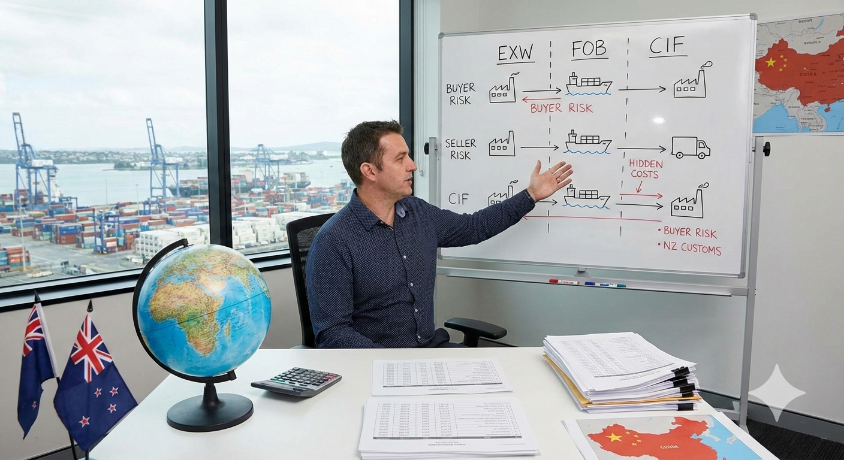
Incoterms — short for International Commercial Terms — are a set of globally recognised rules that define exactly where the seller's responsibility ends and the buyer's begins. They determine who pays for what, who arranges what, and critically, who carries the risk if something goes wrong in transit.
Choosing the wrong Incoterm, or not understanding the one your supplier is quoting, can mean unexpected costs, uninsured losses, or paying significantly more than you needed to for logistics you could have controlled yourself.
This guide covers the three Incoterms NZ importers encounter most often — EXW, FOB, and CIF — in plain English, with real numbers and practical advice for New Zealand businesses.
A Quick Note on Incoterms
Incoterms are published by the International Chamber of Commerce (ICC) and are updated periodically — the current version is Incoterms 2020. There are 11 Incoterms in total, covering everything from pure land transport to multimodal international shipping. For most NZ importers dealing with Chinese suppliers, the three that matter are EXW, FOB, and CIF. We'll cover those three in depth, with a brief mention of DDP at the end because it comes up more often than people expect.
EXW — Ex Works
What it means
Under EXW (Ex Works), the seller's only obligation is to make the goods available at their premises — typically the factory or warehouse. Everything else is the buyer's problem: arranging collection from the factory, inland transport to the export port, export customs clearance in China, loading onto the vessel, international freight, insurance, import duties, and delivery to your door in New Zealand.
In other words, EXW is the absolute minimum the seller will do. You take responsibility the moment the goods are ready at the factory gate.
What this looks like in practice
Your supplier in Ningbo quotes you EXW ¥85 per unit. That price covers manufacturing and having the goods ready for collection. You (or your freight forwarder) need to arrange:
- A truck to collect from the factory and deliver to Ningbo port
- Export customs declaration in China
- Container stuffing and port handling fees
- International sea freight to Auckland
- Marine insurance
- NZ import customs clearance
- Biosecurity compliance and any MPI inspections
- Delivery from Auckland port to your warehouse
The upside of EXW
EXW gives you maximum control over the entire logistics chain. You choose your own freight forwarder, negotiate your own freight rates, and aren't paying a markup on logistics costs built into your supplier's quote. For experienced importers with established freight forwarder relationships, this control can translate into meaningful cost savings.
The downside of EXW
EXW is genuinely complicated for buyers who don't have an established freight forwarder with China-side operations. Arranging export customs clearance in China as a foreign buyer is particularly tricky — you typically need a local agent with the authority to lodge export declarations, which your freight forwarder should be able to provide, but it adds a layer of complexity.
There's also a risk gap: under EXW, you carry the risk from the factory gate. If goods are damaged while being loaded at the factory, or during trucking to the port, that's your problem. For new importers, this exposure can be uncomfortable.
Best for: Experienced importers with trusted freight forwarder relationships, large volume shipments where logistics cost savings are significant, or buyers who want complete control over their supply chain.
FOB — Free on Board
What it means
Under FOB (Free on Board), the seller is responsible for delivering the goods to the named port of shipment and loading them onto the vessel. Once the goods are on board the ship, risk and responsibility transfer to the buyer.
This means the supplier handles inland trucking in China, export customs clearance, and port handling up to and including loading. You take over from the moment goods are on the ship — arranging international freight, insurance, NZ import clearance, and local delivery.
What this looks like in practice
Your supplier quotes FOB Shenzhen $21.00 per unit. That price includes the product plus all costs to get it loaded onto a vessel at Shenzhen port. Your freight forwarder then takes over for the ocean leg to Auckland.
Your additional costs from that point: international sea freight, marine insurance, NZ customs clearance fees, biosecurity levies, and local delivery in New Zealand.
The upside of FOB
FOB is the sweet spot for most NZ importers — and for good reason. The seller handles the export complexity in China (where they have the relationships, language, and local knowledge to do it efficiently), while you retain control over the international freight leg, which is often the largest variable cost.
By controlling the freight booking yourself (through your chosen freight forwarder), you can shop around for competitive rates, choose your preferred shipping line, and aren't paying a logistics markup baked into your supplier's CIF quote.
FOB is also the Incoterm your NZ customs broker and freight forwarder will be most familiar with. It's the standard for most commercial imports from China to New Zealand.
The downside of FOB
Once goods are on the vessel, you're responsible. If there's damage during the ocean voyage, a container gets lost, or your shipment is delayed, that's your risk to manage — which is why marine insurance is strongly recommended under FOB terms.
FOB also puts some administrative burden on the buyer that EXW doesn't: you need to coordinate with your freight forwarder on booking the vessel, provide shipping instructions to your supplier, and manage the documentation flow.
Best for: Most NZ importers. FOB balances practical simplicity (seller handles the China-side logistics) with buyer control over international freight costs. It's the default recommendation for businesses importing regularly from China.
CIF — Cost, Insurance and Freight
What it means
Under CIF (Cost, Insurance and Freight), the seller is responsible for delivering goods to the named destination port — in our case, typically Auckland or another NZ port — and is required to provide minimum marine insurance cover during the voyage. Risk actually transfers to the buyer when goods are loaded onto the vessel (same as FOB), but the seller arranges and pays for the freight and insurance to the destination port.
This means your CIF quote from a Chinese supplier includes: the product, export handling in China, international sea freight to Auckland, and basic cargo insurance. What it doesn't include: NZ import duties, GST, customs clearance fees, biosecurity costs, and local delivery from the port.
What this looks like in practice
Your supplier quotes CIF Auckland $24.30 per unit. That looks simple — one number that gets your goods to Auckland. But you still need to budget for NZ customs clearance, biosecurity, GST, and local delivery once your container arrives at Ports of Auckland.
The upside of CIF
CIF looks convenient, especially for first-time importers who don't yet have a freight forwarder relationship. One quote, supplier handles the shipping, goods arrive at your port. It reduces the number of parties you need to coordinate with for your first few shipments.
The downside of CIF — and why most experienced importers avoid it
The convenience of CIF comes at a cost. Here's the problem: when your supplier arranges the freight, they're using their own freight forwarder, who charges a rate that includes a margin for the supplier. You have no visibility into what the actual freight cost is, no ability to negotiate it, and no ability to choose a faster, cheaper, or more reliable carrier.
The minimum insurance required under CIF (Institute Cargo Clauses C) is also very basic — covering only major casualties like vessel sinking or fire, not damage from rough handling or water ingress. Most experienced importers arrange broader all-risks coverage themselves regardless of Incoterm.
There's also a customs valuation issue to be aware of: NZ Customs calculates GST and duties on the CIF value of your shipment. Under FOB or EXW terms, your declared value doesn't include freight, which can result in a slightly lower customs value and therefore lower GST. Under CIF, the freight cost is included in your customs value — meaning you're paying GST on your freight charges as well as your goods.
For a NZ$50,000 FOB shipment with NZ$3,000 freight, the difference in GST is NZ$450 — not huge, but it adds up across multiple shipments per year.
Best for: First-time importers testing a new supplier with a small order, or situations where freight is genuinely difficult to arrange independently (e.g. remote origin ports where your forwarder doesn't have strong coverage).
Side-by-Side Comparison
EXW: Seller responsibility ends at the factory gate. Buyer arranges everything including China-side export. Maximum buyer control, maximum buyer complexity. Best for experienced importers with established logistics networks.
FOB: Seller handles China-side logistics and loads goods onto vessel. Buyer arranges international freight, insurance, and NZ clearance. Best balance of simplicity and buyer control. Recommended for most NZ importers.
CIF: Seller arranges freight and minimum insurance to NZ port. Buyer still handles NZ clearance, biosecurity, and local delivery. Convenient but expensive — you pay a markup on freight you can't negotiate.
What About DDP?
DDP (Delivered Duty Paid) is worth a mention because it's increasingly offered by Chinese suppliers, particularly on platforms like Alibaba, and it sounds incredibly attractive: the supplier handles everything, including import duties and delivery to your door in New Zealand.
In practice, DDP from a Chinese supplier is usually a bad deal for NZ importers. Here's why: the supplier's agent handles your NZ customs clearance, which means you have no oversight of what HS Code is declared, what duty rate is applied, or whether GST is being handled correctly. For a GST-registered business, you may lose the ability to claim your GST input credit properly. You also have no relationship with the customs broker if there's a dispute or an issue at the border.
DDP can work for very small trial orders where you simply want goods delivered and don't want to set up a freight forwarder relationship yet. For any regular importing, it's not recommended.
How Incoterms Interact With Your Landed Cost
When comparing supplier quotes across different Incoterms, you need to convert everything to the same basis before you can compare apples with apples. The easiest way is to convert everything to a FOB equivalent, then add your own freight and insurance costs.
For example, if Supplier A quotes EXW $18.50 and Supplier B quotes FOB $21.00, you can't assume Supplier A is cheaper. You need to add the cost of inland trucking and export handling in China to Supplier A's EXW price — which might add $1.50–3.00 per unit depending on the factory location and your freight forwarder's China-side charges. Once you've done that conversion, the prices may be much closer than they appear, or may actually flip.
This is one of the areas where a sourcing agent earns their fee — they can normalise quotes across different suppliers quoting different Incoterms, so you're making decisions on a true apples-to-apples basis. We cover how to calculate your full landed cost in our guide to the hidden costs of importing from China to NZ.
Practical Tips for NZ Importers
Always confirm the named place. Incoterms only work when a specific location is named. "FOB" alone is meaningless — it should be "FOB Shenzhen" or "FOB Shanghai". The named place defines exactly where the handover happens.
Get FOB as your default. For most NZ businesses importing from China, FOB is the right Incoterm. It's the most widely understood, gives you control over the freight, and works seamlessly with NZ freight forwarders and customs brokers.
Don't accept CIF without doing the maths. Before accepting a CIF quote, ask your freight forwarder what they would charge for the same freight on a FOB basis. The difference often surprises people.
Get proper marine insurance regardless of Incoterm. The minimum insurance included in a CIF quote is inadequate for most commercial shipments. Whether you're shipping FOB or CIF, arrange all-risks cargo insurance through your freight forwarder or broker.
Align your Incoterm with your biosecurity compliance. Under FOB and EXW, you're responsible for ensuring biosecurity compliance before goods are loaded — including ISPM 15 treatment for wooden packaging. Make sure your supplier knows this and has confirmation of treatment before the vessel departs. Our NZ biosecurity guide has the full requirements.
The Bottom Line
For most New Zealand importers sourcing from China, FOB is the right default. It gives you the best balance of simplicity and control, puts the China-side logistics complexity in the hands of the supplier (who's better placed to manage it), and lets you control and negotiate your international freight costs.
EXW makes sense once you've scaled up and have strong freight forwarder relationships that can handle China-side operations efficiently. CIF is generally a convenience tax — you pay more for logistics control you've handed to your supplier.
If you're unsure which Incoterm is right for your next order, or you want help normalising quotes from multiple suppliers across different terms, the Epic Sourcing team can help. We work through these numbers with NZ clients every day.
Related Articles



Let’s Make It Epic
We're here to make sourcing simple – and a whole lot less stressful.
We are experiencing a higher volume of enquiries than usual. Our standard reply time for form submissions and emails is within 72 hours.
If your matter is urgent, please schedule a video call using the link below.
