.svg)
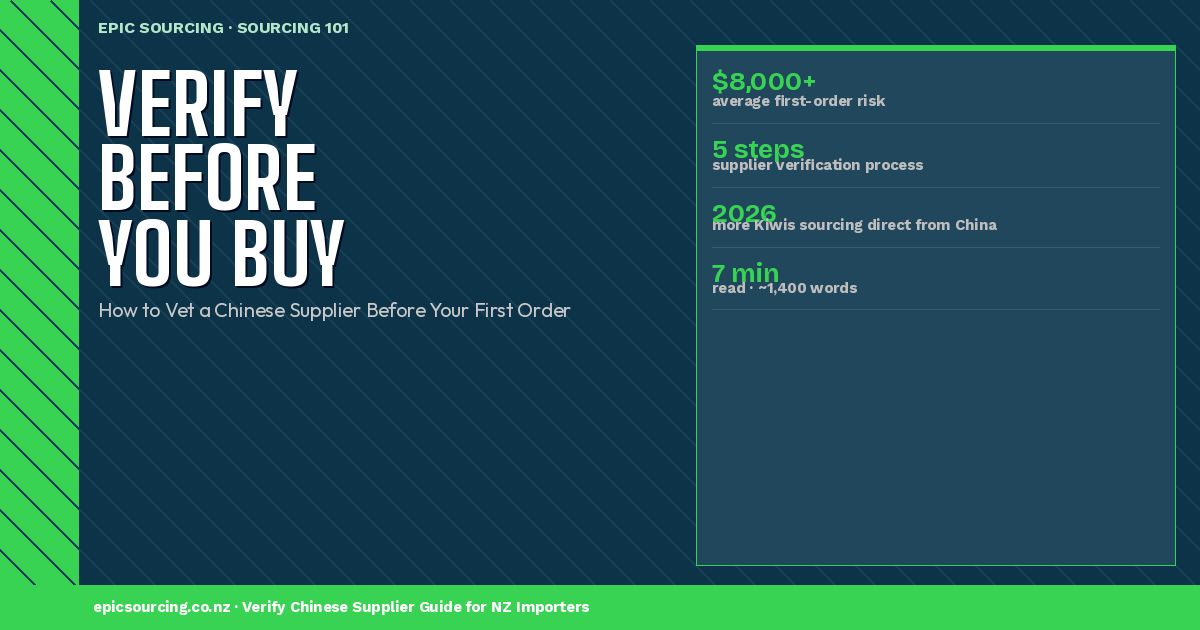
How to Verify a Chinese Supplier Before You Place Your First Order

.svg)
Here's a scenario we hear about too often at Epic Sourcing: a Kiwi business owner finds what looks like the perfect supplier on Alibaba. Great photos. Low prices. Fast responses. They place an order for $8,000 worth of goods, wire the money across, and then… either the goods never arrive, arrive completely wrong, or arrive so far below the promised spec that they're unsellable.
It's painful, it's avoidable, and it happens because supplier verification got skipped. The good news is that vetting a Chinese supplier properly isn't complicated — it just takes a bit of time and knowing what to look for.
Why Supplier Verification Matters More Than Ever in 2026
We're seeing more Kiwi businesses arrive with an existing Chinese supplier relationship they've found themselves — usually through Alibaba, a trade show, or a referral — and want us to verify before they commit significant spend. This is smart thinking. The volume of China sourcing globally surged 25% during "Amazing April" 2026 events, and with that surge comes more noise: more trading companies posing as factories, more listings with borrowed photos, and more opportunistic players who know that eager importers tend to move fast.
A proper verification process typically takes 5–10 business days and costs a fraction of what you stand to lose on a bad order.
Step 1: Verify the Company's Legal Registration
Every legitimate Chinese manufacturer or trading company should be registered with China's State Administration for Market Regulation (SAMR). Ask the supplier directly for their 营业执照 (business licence). A legitimate business will send it without hesitation. Cross-check the company name and registration number on the National Enterprise Credit Information Publicity System (gsxt.gov.cn) — it's publicly searchable and free.
Key things to check: registration date, registered capital, business scope (does it include manufacturing in your product category?), and legal representative name.
Sourcing Hack #1: Cross-Check the Bank Account Name — When a supplier sends you payment details, verify that the bank account name matches the company name on their business licence exactly. A mismatch could mean you're sending money to a different entity entirely. This is one of the most common fraud vectors in China trade.
Step 2: Check Their Export History and Trade Data
China's customs data is commercially available and gives you a powerful window into a supplier's actual export activity. Tools like ImportYeti, Panjiva, Volza, and Flexport's shipment data let you search by company name and see which countries they've shipped to, the types of products actually shipped, and which importers have bought from them previously.
A factory claiming to export to the USA, Australia, and Europe but showing zero shipment records anywhere is a serious red flag. You can also ask the supplier directly for at least 3 customer references from English-speaking markets and follow up to ask about their experience.
Step 3: Assess Their Online Presence and Platform History
- Alibaba Gold Supplier status — how many years have they held it? New Gold Suppliers carry more risk than those with 5+ years.
- Response rate and response time on Alibaba — consistently high responsiveness suggests an active, professionally-run business.
- Google the company name — look for fraud complaints, negative reviews on sourcing forums, or scam reports.
- Reverse image search their product photos — some fraudulent listings use photos stolen from other manufacturers.
Step 4: Request a Video Factory Tour
Ask your supplier to do a live video call and walk you through their factory floor. A legitimate factory won't hesitate. Watch for: is the factory clearly operational? Are they manufacturing the product you're buying, or is it just stored product? How many workers are on site? A "factory" with just 2–3 people is almost certainly a trading company, not a manufacturer.
If a supplier is "too busy" or their camera is "broken", treat that as a significant red flag and move on.
Sourcing Hack #2: Book a Factory Visit if the Order is Big Enough — If your first order is NZD 15,000 or more, it's often worth commissioning a third-party inspection service to do a factory visit on your behalf (typically $250–$450 USD for a factory audit). The peace of mind is worth every dollar, and it usually leads to better pricing and a stronger relationship too.
Step 5: Order Samples and Inspect Them Critically
- Always pay for samples — free samples often means the supplier will cut corners or charge artificially high production prices to recoup it.
- Request samples of their standard production stock first (not a special "showcase" sample) — this gives you a more realistic view of what you'll receive at scale.
- If something's wrong, note it in writing and send photos — how they respond tells you a lot about how they'll handle future QC issues.
Step 6: Consider a Third-Party Verification Service
For higher-stakes orders or industries with significant QC risk (electronics, personal care products, children's goods), a third-party factory audit is money well spent. Recognised audit providers operating in China include SGS, Bureau Veritas (BV), Intertek, QIMA, and AsiaInspection. A standard factory audit costs $250–$450 USD and typically covers legal registration, factory capacity, worker headcount, quality management systems, and social compliance.
What to Do If You're Already Working with a Supplier and Have Concerns
This is more common than you might think. Businesses come to us regularly having worked with a Chinese supplier for 1–2 years and noticing creeping quality issues, missed delivery windows, or unexplained price increases. It's not too late to run a proper verification and re-qualification process. We'll often recommend asking for new samples to the original spec, commissioning a surprise pre-shipment inspection on the next order, and doing a parallel supplier search to ensure you have a backup option.
Ready to verify your Chinese supplier or find a new one? Book a free 30-minute consultation with the Epic Sourcing team at epicsourcing.co.nz — we've been vetting Chinese factories for NZ businesses since 2016.
Related Articles

Let’s Make It Epic
We're here to make sourcing simple – and a whole lot less stressful.
We are experiencing a higher volume of enquiries than usual. Our standard reply time for form submissions and emails is within 72 hours.
If your matter is urgent, please schedule a video call using the link below.
