

The Complete Guide to Importing from China to New Zealand (2026)


China remains the world's factory floor — producing around 29% of global manufacturing output and offering an unmatched range of products, price points, and manufacturing capabilities. For Kiwi businesses, importing from China has never been more accessible — but it does require knowing what you're doing to avoid costly mistakes.
This guide covers everything you need to get started: finding suppliers, understanding freight and customs, leveraging the NZ-China Free Trade Agreement, and making sure your first (or next) China import goes smoothly.
Step 1: Know What You Want to Import (and Whether It's a Good Fit)
Before you open Alibaba or contact a single supplier, get clear on your product. That means:
- Product specification: What exactly are you importing? Materials, dimensions, colours, packaging, certifications required. The more specific you are, the better quotes you'll get and the fewer surprises.
- Volume: How many units? MOQs from Chinese factories typically start at 100-500 units for standard products, higher for custom items.
- Budget: What's your target landed cost (product + freight + duty + compliance)? Work backwards from your retail price to make sure the maths stack up before you commit.
- Regulations: Some products require specific certifications or compliance testing before they can be sold in New Zealand. Safety standards, electrical compliance, and labelling requirements are the most common hurdles.
Sourcing Hack #1: Do the Landed Cost Maths Before You Order — Don't just look at the unit price from the factory. Add: freight cost (sea or air), port charges, NZ Customs duty (usually 0% for China under the NZ-China FTA), GST (15% of value + freight), and any compliance/testing costs. Your landed cost will typically be 20-40% higher than the ex-factory price.
Step 2: Find and Vet Suppliers
There are several ways to find Chinese suppliers, each with pros and cons:
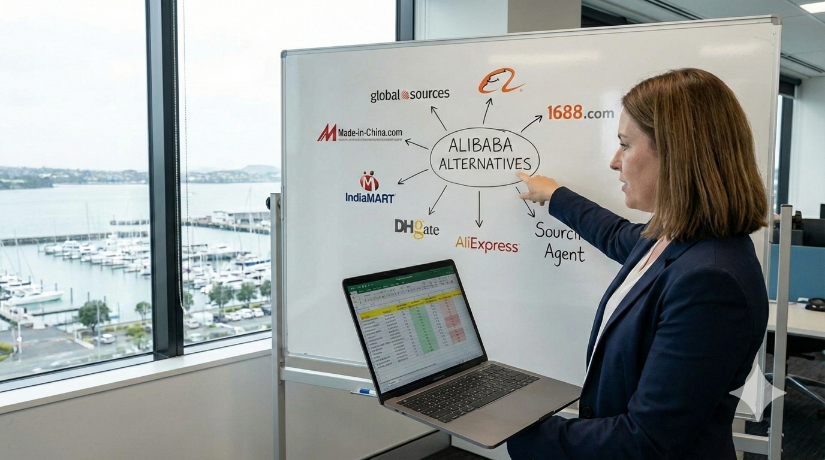
- Alibaba: The most widely used platform for NZ importers. Good selection, Trade Assurance provides some payment protection, but quality varies enormously. Always verify suppliers independently before ordering.
- Made-in-China.com and Global Sources: Good alternatives, often with more manufacturing-focused suppliers rather than traders.
- 1688.com: China's domestic B2B platform — cheaper prices but requires a Chinese intermediary or agent to communicate and transact.
- Trade shows: The Canton Fair (held in Guangzhou twice yearly) is the world's largest trade show. Epic Sourcing runs NZ client groups to the Canton Fair.
- Sourcing agents: A reputable NZ-based sourcing agent can find, vet, and manage suppliers on your behalf — a major time-saver and risk reducer.
Regardless of how you find suppliers, always verify them before placing a significant order. Check their business licence, request a factory video or audit, order samples, and check references from other buyers if possible.
Step 3: Understand the NZ-China Free Trade Agreement (FTA)
New Zealand has a comprehensive Free Trade Agreement with China — one of the first developed countries to secure such an agreement. For importers, the key benefit is that most manufactured goods from China can be imported into New Zealand at 0% duty.
This is a significant advantage. To claim FTA rates, your goods need to meet the Rules of Origin requirements (essentially, they need to be manufactured in China, not just assembled or re-exported from there). Your supplier should be able to provide a Certificate of Origin (Form E) if your goods qualify.
Sourcing Hack #2: Always Request a Certificate of Origin — Even if your product has 0% duty under the NZ-China FTA, your NZ Customs broker will need documentation to apply the preferential rate. Ask your Chinese supplier for a Form E (Certificate of Origin for China FTA) before shipment — getting it afterwards is much harder.
Step 4: Get Your Freight Right
Freight is often the biggest variable cost in an import equation. In August 2026, sea freight rates from China to Auckland are running $2,250-$2,750 for a 20GP container and $4,455-$5,445 for a 40GP — up 36-38% from June due to peak-season capacity crunches.
Your freight options from China to NZ:
- FCL (Full Container Load): You fill an entire container. Most cost-effective per unit if you have the volume. Transit time: 20-23 days from major Chinese ports.
- LCL (Less-than-Container Load): Your goods share a container with other importers' freight. Works for smaller volumes. Transit: 21-27 days, plus consolidation time.
- Air freight: Fast (3-5 days) but expensive (~$4.50-6/kg). Best for high-value, low-weight goods, or urgent restocks.
Work with an experienced NZ freight forwarder who handles China-NZ shipments regularly — they'll know the carriers, rates, and local customs process.
Step 5: Clear NZ Customs
When your goods arrive in New Zealand, they need to clear NZ Customs before you can take possession. Here's what to expect:
- Customs Entry: Your freight forwarder or customs broker will lodge an import entry with NZ Customs. You'll need to provide the commercial invoice, packing list, Bill of Lading, and Certificate of Origin.
- Duties and Tariffs: Most Chinese manufactured goods enter at 0% under the FTA. Some categories may still attract tariffs — check the NZ Tariff Finder before you order.
- GST: 15% GST applies to all imports over NZ$1,000 (calculated on the CIF value — cost + insurance + freight).
- MPI Biosecurity: Some product categories trigger Ministry for Primary Industries biosecurity checks. Wooden goods, outdoor products, and items with natural materials are most commonly affected.
Common Mistakes NZ Importers Make (and How to Avoid Them)
- Skipping samples: Never place a full production order without approving samples first. Ever.
- Paying 100% upfront: Standard payment terms are 30% deposit, 70% before shipment. Paying in full upfront removes your leverage if something goes wrong.
- Ignoring lead times: Chinese factories typically need 30-60 days for production, plus shipping time. Plan around Chinese New Year (January-February) when factories close for 2-4 weeks.
- Not building in QC: Quality Control inspection during or after production is strongly recommended, especially for first orders with a new supplier.
- Underestimating compliance: Products sold in NZ must meet NZ standards. The Consumer Guarantees Act and Fair Trading Act have real teeth.
Want help navigating this for your business? Epic Sourcing offers a free 30-minute consultation for Kiwi importers — no obligation, just practical advice from people who do this every day. Book your free chat at epicsourcing.co.nz.
Related Articles

Let’s Make It Epic
We're here to make sourcing simple – and a whole lot less stressful.
We are experiencing a higher volume of enquiries than usual. Our standard reply time for form submissions and emails is within 72 hours.
If your matter is urgent, please schedule a video call using the link below.
