.svg)
Tech Packs Explained: How to Prepare Specs for Clothing Manufacturers
.jpg)
.svg)
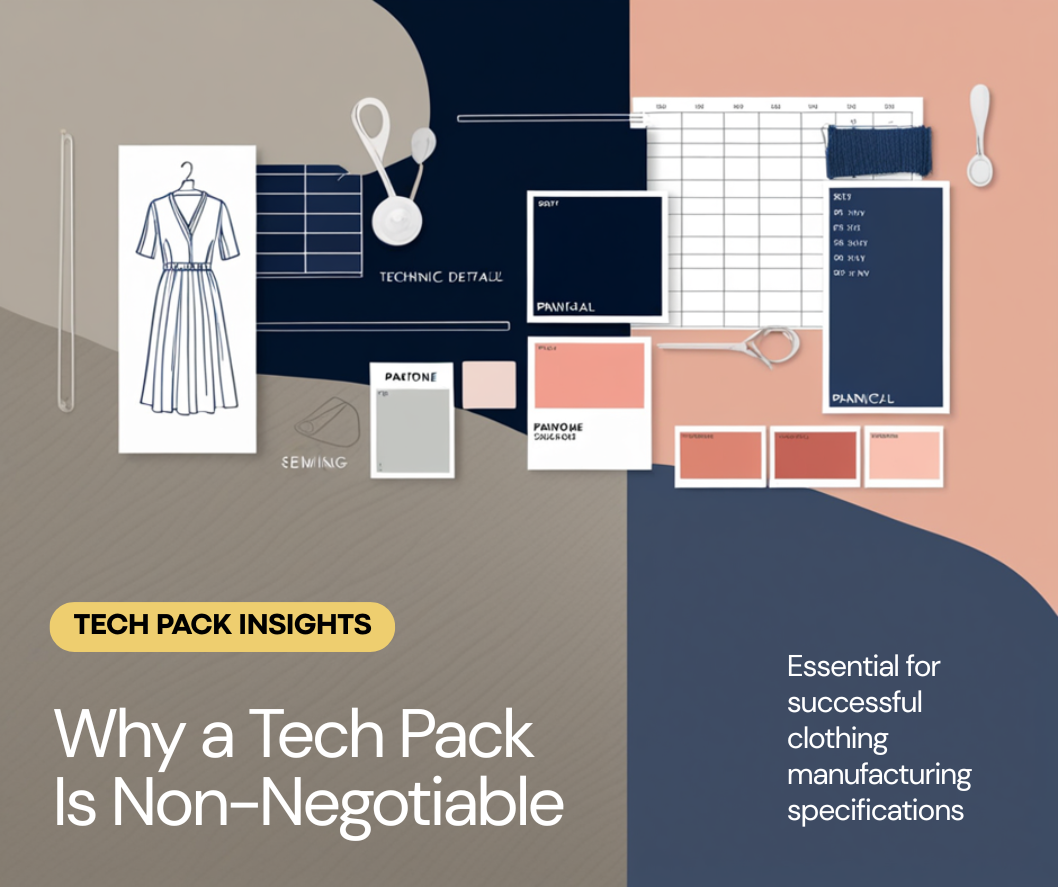
Why a Tech Pack Is Non-Negotiable
If you are developing a clothing range and planning to have it manufactured in China, a tech pack is not optional. It is the document that tells the factory exactly what to make. Without it, you are relying on verbal descriptions, email exchanges, and the factory's own interpretation of what you want. That approach produces inconsistent samples, expensive revision rounds, and production runs that arrive looking nothing like what you approved.
A tech pack, short for technical package, is a comprehensive specification document that contains every piece of information a manufacturer needs to produce your garment accurately and consistently. It is the bridge between your design intent and the physical product that comes off the production line. The better your tech pack, the fewer rounds of sampling you need, the lower your risk of production errors, and the stronger your position when holding a factory accountable to a quality standard.
This guide explains every section of a garment tech pack, what information goes in each section, and how to prepare specs that work effectively with Chinese manufacturers. Whether you are launching your first clothing brand or preparing to move production to a new factory, getting your tech pack right is the most important single step you can take before approaching any manufacturer.
What a Tech Pack Contains
A complete tech pack for a garment typically runs from 8 to 20 pages depending on the complexity of the style. Each page covers a distinct category of information. Taken together, they give the factory a complete and unambiguous picture of what they are being asked to produce.
1. Cover Page and Style Summary
The cover page identifies the document and the style it relates to. It should include your brand name, the style name and number, the season or collection it belongs to, the date the tech pack was issued, and the version number. Version control matters because tech packs are typically revised through the sampling process. Keeping track of which version of the spec the factory is working from prevents costly errors where a factory produces to an earlier version after changes have been agreed.
The style summary provides a brief written description of the garment, its intended use, and any key design features or construction details the factory should be aware of before reading the full document.
2. Technical Flat Sketches
Technical flat sketches, also called CADs or flat drawings, are the visual centrepiece of the tech pack. Unlike fashion illustrations, which show garments on a figure, technical flats are drawn as if the garment is laid out on a flat surface. They show the garment from the front, back, and where relevant the inside or detail views.
Good technical flats are accurate in proportion, clearly show every seam, topstitch line, pocket placement, zip or button position, and any other construction detail. They are annotated with callouts pointing to specific features that require further explanation in other sections of the tech pack.
You do not need to produce technical flats by hand. Adobe Illustrator is the industry standard tool for creating professional flat sketches. There are also purpose-built fashion design software options. If you are not proficient in these tools, a freelance technical designer can convert your hand sketches or concept images into production-ready technical flats at relatively low cost. This is worth doing properly, as unclear or inaccurate flats are a leading cause of sampling errors.
3. Bill of Materials
The bill of materials, often abbreviated to BOM, lists every component that goes into the garment. This includes the shell fabric, any lining or interlining, all trims and hardware, and all labelling components. For each item in the BOM, the tech pack should specify the material name and composition, the colour with a Pantone or physical colour reference, the supplier or sourcing instruction, the placement in the garment, and the quantity required per garment.
The fabric specification is the most critical section of the BOM. It should include the fabric name, fibre content and percentages, fabric construction type (woven, knit, jersey, fleece, etc.), weight in grams per square metre (GSM), and finish or treatment if applicable. For technical fabrics making performance claims such as water resistance, UV protection, or moisture management, the specification should reference the relevant performance standard and minimum test result required.
Trims and hardware should be specified with equal precision. A zip should be specified by brand (YKK is the industry benchmark), type (coil, metal, invisible), length, colour, and pull style. Buttons should be specified by material, diameter, thickness, and number of holes. Elastic should be specified by width, stretch percentage, and recovery. Ambiguous trim specs are a frequent source of factories substituting cheaper alternatives without disclosure.
4. Construction Details and Stitching Specifications
This section documents how the garment is assembled. It specifies the seam type for each seam in the garment, the stitch type using standardised ISO 4915 stitch class codes, the stitch density in stitches per centimetre, and any topstitching requirements including thread type, colour, and distance from seam.
For each key construction detail, a callout from the flat sketch should reference this section. For example, a callout on the side seam might specify: 5 thread safety stitch, ISO 504, 5 SPC, seam allowance 1cm, pressed open. This level of specificity leaves no room for the factory to make their own interpretation of how the garment should be sewn.
Special construction techniques should be documented in this section, including any bonding, taping, welding, or waterproof seam treatments for technical outerwear, and any special hemming techniques for stretch fabrics.
5. Size Specifications and Measurement Chart
The measurement chart, sometimes called a graded spec sheet, documents the finished garment measurements for every size in the range. Measurements are taken at specific points on the garment defined by industry convention, and the chart lists the measurement at each point for every size.
For the NZ market, your size range typically runs XS through XXL or equivalent numeric sizes depending on the garment category. The measurement chart should be provided in centimetres. If you are also supplying to export markets with different sizing conventions, a separate chart or conversion reference may be needed.
Grading rules document how measurements change between sizes. Rather than specifying every measurement for every size, grading rules define the increment by which each measurement increases or decreases across the size run. A factory's grading technician uses these rules to produce the full measurement set for each size from the base size specification.
Critical measurements, those that have the most impact on fit and which the factory's QC team should check against in every sample and production AQL inspection, should be clearly identified in the spec. These typically include chest, waist, hip, body length, sleeve length, and any other measurement specific to the garment's fit.
6. Label and Packaging Specifications
This section covers all labelling requirements including the main brand label, size label, care label, and any country of origin label. For each label, specify the content, placement in the garment, dimensions, font, and attachment method.
Care label content must be accurate for the actual fabric composition and construction of the garment. Under New Zealand's Fair Trading Act, care instructions must be correct and must use a format that is understandable to NZ consumers. The internationally recognised GINETEX care symbol system is the appropriate standard for NZ garments. Your care label should include washing instructions, bleaching instructions, drying instructions, ironing temperature, and professional cleaning instructions if applicable.
Country of origin labelling is mandatory for clothing sold in New Zealand. The label must state the country where the garment was manufactured, not the country of design or brand origin. For garments produced in China, the label must say Made in China.
Packaging specifications should cover how each garment is folded, whether it is bagged individually, what size and type of polybag is used, hangtag specifications if applicable, and carton pack quantities and dimensions.
7. Quality Requirements and AQL Standards
This section documents the quality standards the factory is expected to meet, and forms the basis for sample approval and production AQL inspections. It should specify the acceptable quality level for the production run, the defect classification criteria (which defects are critical, major, or minor), and any specific quality checkpoints that must be verified during production.
For clothing, common defect classifications include measurement deviations from spec, fabric defects such as holes, pulls, or inconsistent colour, construction defects such as skipped stitches, uneven seams, or misaligned components, trim defects such as incorrect placement or poor attachment, and label defects such as incorrect content or misaligned placement.
Specifying your quality requirements in the tech pack rather than communicating them verbally means the factory cannot later claim they were unaware of your standards. It also gives your pre-shipment inspector a clear reference document to work from.
Common Tech Pack Mistakes That Cause Production Problems
The most common mistake NZ clothing brand founders make with tech packs is treating them as a design document rather than a manufacturing document. A tech pack is not for showing to investors or posting on Instagram. It is a working document for a factory floor. Clarity and precision matter more than visual polish.
Leaving measurements to the factory is a frequent error. Some brands provide beautiful sketches but no measurement chart, assuming the factory will figure out the sizing. Factories will produce something to a size, but it will reflect their interpretation, not yours. Measurement charts are non-negotiable.
Using verbal colour references instead of Pantone codes is another common problem. Telling a factory you want a garment in dusty rose or forest green is an invitation for the factory to produce whatever they interpret those descriptions to mean. Pantone codes are the universal reference language for colour specification. If you do not have access to Pantone guides, a physical colour swatch sent with your tech pack is the next best option.
Not updating the tech pack version after changes is a frequent source of production errors. Every change agreed through the sampling process should be reflected in an updated, version-controlled tech pack before production is authorised. Factories working from an earlier version of the spec are not making a mistake. They are following the document they have.
Getting Help With Tech Pack Preparation
For NZ clothing brands without an in-house technical designer, preparing a professional tech pack can feel like a significant barrier. The good news is that experienced freelance technical designers are accessible globally, and the cost of good tech pack preparation is modest relative to the cost of a poorly specified production run.
Epic Sourcing can review your existing tech pack materials, identify gaps that are likely to cause production problems, and connect you with technical design resources appropriate for your product category and budget. We also communicate directly with factories in Mandarin, which means specification questions get resolved quickly and accurately rather than getting lost in translation.
If you are preparing to approach manufacturers for the first time and want to make sure your specs are production-ready before you do, get in touch with our team. Getting the tech pack right before sampling begins is the highest-return investment you can make in your clothing brand's production journey.
Related Articles



Let’s Make It Epic
We're here to make sourcing simple – and a whole lot less stressful.
We are experiencing a higher volume of enquiries than usual. Our standard reply time for form submissions and emails is within 72 hours.
If your matter is urgent, please schedule a video call using the link below.
