.svg)
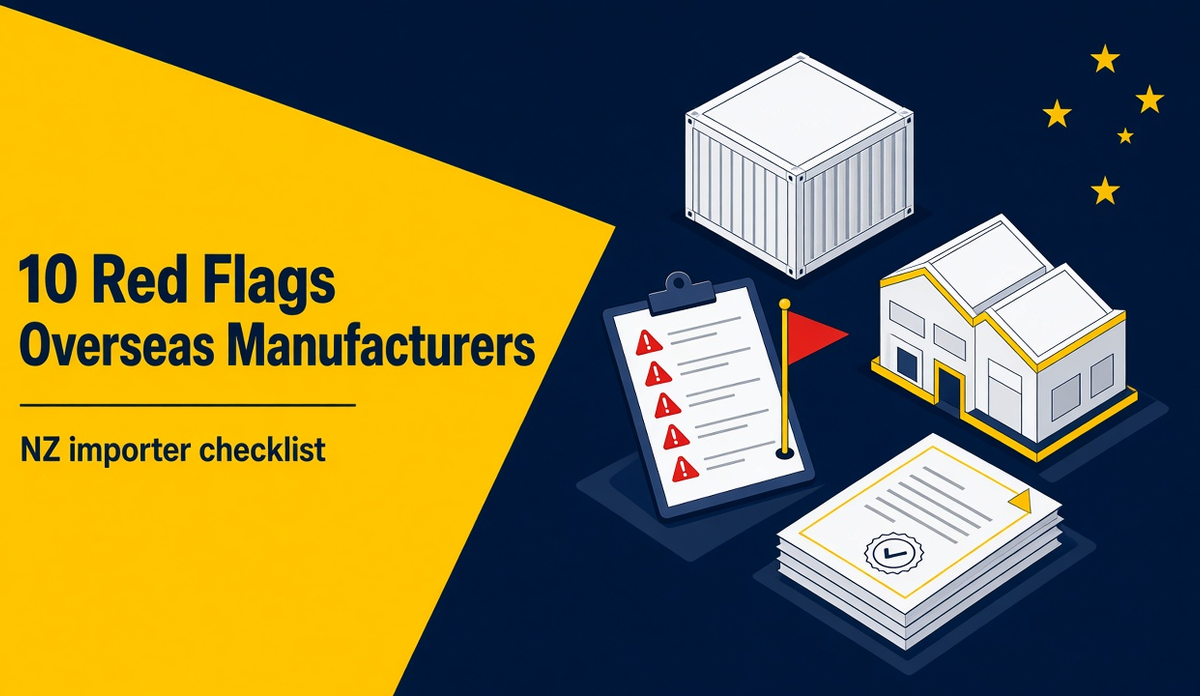
10 Red Flags to Look for in an Overseas Manufacturer
.jpg)
.svg)
Last updated: October 2026
The clearest warning signs in an overseas manufacturer are a refusal to show the factory on a video call, no business licence when you ask, a price far under every other quote, and pressure to pay the full amount before production starts. If you see two or more of these, pause before you send a deposit. These are the ten signs to check when you screen a factory in China or Vietnam for a New Zealand order.
Why should you check for red flags before you pay a deposit?
A bad supplier can cost you months, and a deposit you will not get back. Many Kiwi importers only learn what a proper factory looks like after the first order goes wrong. Work through this list before you commit.
Free Download: Manufacturer Red Flags Checklist
15-page checklist of warning signs to check before you wire a deposit to a new overseas manufacturer.
Download the Free ChecklistWhat are the 10 red flags to look for in an overseas manufacturer?
One flag is a reason to ask more questions. Two or more should stop you, especially if the factory will not show itself, will not share paperwork, and wants all the money up front.
1. They will not let you see the factory
A working factory has nothing to hide. If a supplier keeps delaying a visit or a live video walk-through, treat that as the strongest warning on this list. Plenty of "manufacturers" on sourcing sites are trading firms that have never stood on the floor they claim to run.
Next step: Ask for a live video walk-through of the production floor before you send a deposit.
2. No business licence or export paperwork when you ask
A factory in China has a registered business licence, and that licence carries a Unified Social Credit Code (USCC) you can look up. Most exporters also hold a customs registration. Ask for a copy early. A supplier who stalls, or who sends a scan you cannot read, is telling you to slow down.
Next step: Get the licence copy and check that the name and registration number match the company you are dealing with.
3. The quote sits far under every other quote
If one quote is well under the others for the same product and the same spec, ask why before you get excited. A gap that large often means thinner materials, skipped checks, or a plan to swap parts after your deposit clears. Do not treat a single percentage gap as a rule. Compare the spec, not just the number.
Next step: Line up the quotes against the same materials, finishes, and tolerances before you pick a winner.
4. They want the full amount before production starts
Full payment up front leaves you with no way to push back if the goods are wrong. There is no single standard deposit split for every China or Vietnam order. A common starting point for a new factory is a deposit to start production, then the balance only after agreed evidence such as a passed independent pre-shipment inspection and the shipping documents you named in the purchase order. A bill of lading proves goods were shipped for sea freight; it does not prove they match your sample. Incoterms cover delivery and risk, not when you pay. Pay only the contracted legal entity, not a personal account or an unrelated company. The name on the invoice must match the bank payee. Put the split, the payee, and the release triggers in writing before you pay.
Next step: Confirm the legal entity, bank beneficiary, and invoice name match, and write down what evidence releases the balance.
5. The photos do not match the sample
Stock photos, pictures copied from another catalogue, and renders dressed up as product shots are common on sourcing sites. Ask for photos and video of your product, not a catalogue shot, and compare them with the sample that arrives.
Sourcing Hack: Run a reverse-image search on the product photos before you reply. If the same picture sits on other suppliers' pages, or on a brand you do not work with, you are not looking at their own shot.
Not sure this factory checks out?
Epic's Manufacturer Prospecting service finds and shortlists factories in China and Vietnam, with checks before you send a deposit.
See Manufacturer Prospecting6. Answers stay vague, slow, or dodge the question
A factory that runs its own line can answer plain questions: capacity, lead time, materials, and how they check goods. Long delays, fuzzy answers, or a change of subject when you ask about quality checks often mean you are talking to a middleman.
Next step: Ask for capacity, lead time, materials, and their quality check process in writing.
7. No quality check, or they block an outside inspection
Ask how they check goods before they ship. A supplier with a process can describe it in a sentence or two. One who refuses an independent inspection before you pay the balance expects problems. Order a sample first, then write a pre-shipment inspection into the purchase order before the balance is due.
Next step: Write the right to an independent pre-shipment inspection into the order before you pay the balance.
8. The company details do not match
Check the company name, registration number, bank beneficiary, and invoice payee against each other. The website, sourcing profile, and invoice should all point to the same legal entity. A mismatch, a home address for a large factory, a name that changes between documents, a personal bank account, or a sudden change of bank details after you agree terms is worth chasing before you pay.
Next step: Match company name, registration, bank beneficiary, and invoice payee before you wire anything.
9. Reviews and trade history look thin or brand new
A factory that has exported for years should leave a trail: platform reviews, trade history, or past buyers you can call. Be careful with an account that is only a few months old and still claims a long manufacturing history.
Next step: Ask for past buyers you can contact, and check how long the account has been active.
10. They cannot explain the rules for New Zealand
Biosecurity rules for New Zealand imports follow the Import Health Standard (IHS) for that commodity and pathway. Requirements are product-, packaging-, and pathway-specific; not every shipment from China needs an MPI permit. Under the Consumer Guarantees Act and the Fair Trading Act, the New Zealand seller stays responsible for consumer guarantees and for not misleading buyers, even when the factory is overseas. Mandatory product-safety standards are category-based; a CE or FCC mark from another market is not an automatic New Zealand pass. Chemical controls are substance- and use-specific. New Zealand does not ban every PFAS-containing finished good: PFAS firefighting foams are banned from December 2025, and cosmetics with PFAS ingredients are banned from 1 January 2027. Customs clearance is not the same as lawful sale. Ask which standard applies to your product, and ask for product-specific test evidence. A vague "we meet all standards" is not an answer. For official starting points, see MPI Import Health Standards, Commerce Commission product safety standards, and the EPA note on PFAS in cosmetics.
Next step: Ask for the standard that applies to your product and the matching test report before you order.
What should you do if you spot a red flag?
One flag means ask more questions. Two or more, especially a hidden factory, missing paperwork, and full payment up front, is a strong reason to keep looking. Before you send a deposit, ask for a video walk-through, check the paperwork, match the payee details, and write down what evidence releases the balance.
That check is what Epic Sourcing's Manufacturer Prospecting service is for. The team in China and Vietnam handles the factory visit, the paperwork check, and the reference calls before you wire a deposit. If you already have a shortlist, the Manufacturer Verification Reports service checks licence status and trading history before you commit.
Once a supplier clears this list, the guide on 5 ways to find reliable overseas manufacturers safely walks through how to shortlist and check the next one. For quality-specific warning signs after samples start arriving, see the quality control red flags guide.
FAQs
How do I know if a Chinese manufacturer is a scam?
Watch for the signs in this guide: no factory visit or video call, no business licence, a price far under every other quote, and a demand for full payment up front. Two or more together is a strong warning.
How do I verify a Chinese factory exists without visiting China?
Ask for a live video walk-through of the production floor, a clear copy of the business licence with the Unified Social Credit Code, and matching bank and invoice details. A licence check and a remote walk-through reduce risk; they do not replace an on-site audit when the order is large or custom.
Should I pay a 30% deposit to a new Chinese supplier?
Not automatically. There is no universal 30% deposit plus balance against bill of lading rule. Agree the deposit and the balance release triggers in the purchase order, and tie the balance to evidence such as a passed independent inspection and the shipping documents you named. Do not pay a personal account, and re-check any change of bank details before you send money.
Should I pay the full amount to a new overseas supplier before production starts?
No. Pay a deposit to start, and pay the balance only after the finished goods match the sample you approved and the release evidence in your order. Do not treat a bill of lading as proof the goods are right. Pay only the contracted legal entity; the invoice name must match the bank payee, not a personal or unrelated account.
What is a trading company that calls itself a factory?
A trading company buys from factories and resells to overseas buyers. Some list themselves as manufacturers even though they do not run a production line, and they may add a margin without adding a quality check.
Can I check a Chinese factory's business licence myself?
You can ask for the copy, and a China licence includes a Unified Social Credit Code you can look up. The document is usually in Chinese and a fake can look convincing. A sourcing agent can check the registration against government records and see that it matches the address and bank details you were given.
Is an Alibaba Gold Supplier or Trade Assurance badge enough?
No. Platform badges and Trade Assurance limits are not proof the seller runs the factory, holds a clean licence, or will ship goods that match your sample. Treat them as one data point, then still ask for a video walk-through, paperwork, matching payee details, and an independent inspection where the order size warrants it.
What New Zealand import checks should I do before the first order?
Confirm the factory exists and matches the paperwork, agree payment release triggers, and check the product pathway for New Zealand: the relevant MPI Import Health Standard if biosecurity applies, category product-safety and labelling rules under New Zealand consumer law, and any substance-specific chemical controls. Customs clearance is not the same as lawful sale.
How does a sourcing agent help you avoid a bad manufacturer?
An agent with people on the ground can visit the factory, check paperwork against local records, and speak the language in the negotiation. That catches problems an overseas buyer often finds only after the goods ship.
Not sure this factory checks out?
Epic's Manufacturer Prospecting service finds and shortlists factories in China and Vietnam, with checks before you send a deposit.
See Manufacturer ProspectingNever miss an update. Subscribe to the Epic Sourcing blog for practical sourcing guides.
Written by TK Wang, Supply Chain Manager, Epic Sourcing New Zealand.
Related Articles



Let’s Make It Epic
We're here to make sourcing simple – and a whole lot less stressful.
We are experiencing a higher volume of enquiries than usual. Our standard reply time for form submissions and emails is within 72 hours.
If your matter is urgent, please schedule a video call using the link below.
