
.svg)
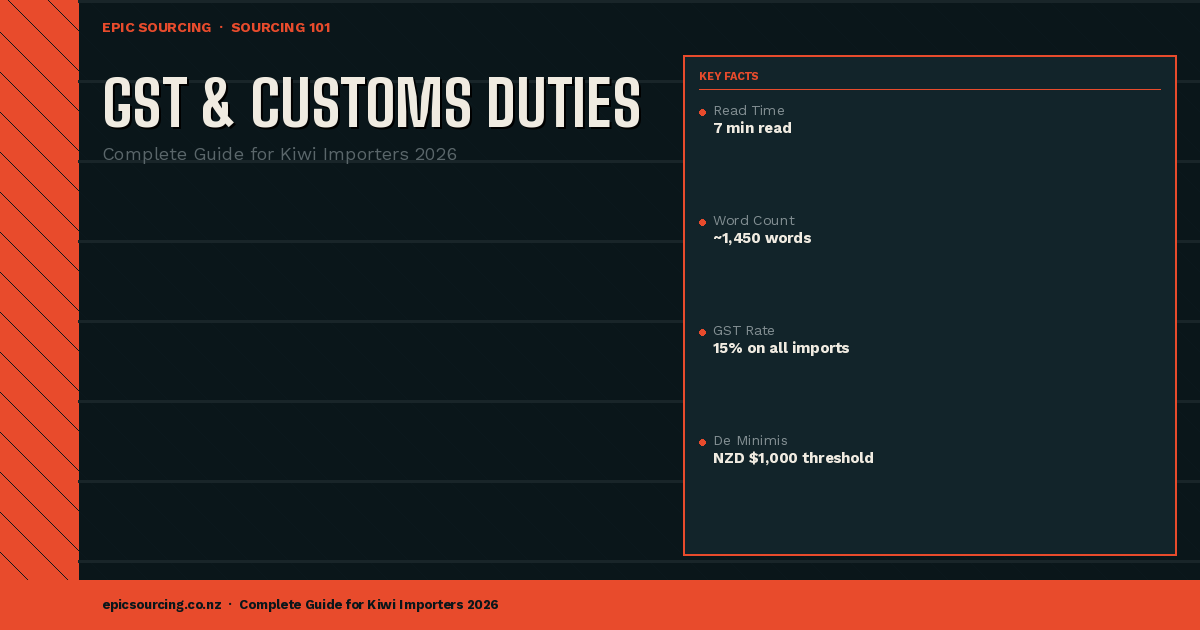
NZ Import GST and Customs Duties Explained: The 2026 Complete Guide for Kiwi Importers

.svg)
If you've ever stared at a customs entry form and felt your eyes glaze over, you're in excellent company. New Zealand's import duties and GST system is actually one of the more straightforward in the world, but when you're just getting started with importing, the terminology can feel like a foreign language.
Understanding your import duties and GST before you place an order is genuinely critical. These costs directly affect your landed cost, your margins, and ultimately whether your importing venture is profitable. Getting it wrong can mean a nasty surprise at the wharf. So let's break it all down in plain English.
What Are NZ Customs Import Duties?
Import duties (also called customs tariffs) are taxes charged by the NZ government on certain goods imported into the country. They're calculated as a percentage of the Customs Value - essentially the FOB price you paid for the goods. Not all goods attract duties - New Zealand has one of the more open tariff schedules in the world.
Common duty rates for popular import categories:
- Apparel and clothing: 10-17.5% (one of the highest rates)
- Footwear: 10-17.5%
- Furniture: 5-10%
- Homewares and ceramics: 0-5%
- Toys and sporting goods: 0-5%
- Electronics: mostly 0% (duty-free)
- Food products: varies (0-10%+)
Sourcing Hack #1: Find your HS code before you order. Every product is classified under a Harmonised System (HS) code - a universal 8-10 digit number used globally to identify goods. Look up your product's HS code using the NZ Customs Tariff Finder tool at customs.govt.nz before you place your first order. It determines your duty rate, any biosecurity requirements, and whether your goods need permits.
GST on Imports - How It Works
GST at 15% applies to virtually all goods imported into New Zealand, including duty-free goods. GST is calculated on the CIF value - the cost of goods plus insurance and freight to the NZ border.
The formula: GST = (Customs Value + Duty + Insurance + Freight to NZ border) x 15%
Example: You import $5,000 NZD worth of kitchenware from China. Freight $800, insurance $50, 5% duty applies. Duty = $250. CIF value for GST = $5,850. GST = $877.50. Total border tax = $1,127.50. That's meaningful - factor it into your landed price calculation.
Important: the $1,000 personal import threshold does NOT apply to commercial importers. If you're importing for resale or business use, GST applies regardless of value.
Sourcing Hack #2: Always request a Certificate of Origin. For goods sourced from China or Vietnam, a valid Certificate of Origin (CO) lets you claim preferential duty rates under NZ's free trade agreements. On a large order, the saving can be hundreds or thousands of dollars. Ask your supplier when you place the order - don't leave it as an afterthought.
Free Trade Agreements - Your Potential Duty Savings
New Zealand has free trade agreements (FTAs) with several major sourcing countries that can reduce or eliminate import duties. This is one of the most underused money-saving tools for Kiwi importers.
- NZ-China FTA (NZCFTA) - NZ was the first developed country to sign an FTA with China. Duty rates on most Chinese-manufactured goods have been progressively reduced to zero.
- ASEAN-Australia-NZ FTA (ASFTA) - covers Vietnam, Thailand, Indonesia, Malaysia, Singapore, Philippines, and more.
- CPTPP - includes Vietnam, Japan, Canada, Mexico, Australia, Singapore, and other Pacific nations.
Understanding Your Landed Cost
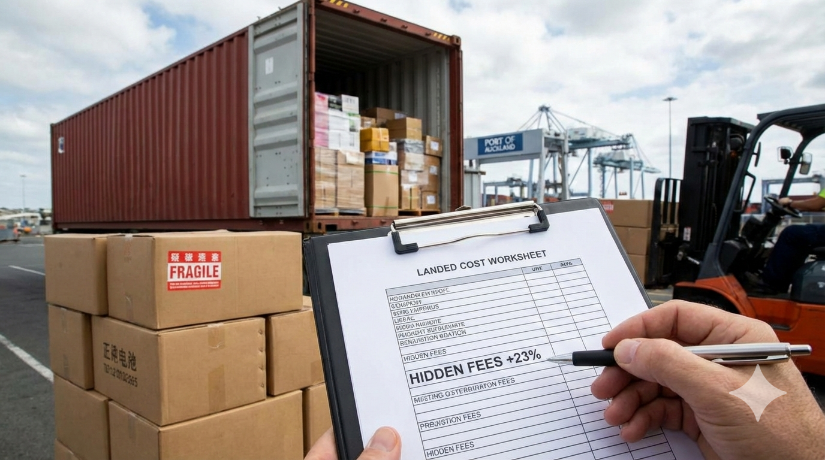
Your landed cost is the total cost of getting a product from the factory floor to your NZ warehouse. A typical breakdown:
- Factory/FOB price - what you pay the supplier
- International freight - sea or air freight to NZ
- Insurance - typically 0.5-1% of cargo value
- NZ Customs duty - if applicable
- GST - 15% on CIF + duties (claimable for GST-registered businesses)
- Customs brokerage fee - typically $100-300 per shipment
- Port fees and terminal handling
- Local cartage to your warehouse
Quick rule of thumb for China-to-NZ sea freight imports: add 30-50% to your ex-factory price to estimate landed cost. For air freight, add 50-80%.
NZ Biosecurity and Product Compliance
MPI Biosecurity: The Ministry for Primary Industries has strict rules about natural materials (wood, rattan, bamboo, leather, feathers) entering NZ - these often require treatment or inspection. Product Safety Standards: Electrical products need AS/NZS standards certification. Children's toys are regulated under the Consumer Guarantees Act. Labelling: Some products require country of origin labelling or composition labels for textiles.
Sourcing Hack #3: Budget a 5-10% customs contingency. Unexpected costs come up: extra MPI inspections, fumigation requirements, destination charges from the shipping line, GST on freight invoices. Experienced importers build this buffer in from the start rather than discovering it at the wharf.
Working with a Customs Broker
For most commercial importers, a licensed customs broker is money well spent. A good broker will classify your goods correctly, lodge your customs entry, claim FTA preferential duty rates, handle biosecurity documentation, and advise on compliance. Fees are typically $100-300 per shipment - a fraction of the savings from correct classification and FTA claims.
GST Returns for Importers
Good news: if your business is GST-registered (turnover over $60,000 per year), you can claim back the GST you pay on imports as an input tax credit on your GST return. So while you pay 15% at the border, you get it back in your next GST filing - effectively making it cost-neutral for registered businesses. Duties, however, are not claimable.
If you're just getting started with importing and want help navigating the numbers, book a free consultation with Epic Sourcing NZ at epicsourcing.co.nz. We can help you calculate a real landed cost estimate and figure out whether direct Asia sourcing makes commercial sense for your business.
Related Articles



Let’s Make It Epic
We're here to make sourcing simple – and a whole lot less stressful.
We are experiencing a higher volume of enquiries than usual. Our standard reply time for form submissions and emails is within 72 hours.
If your matter is urgent, please schedule a video call using the link below.
