
.svg)
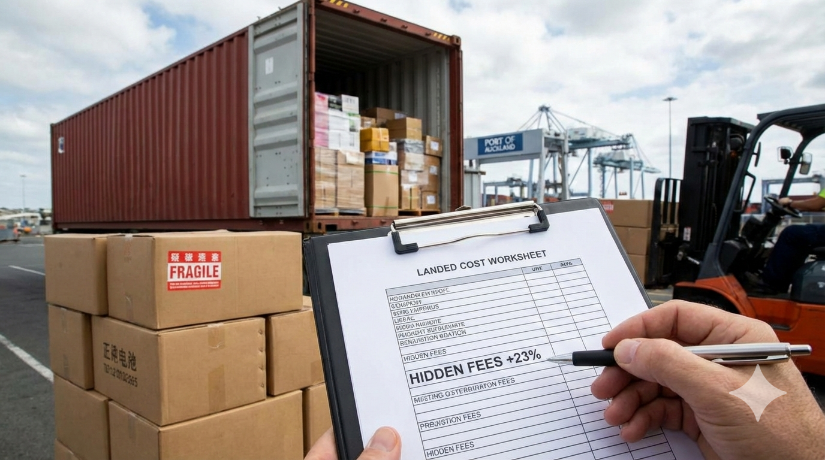
Hidden Costs of Importing from China to NZ: The Complete 2026 Guide
.jpg)
.svg)
The Price on the Invoice Is Just the Beginning
It's one of the most common surprises we see with new importers. They get a factory quote from China, run the numbers, think the margins look great — and then the shipment arrives and the actual landed cost is 30, 40, sometimes 50% higher than they expected.
It's not that they were naive. It's that importing from China involves a stack of costs that don't show up on the supplier's invoice, and if you don't know to look for them, they'll quietly eat your margins before your first order has even cleared customs.
This guide breaks down every cost you need to account for when importing from China to New Zealand — including the ones most people miss until it's too late.
What Is "Landed Cost" and Why Does It Matter?
Your landed cost is the true total cost of getting a product from a Chinese factory to your door in New Zealand — everything included. It's the number you need to know before you can accurately price your product, calculate your margins, or decide whether a supplier quote actually stacks up.
The formula looks like this:
Landed Cost = Factory Price + Export Charges + Freight + Insurance + Import Duties + GST + Customs Clearance + Biosecurity + Local Delivery
Each of those line items has sub-components. Let's go through them one by one.
1. The Factory Price (And What's Hidden Inside It)
The quoted price from your supplier is your starting point, but it's rarely the full story.
FOB vs EXW pricing
Most Chinese suppliers quote FOB (Free on Board), which means the price includes delivery to the port and loading onto the ship. Some quote EXW (Ex Works), which means you're responsible for collecting goods from the factory gate. If you're comparing quotes, make sure you're comparing the same Incoterm — an EXW price that looks cheaper than an FOB price almost never is once you add inland trucking and export handling.
Tooling and sampling costs
For custom or private label products, tooling fees (for moulds, dies, or custom components) and sample costs are often not included in the unit price. These can range from a few hundred dollars to several thousand depending on the product, and they're typically charged upfront.
Packaging costs
Branded packaging, custom boxes, hang tags, and labels are often quoted separately from the product itself. Don't assume your quoted price includes the packaging you want.
2. Export Charges from China
Before your goods even leave China, there are costs at the origin end that many first-time importers don't budget for.
Inland freight (China)
If your supplier quotes EXW, you'll need to pay for trucking from the factory to the port. Even on FOB quotes, if the factory is far from the port (e.g. a furniture factory in Foshan shipping through Guangzhou, or a goods supplier in Yiwu shipping through Shanghai), inland freight can be a meaningful cost.
Origin handling and documentation fees
Freight forwarders at the China end charge for preparing export documentation, container stuffing, and port handling. These fees vary but typically run NZ$150–400 per shipment.
Export customs clearance
China requires export customs declarations, and your freight forwarder or supplier's agent will charge for this. Usually bundled into origin charges but worth confirming.
ISPM 15 treatment for wooden packaging
If your goods are on wooden pallets or in wooden crates, they must be heat-treated to ISPM 15 standard before export to New Zealand. This is usually arranged at the factory, but it's a real cost — typically NZ$50–150 per pallet set — and if it's not done correctly, your goods will be held at the NZ border.
3. International Freight
This is usually the largest single cost after the factory price, and it's also the most variable.
Sea freight (FCL vs LCL)
A Full Container Load (FCL) means you're paying for the whole container — typically a 20-foot (33 cbm) or 40-foot (67 cbm) box. A Less than Container Load (LCL) means you share container space with other importers and pay by cubic metre. LCL is more flexible for smaller shipments but has a higher per-cbm rate and additional consolidation/deconsolidation fees at both ends.
As a rough guide for 2026, sea freight from China to Auckland runs approximately NZ$2,500–4,500 for a 20-foot FCL and NZ$4,000–7,000 for a 40-foot FCL, depending on the origin port and market conditions. LCL rates typically run NZ$80–180 per cbm, plus handling fees.
Fuel surcharges and port congestion surcharges
These come and go depending on global shipping market conditions. Always ask your freight forwarder for a fully itemised quote that includes all surcharges — the base rate is rarely the number you'll actually pay.
Air freight
For time-sensitive shipments, air freight from China to New Zealand runs approximately NZ$8–20 per kilogram depending on volume and carrier. For most physical products, air freight is only viable for small, high-value, or genuinely urgent shipments.
Cargo insurance
Insurance is technically optional but strongly recommended. Standard cargo insurance typically costs 0.3–0.5% of the CIF value (cost + insurance + freight). Skipping it is a false economy — container damage, theft, and transit losses do happen.
4. New Zealand Import Duties
New Zealand's import duty rates are relatively low compared to many countries, but they're not zero for everything, and getting your tariff classification wrong can be an expensive mistake.
The NZ-China Free Trade Agreement
New Zealand and China have had a Free Trade Agreement since 2008, which eliminates or significantly reduces tariffs on most goods. Under the FTA, most manufactured goods imported from China now attract 0% duty. However, some categories — including certain textiles, footwear, and agricultural products — still carry duties. Always check the applicable rate for your specific product using the NZ Customs Tariff or ask your customs broker.
HS Code classification
Your duty rate depends on your product's HS (Harmonised System) Code — the internationally standardised classification system for traded goods. Getting the wrong HS Code assigned to your product can mean paying the wrong duty rate (too much or too little — both cause problems). Your customs broker will classify your goods, but it's worth understanding the code yourself.
Anti-dumping and countervailing duties
For certain product categories where Chinese exports are deemed to have been sold at unfairly low prices, NZ Customs can apply additional anti-dumping duties. Furniture from China, for example, has historically attracted anti-dumping levies in some categories. Check whether your product is subject to any special measures.
5. GST on Imports
New Zealand GST of 15% applies to virtually all imported goods, calculated on the CIF value plus any import duty. This means GST is charged on your total cost to get goods to the NZ border — not just the factory price.
For GST-registered businesses, this is claimable as an input tax credit, so it's essentially a cashflow cost rather than a true cost. But for non-GST-registered importers (typically those below the $60,000 turnover threshold), it's a real cost to budget for.
The GST-free threshold for imports is NZ$1,000 CIF value. Shipments under this value clear customs without GST or duty being charged. This is worth knowing if you're testing products with small initial orders.
6. Customs Clearance Fees
Your customs broker charges for lodging your import entry with NZ Customs and managing the clearance process. Typical costs include:
Customs broker fee: NZ$80–200 per entry depending on complexity.
Import Entry Transaction Fee (IETF): NZ$29.26 (including GST) — a government levy applied to each import entry.
Biosecurity System Entry Levy: NZ$26.45 (including GST) — applied to imports that attract the IETF.
MPI inspection charges: If your goods are selected for biosecurity inspection, MPI charges at an hourly rate of NZ$155.50 (ex-GST). Inspections are not guaranteed, but for higher-risk goods (wood, textiles, natural materials), budget for the possibility.
7. Approved Transitional Facility (ATF) Costs
If your goods are directed to an Approved Transitional Facility for biosecurity inspection or treatment, you're looking at additional costs that can surprise importers who haven't budgeted for them.
ATF service fees: NZ$250–500 per container for standard container examination.
Storage fees: If your goods sit at the ATF beyond the free period (usually 3–5 business days), daily storage charges apply — typically NZ$50–150 per day depending on the facility.
Treatment costs: If fumigation or heat treatment is required at the NZ end, costs can run NZ$500–1,500 per container.
The best way to avoid ATF surprises is to get your biosecurity compliance sorted before goods leave China. Our NZ biosecurity guide covers exactly what you need to do.
8. Local Delivery in New Zealand
Once your goods are cleared, someone needs to get them from the port to your warehouse or premises.
Port to door delivery: Typically NZ$350–700 for a 20-foot container delivered within Auckland. Longer distances cost more — delivery to Wellington or Christchurch from Auckland port adds NZ$800–1,500 depending on the carrier.
Deconsolidation for LCL shipments: LCL cargo needs to be unpacked from the shared container at a deconsolidation depot (CFS). CFS charges typically run NZ$100–250 per shipment, plus delivery.
Cartage surcharges: Tail-lift delivery, after-hours delivery, or difficult access sites can attract additional charges. Worth clarifying with your transport provider upfront.
9. The Costs People Always Forget
Beyond the standard landed cost components, there are a few more costs that regularly catch importers off-guard.
Currency exchange costs
Most Chinese suppliers invoice in USD. The exchange rate between NZD and USD fluctuates, and if you're paying via bank transfer, your bank's exchange rate and wire transfer fees (typically NZ$15–30 per transaction) add up across multiple orders. Some importers use currency exchange services like Wise or OFX to reduce forex costs — worth considering if you're placing regular orders.
Product compliance testing
Depending on your product category, you may need to arrange compliance testing before or after import — particularly for electronics (EMC testing, electrical safety), children's products, or food contact materials. Testing costs vary widely but can run NZ$500–3,000 per product.
Returns and defects
No supplier is perfect. Budget for a defect rate and factor in the cost of dealing with returns, replacements, or product rework. A common rule of thumb is to budget 1–3% of order value for quality-related costs, more if you're working with a new supplier for the first time.
Sourcing agent fees
If you're working with a sourcing agent like Epic Sourcing, factor their fees into your landed cost calculation. The flip side: a good sourcing agent typically negotiates better factory pricing, catches quality issues before shipment, and prevents the costly mistakes that wipe out margins — so the net effect on your landed cost is usually positive.
Putting It All Together: A Worked Example
Let's say you're importing 500 units of a product with a factory price of NZ$50 each, shipping LCL from China to Auckland.
Factory price (500 × $50 FOB): $25,000
Origin handling & documentation: $300
Sea freight (LCL, 5 cbm): $700
Marine insurance (0.4%): $105
Import duty (0% under NZ-China FTA): $0
GST (15% on $26,105): $3,916
Customs broker fee + IETF + levy: $350
CFS deconsolidation + delivery: $400
Total landed cost: $30,771
Landed cost per unit: $61.54
That's 23% above the factory price — and this is a clean example with no biosecurity complications, no ATF costs, and a 0% duty rate. For higher-risk products or less favourable duty rates, the gap between factory price and landed cost can be significantly wider.
How to Build a Landed Cost Calculator for Your Business
The best thing you can do as an importer is build a simple landed cost spreadsheet that you run on every order before you commit. Include every line item above, use conservative estimates where you're uncertain, and update it as you gather real cost data from your freight forwarder and customs broker.
At Epic Sourcing, we help our NZ clients build accurate landed cost models as part of our sourcing process — so you know exactly what your true margins look like before you place an order, not after your shipment arrives.
If you'd like help working through the numbers on a specific product, get in touch with our Auckland team. We're happy to run through a landed cost estimate with you before you commit to an order.
Related Articles


Let’s Make It Epic
We're here to make sourcing simple – and a whole lot less stressful.
We are experiencing a higher volume of enquiries than usual. Our standard reply time for form submissions and emails is within 72 hours.
If your matter is urgent, please schedule a video call using the link below.
