.svg)
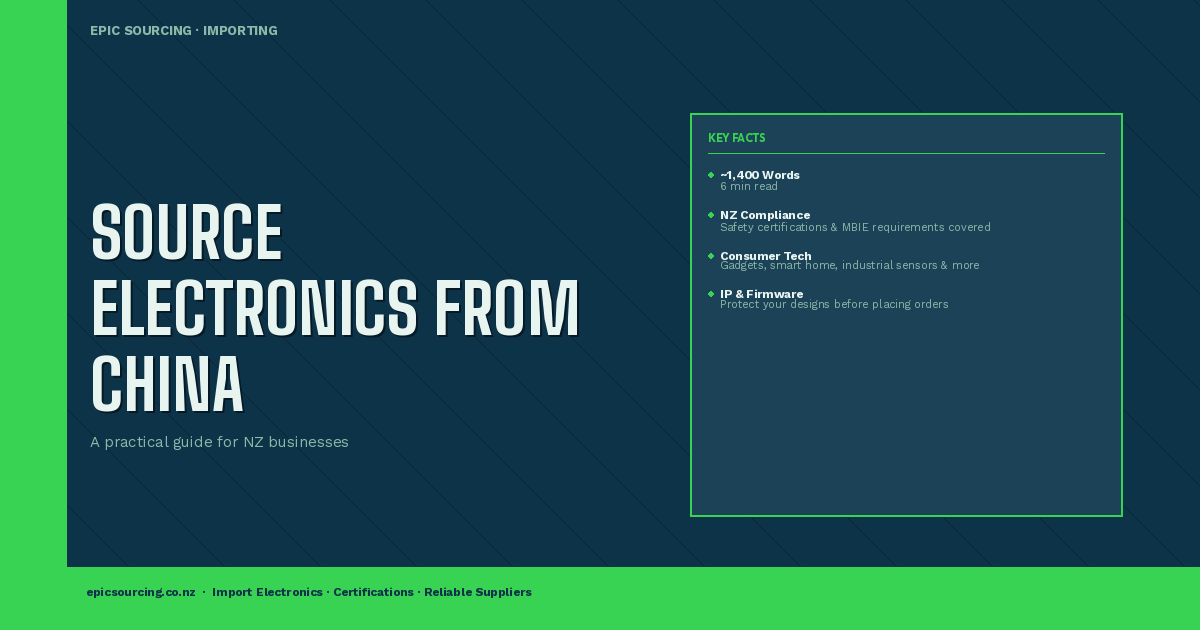
How to Source Electronics and Tech Products from China for Your NZ Business

.svg)
China makes the world's electronics. That's not an oversimplification — it's simply a fact. From consumer gadgets and smart home devices to agricultural sensors and industrial control units, the vast majority of electronic products sold globally are designed and manufactured in China.
For NZ businesses, this creates a genuine opportunity. Whether you're building a consumer product brand, supplying industrial equipment, or creating a private-label tech product, sourcing electronics from China is increasingly accessible — even for small and medium businesses.
But electronics sourcing has unique challenges that don't apply to importing garments or homewares. Compliance certifications, component quality, firmware and IP considerations, and the complexity of technical specifications all raise the stakes. Get it right, and you can build a defensible product business. Get it wrong, and you've got a warehouse full of products you can't legally sell.
What Types of Electronics Can You Source from China?
The range is enormous. NZ businesses are actively sourcing the following categories from China:
- Consumer electronics: Wireless earbuds, smart speakers, portable chargers, LED lighting, smart home devices
- Agricultural technology: Soil moisture sensors, GPS tracking devices, electronic control units for farm equipment, weather monitoring systems
- Industrial and commercial equipment: Control panels, industrial automation components, safety equipment
- Health and wellness tech: Fitness trackers, massage devices, blood pressure monitors, light therapy devices
- Solar and renewable energy products: Solar panels, inverters, battery storage systems, EV charging components
- Educational and toy electronics: STEM kits, programmable devices, electronic learning toys
Shenzhen: The World's Electronics Capital
If you're sourcing electronics, you need to know about Shenzhen. Located in Guangdong Province, Shenzhen is the global epicentre of electronics manufacturing and design. What makes Shenzhen unique is the density of the supply chain. Component suppliers, PCB manufacturers, enclosure moulders, assembly factories, and testing labs are all clustered within a short drive of each other.
- Huaqiangbei Market: The world's largest electronics components market. If a component exists, it's here.
- Longhua / Foxconn district: Large-scale assembly. Where Apple products are made.
- Bao'an: Consumer electronics and smart home device manufacturers.
- Dongguan (nearby): Power electronics, adapters, cables, and related components.
Sourcing Hack #1: Visit (or Have Someone Visit) Shenzhen Before Committing — The difference between a credible electronics manufacturer and a trading company reselling products from multiple factories is almost impossible to spot online — but obvious in person. If you're placing a significant order, arrange a factory audit through a local agent. China's equipment manufacturing exports rose 18.2% YoY in H1 2026 — that's a lot of new capacity chasing orders.
NZ Compliance Requirements for Electronic Products
This is where electronics sourcing gets serious. New Zealand has mandatory compliance requirements for many electronic products, and selling non-compliant products can result in product recalls, fines, and significant brand damage. Key compliance standards for NZ-sold electronics:
- Electrical safety (AS/NZS): Products that connect to the NZ power grid (240V/50Hz) must comply with relevant AS/NZS standards. The mains plug standard is AS/NZS 3112.
- EMC (Electromagnetic Compatibility): Products that can emit or be affected by electromagnetic interference must pass EMC testing.
- RCM mark: The Regulatory Compliance Mark (RCM) is required for electrical products sold in Australia and NZ. It indicates the product meets applicable electrical safety and EMC standards.
- Radio devices: Products with wireless capabilities (WiFi, Bluetooth, Zigbee) are classified as radiocommunications devices in NZ and require compliance with relevant standards.
- Battery safety: Lithium battery products have specific compliance requirements. This affects consumer electronics, e-bikes, and energy storage products.
Work with your Chinese supplier to obtain test reports from accredited testing laboratories. Common labs with NZ-recognised accreditation include SGS, Bureau Veritas (BV), and TÜV Rheinland.
Sourcing Hack #2: Get Compliance Documentation Before Paying Final Balance — Make RCM test reports and relevant compliance certificates a condition of your final payment release. Once your balance is paid and goods are en route, your leverage to get documentation is gone. Build compliance documentation into your payment terms from the start.
Protecting Your Intellectual Property When Sourcing Electronics
Electronics sourcing often involves sharing proprietary information — product specifications, firmware, PCB designs, industrial design drawings. Practical steps to protect your IP:
- NDA first: Always have suppliers sign a Non-Disclosure Agreement before sharing detailed product specifications. A Chinese-law NDA is significantly more enforceable in China than a NZ-law NDA.
- Split your supply chain: Source components from different suppliers and assemble elsewhere. This prevents any single supplier from holding your complete product formula.
- Register your trademark in China: China's trademark system operates on a first-to-file basis. If your brand is growing, register it in China before competitors or factories do it for you.
- Keep firmware in-house: If your product has software or firmware, consider flashing it yourself after import rather than having the Chinese factory load it.
Quality Control for Electronic Products
Electronics QC goes beyond visual inspection — you're checking that the product actually works correctly, safely, and consistently. A solid electronics QC process includes:
- Pre-production sample review: Get a working sample before production begins. Test it thoroughly — especially any wireless or power functions.
- In-line production checks: Have an inspection agent visit during production (not just at the end) to catch issues early.
- Final random inspection: 100% functionality testing on a random sample. Check for cosmetic defects, packaging accuracy, and accessory completeness.
- Burn-in testing: For complex electronics, running devices at full power for an extended period catches early-life failures before they reach customers.
Getting Started: Finding the Right Electronics Supplier
The path to finding a quality electronics supplier typically goes:
- Define your product precisely: The more detailed your specification (dimensions, components, functions, certifications required, target price), the better quality your supplier responses will be.
- Use Alibaba or Global Sources as a starting point: Filter by verified and assessed suppliers, and look for manufacturers (not trading companies) where possible.
- Request OEM capability: If you want your own brand on the product, confirm the factory offers OEM service and can customise packaging.
- Ask about existing certifications: Good electronics manufacturers proactively maintain CE (Europe), FCC (US), and RCM (ANZ) certifications for their product lines.
- Engage a sourcing agent for complex products: For products with significant compliance requirements or custom development needs, an experienced sourcing agent in China can save you from costly mistakes.
Ready to get started? Book a free consultation with the Epic Sourcing team at epicsourcing.co.nz — no obligation, just a straight-talking conversation about your electronics product and the best path to market.
Related Articles

Let’s Make It Epic
We're here to make sourcing simple – and a whole lot less stressful.
We are experiencing a higher volume of enquiries than usual. Our standard reply time for form submissions and emails is within 72 hours.
If your matter is urgent, please schedule a video call using the link below.
