
.svg)
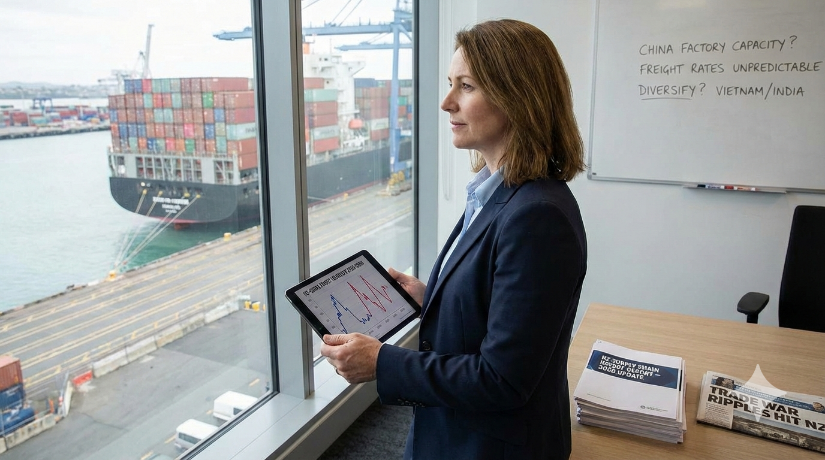
How US-China Tariffs Are Affecting NZ Importers in 2026
.jpg)
.svg)
A Trade War NZ Importers Didn't Start — But Can't Ignore
When the United States and China escalate their trade war, the immediate headlines focus on American consumers and Chinese exporters. But the ripple effects travel much further — including to New Zealand businesses that import products from China for the local market.
2025 was a year of extraordinary tariff volatility. US tariffs on Chinese goods swung from 20% in January to a peak of 145% by April, before a temporary US-China deal brought them back down to 30% by mid-year. In February 2026, the US Supreme Court ruled that the President could not use IEEPA (International Emergency Economic Powers Act) authority to impose tariffs unilaterally — a decision that has introduced fresh uncertainty about the future direction of US trade policy.
None of this directly changes the tariffs NZ importers pay when bringing goods in from China. New Zealand's own import tariff rates haven't changed. But the US-China trade war has created a cascade of indirect effects that are very much a NZ importer's problem — affecting freight costs, supplier pricing, factory capacity, product availability, and the broader competitive landscape.
This guide explains what's actually happened, what it means for your business in 2026, and what the most strategically minded NZ importers are doing in response.
What's Actually Happened: The 2025–2026 Tariff Timeline
To understand the current situation, it helps to know how we got here.
In February 2025, the Trump administration began escalating tariffs on Chinese imports, starting with a 10% levy applied on top of existing duties under IEEPA authority. By April 2025 — following China's retaliatory tariffs on US goods — the rate on Chinese imports had reached a staggering 145%. At that level, direct US-China goods trade was effectively frozen for most product categories.
In May 2025, both sides agreed to a 90-day pause on escalation, reducing US tariffs on Chinese goods to 30% (comprising a 20% "fentanyl" tariff and a 10% "reciprocal" tariff). China's tariffs on US goods fell to 10%. This pause was subsequently extended and has remained broadly in place into 2026.
Then in February 2026, the US Supreme Court ruled that the IEEPA-based tariffs were unlawful — a decision that would, if implemented, reduce the effective US tariff rate on Chinese goods significantly. As of the time of writing, the White House has indicated it will pursue alternative legal authorities to maintain tariffs, meaning the outcome remains uncertain.
For NZ importers, the practical takeaway is this: US tariffs on Chinese goods currently sit at approximately 30%, with meaningful legal and political uncertainty about where they go from here.
How This Affects NZ Importers — Even Though Our Tariffs Haven't Changed
New Zealand's own tariff rates on Chinese goods haven't changed. Under the NZ-China Free Trade Agreement, most manufactured goods from China still enter NZ at 0% duty. So why does the US-China trade war matter to NZ importers? Several reasons.
1. Chinese factories are under pressure — and that affects your pricing
The 145% tariff peak in 2025 effectively shut US buyers out of the Chinese market for several months. Chinese factories that had been heavily dependent on US orders suddenly had spare capacity and were aggressively seeking alternative buyers. For NZ importers, this created short-term pricing opportunities — factories were more willing to negotiate on price, MOQs, and terms.
However, as US tariffs moderated and some US buying resumed, that dynamic has shifted. Chinese factory margins are under structural pressure from the uncertainty, and some factories that over-committed to non-US buyers during the peak tariff period are now managing capacity carefully. The net effect in 2026 is a more complex negotiation environment than existed pre-2025.
2. Freight costs and shipping capacity have been disrupted
The US-China trade war caused significant disruption to transpacific shipping lanes. When US-China trade volumes dropped sharply in mid-2025, shipping lines redeployed container capacity away from transpacific routes. Some of that capacity ended up on Asia-Pacific routes — including China-NZ — creating temporary capacity surges and rate fluctuations.
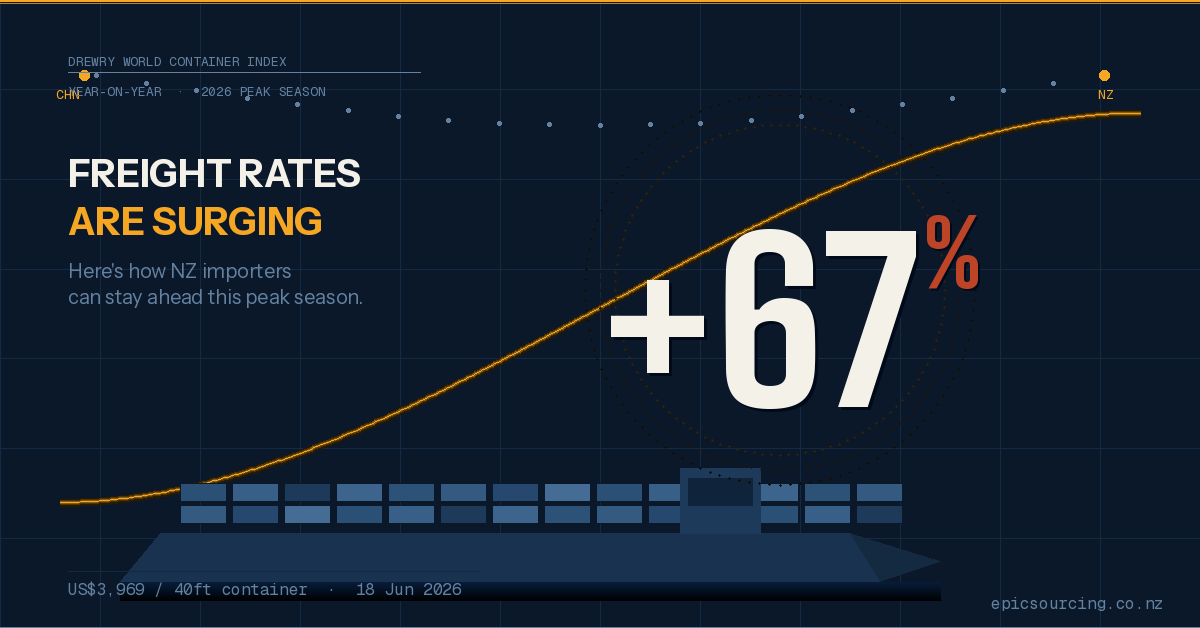
In practical terms, NZ importers experienced unusual freight rate volatility through 2025. Rates that had stabilised after the post-COVID normalisation spiked again briefly, then softened. In 2026, freight rates on the China-NZ corridor remain somewhat unpredictable. The guidance from NZ freight forwarders is consistent: book earlier, secure space, and don't rely on last-minute capacity being available at reasonable rates.
3. Chinese goods are being redirected to markets like NZ
With US buyers largely out of the market at 145% tariffs, Chinese exporters redirected product to alternative markets — including New Zealand, Australia, and Southeast Asia. This has had a visible effect: NZ consumers have seen an increase in low-cost Chinese goods available through platforms like Temu and AliExpress, and some product categories have become more competitively priced.
For NZ importers competing with direct-to-consumer platforms that import at low volumes, this represents a competitive pressure. For importers who are buying B2B from Chinese factories, the surplus factory capacity and redirected inventory created genuine negotiating leverage — at least through 2025.
4. Supply chain diversification has accelerated
The tariff disruption accelerated a trend that was already underway: buyers globally are diversifying their supply chains away from sole dependence on China. Vietnam, India, Thailand, and Bangladesh have all seen increased manufacturing investment and sourcing interest as a result.
For NZ importers, this creates both opportunity and complexity. Opportunity, because there are now more viable alternatives to Chinese manufacturing for many product categories than there were five years ago. Complexity, because evaluating, onboarding, and managing suppliers in new countries requires investment in relationships and expertise. We covered the Vietnam opportunity in depth in our Vietnam vs China manufacturing guide.
5. Currency and pricing uncertainty
The US-China trade war has contributed to NZD/USD exchange rate volatility, as global risk sentiment has shifted with each new tariff announcement. For NZ importers who pay Chinese suppliers in USD, this has added forex unpredictability on top of the pricing uncertainty from factories.
The Chinese yuan (RMB) has also moved in response to tariff escalations, with China allowing some depreciation to partially offset the competitiveness impact of tariffs on its exporters. A weaker yuan relative to the NZD can reduce the NZD cost of Chinese goods — a silver lining, but one that comes with its own unpredictability.
What About NZ Businesses That Sell Into the US Market?
For NZ-based businesses that manufacture or value-add in New Zealand and export to the US, the tariff landscape is actually relatively favourable. New Zealand goods face only the 10% baseline US tariff — far below the 30%+ applied to Chinese goods.
However, it's important to understand the rules of origin requirements. Products assembled or processed in New Zealand from Chinese components are not automatically considered "New Zealand origin" for US tariff purposes. The country of origin is determined by where substantial transformation occurred. Simply relabelling or repackaging Chinese goods in New Zealand does not qualify for NZ tariff treatment in the US.
Genuine value-add in New Zealand — meaningful manufacturing, processing, or transformation — is required. If you're exploring this as a business strategy, consult with a trade lawyer or MFAT before proceeding.
The February 2026 Supreme Court Ruling: What It Means
In February 2026, the US Supreme Court ruled that the IEEPA tariffs — which form the basis of most of the tariffs imposed on Chinese goods since 2025 — were unlawful. This is a significant legal development, but its practical impact is uncertain for several reasons.
First, the White House has indicated it will pursue alternative legal authorities to maintain tariffs, including Section 301 and Section 232 authorities that have different legal bases. Second, even if IEEPA tariffs were to be refunded or reversed, the political direction of US trade policy under the current administration is clearly toward higher tariffs on Chinese goods, not lower. Third, the uncertainty itself is disruptive — businesses on both sides of the Pacific are reluctant to make long-term sourcing commitments while the legal and policy picture remains unclear.
For NZ importers buying Chinese goods for the NZ market, the ruling has limited direct impact. It matters most if you're trying to assess the medium-term direction of Chinese factory pricing and capacity — which depends in part on whether US buyers return to the Chinese market in volume.
Practical Strategies for NZ Importers in 2026
Given all of this uncertainty, what should NZ importers actually do? Here's how the most strategically minded businesses we work with are approaching it.
Don't over-react to short-term tariff movements
The single biggest mistake NZ importers made in 2025 was making major supply chain changes in response to short-term tariff movements that reversed within months. Businesses that abruptly switched suppliers, overstocked inventory, or made expensive supplier transitions based on April 2025 conditions often found themselves worse off when the situation shifted in May and June.
Tariff policy in the current environment is genuinely unpredictable. Make sourcing decisions based on your medium-term business needs, not on reacting to the latest headline.
Build supplier relationships in more than one country
This doesn't mean abandoning Chinese suppliers — for most NZ importers, China remains the best source for the majority of manufactured products in terms of cost, quality, capability, and supply chain depth. But having a qualified backup supplier in Vietnam, Thailand, or India for your most critical product lines gives you options and negotiating leverage.
Even if you never switch, the act of qualifying an alternative supplier changes your relationship with your primary Chinese supplier. It signals that you have options — and that matters in price negotiations.
Improve your landed cost visibility
In a volatile environment, importers who have clear, real-time visibility of their landed costs are much better positioned than those relying on rough estimates. Build or update your landed cost model to include freight rate sensitivities and currency assumptions. Know your margin break-even point at different freight rate scenarios. Our hidden costs of importing guide covers every component of landed cost in detail.
Work with suppliers who understand your biosecurity requirements
One indirect effect of the tariff disruption has been an increase in factory switching by global buyers. New factories, unfamiliar with NZ's specific biosecurity requirements, are more likely to ship goods with non-compliant wooden packaging or materials that trigger MPI holds. Make sure your biosecurity requirements are clearly documented and confirmed with any supplier you're working with — new or existing. Our NZ biosecurity guide has everything you need.
Think about your pricing strategy
If you're competing with direct-to-consumer Chinese platforms that have gained market share in NZ, consider what you offer that they can't: relationship, warranty, local stock, after-sales service, and the ability to provide consistent quality on repeat orders. These are durable competitive advantages that don't depend on being the cheapest landed cost in the market.
The Bigger Picture: What This Means for NZ's Trade Position
New Zealand is in a structurally interesting position relative to the US-China trade war. As a small, open economy with FTAs with both China and the broader CPTPP bloc, NZ is well positioned to trade with both major powers without being caught in the middle of their dispute — at least for now.
NZ's largest trading partner is China, which took roughly NZ$18 billion of NZ exports in 2024. The health of the Chinese economy — and therefore demand for NZ exports — is directly affected by US tariff pressure. A significant Chinese economic slowdown triggered by the trade war would reduce demand for NZ dairy, meat, and other agricultural exports, with flow-on effects for the broader NZ economy and consumer spending.
For NZ importers, the strategic message is clear: build supply chains that are resilient, diversified, and based on genuine supplier relationships — not purely on who is cheapest at any given moment. The businesses that navigated 2025 best were the ones that had invested in those relationships before the disruption hit.
At Epic Sourcing, we've been helping NZ businesses source from China and Vietnam through multiple cycles of trade disruption since 2019. If you'd like to talk through how the current tariff environment affects your specific product categories and supply chain, get in touch with our Auckland team.
Related Articles

Let’s Make It Epic
We're here to make sourcing simple – and a whole lot less stressful.
We are experiencing a higher volume of enquiries than usual. Our standard reply time for form submissions and emails is within 72 hours.
If your matter is urgent, please schedule a video call using the link below.
